The bench press can train the chest, front delts, and triceps effectively, but the way we set up and perform it changes the emphasis. Bench angle, grip width, range of motion, and technique all influence what we get from the exercise.
For muscle growth, the goal is not necessarily to lift the greatest possible weight. It is to use a setup that trains the intended muscles effectively, works comfortably through an appropriate range of motion, and fits into a complete training program.
Key Takeaways
- Flat pressing trains the whole chest, while a low incline slightly emphasizes the upper pec fibers.
- Prioritize a full, comfortable bottom range rather than worrying about small changes to lockout.
- A standard grip suits chest training, while a narrower grip increases the relative triceps emphasis.
- Count supporting muscle work fractionally and supplement bench pressing with direct shoulder and triceps exercises.
Table of Contents
- Bench Press Variations: What Can We Change?
- Joint Movements During the Bench Press
- Which Muscles Does the Bench Press Train?
- Exercise Setup: Bench Angle and Grip Width
- Bench Press Technique for Hypertrophy
- Programming the Bench Press for Muscle Growth
- A Practical Default for Hypertrophy-Focused Bench Pressing
Bench Press Variations: What Can We Change?
At a basic level, a bench press involves lying on a bench and pressing a resistance upward. There are three main variables we can adjust to create different variations:
- Bench angle: Decline, flat, low incline, moderate incline, and the angles between them.
- Resistance type: A barbell, dumbbells, a Smith machine, or potentially cables.
- Grip: Wide, medium, or narrow hand spacing. Some implements, particularly dumbbells, also allow us to rotate into a more neutral grip.
These variables can be combined. A flat barbell bench press and a low incline dumbbell bench press are both pressing exercises, but their setups create somewhat different demands.
Joint Movements During the Bench Press
The bench press primarily involves movement at the shoulder and elbow. Understanding these joint actions helps explain why changes in technique can shift the muscular emphasis.
Shoulder horizontal adduction and flexion
Two shoulder movements contribute to pressing:
- Horizontal adduction: Bringing the upper arm horizontally toward the midline, in front of the body.
- Flexion: Raising the upper arm in front of the body.
Most bench press variations involve a combination of both. Flaring the elbows farther outward generally increases the horizontal adduction component. Keeping the elbows more tucked generally increases the shoulder flexion component.
These are not completely separate ways of pressing. In most cases, both movements occur, with the balance depending on the setup and technique.
Elbow extension
During the upward phase, the elbow straightens from a bent position. This is elbow extension, and it occurs across essentially all bench press variations. The elbow bends again as the weight is lowered.
Which Muscles Does the Bench Press Train?
The three primary muscle groups involved are:
- Pectoralis major: The large, superficial chest muscle, usually called the pecs.
- Triceps brachii: The muscles on the back of the upper arm that extend the elbow.
- Anterior deltoids: The front fibers of the shoulder muscle, usually called the front delts.
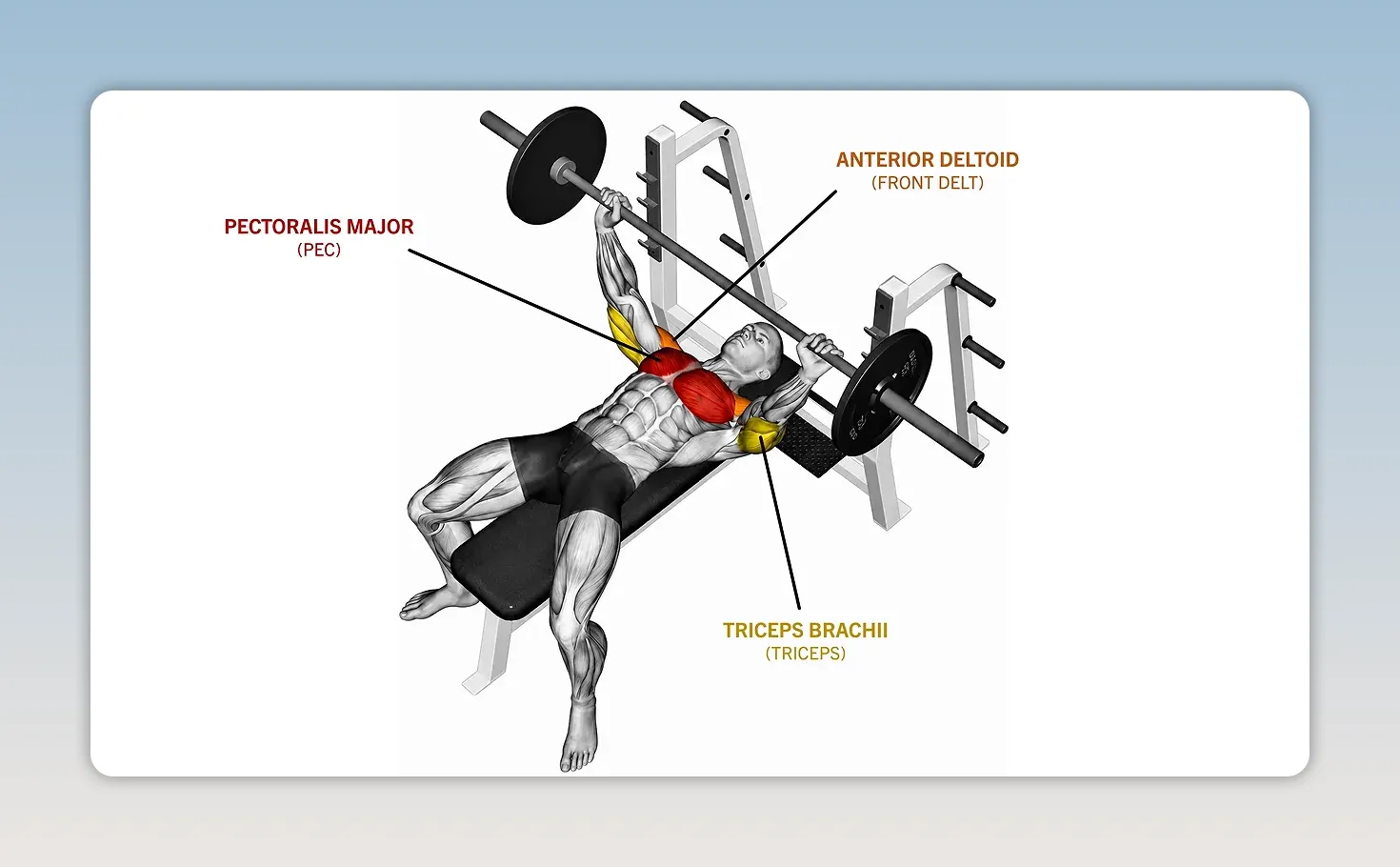
However, involvement does not mean that each muscle receives an equally strong growth stimulus.
Chest versus triceps development
A standard flat barbell bench press appears to train the chest more strongly than the triceps. A 24-week study of bench press training found significant increases in both pectoralis major and triceps muscle thickness, but the chest experienced greater gains.
Muscle activity research shows a similar general pattern. During a standard flat barbell bench press, the different chest regions and the anterior deltoid can show comparable activity, while triceps activity is lower.
For the front delts, I am not aware of studies directly measuring their growth from bench press training. Muscle activity data suggests substantial involvement, potentially similar to the chest, but muscle activity is not the same measurement as long-term muscle growth.
Why the triceps long head may need additional work
The long head of the triceps is different from the other two heads because it crosses both the elbow and shoulder joints. It contributes to elbow extension, but it also contributes to shoulder extension.
This creates a relevant consideration during pressing. As we press upward, the elbow extends while the shoulder flexes. The long head therefore shortens at the elbow while lengthening at the shoulder.
The biarticular muscle theory suggests that a muscle may not contribute maximally when the movement requires an action it assists at one joint but opposes at another. In the bench press, this may limit how strongly the long head is trained.
This consideration applies specifically to the long head. The lateral and medial heads act only at the elbow, so shoulder movement does not affect them in the same way.
Consistent with this explanation, a 10-week bench press training study found greater increases in cross-sectional area in the lateral and medial triceps heads than in the long head. The practical point is that bench pressing can grow the triceps, but it is unlikely to maximize development of every head by itself.
Exercise Setup: Bench Angle and Grip Width
Choosing a bench angle for chest growth
Changing the bench angle can slightly bias different regions of the pectoralis major. Based on its anatomy, an incline should favor the upper fibers, while a decline should favor the lower fibers. Muscle activity research generally supports these regional differences.
In a study comparing five bench inclinations, upper pec activity increased as the angle rose to 30 degrees, then decreased at steeper angles. Middle and lower pec activity was highest on the flat bench and declined as the incline increased.
The anterior deltoid showed the opposite general trend, with greater activity at higher inclines. Triceps activity was lower overall and did not change much between angles.
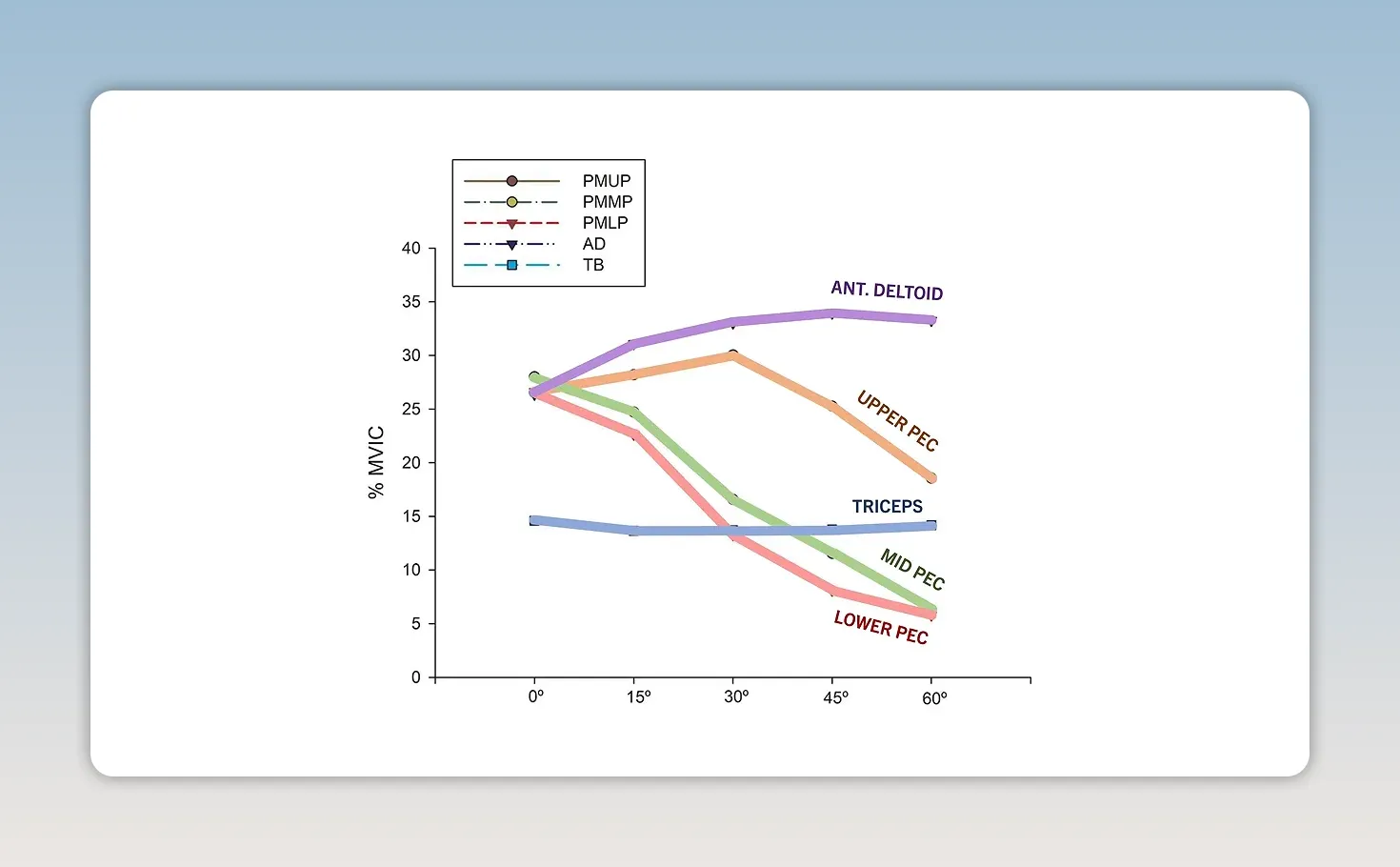
Separate research examining decline pressing found that a 15-degree decline produced the greatest lower pec activity among the angles tested, with activity falling as the bench angle increased.
Here is how I would apply these findings:
- For upper chest emphasis: Use a low incline of approximately 15 to 30 degrees. Once the angle exceeds roughly 45 degrees, the movement appears to become more shoulder-dominant.
- For lower chest emphasis: A decline can slightly bias the lower pec fibers, although flat pressing already trains this region well.
- For overall chest development: A flat bench press is an effective default because it trains all pec regions reasonably well.
- For triceps emphasis: Changing the bench angle does not appear to make a substantial difference.
These are shifts in emphasis, not ways of isolating one section of the chest completely.
Choosing your grip width
Grip width also affects the balance between the pressing muscles. A narrower grip is generally used to increase triceps involvement, while a standard grip places relatively more emphasis on the chest.
Research comparing regular and narrow grips found that the close grip slightly favored the upper pec fibers and triceps. The regular grip slightly favored the middle and lower pec fibers. Front delt activity was similar between the two conditions.
For most chest-focused bench pressing, I would start with a grip a little wider than shoulder width. If the intention is to use the bench press more as a triceps exercise, a grip around shoulder width or slightly narrower is a reasonable option.
A very wide grip is sometimes recommended for additional chest involvement, but there is not clear evidence that it is superior for chest growth. It can also reduce shoulder range of motion, which may be a disadvantage from a hypertrophy perspective.
Bench Press Technique for Hypertrophy
Prioritize the bottom range of motion
Range of motion is probably the most impactful technique consideration for muscle growth. In the vast majority of cases, we want to lower the resistance through a full range rather than cutting the repetition short.
For a barbell bench press, the usual bottom reference is touching the chest. With dumbbells, the same general aim is to lower fully into the bottom pressing position rather than omit the stretched range.
The reason is that the lower portion places the working muscles, particularly the pecs, into a greater stretch. Training through this lengthened position appears more effective for growth than consistently skipping it.
The bottom range is a higher priority than fine-tuning the final part of lockout.
Should you lock out each repetition?
A full repetition finishes with the elbows straight. However, the top portion of the bench press appears less important for hypertrophy than the bottom portion because the working muscles are in a more shortened position.
Two arguments are commonly made for stopping slightly short of lockout:
- Avoiding lockout may maintain more continuous muscular tension by removing the brief opportunity for passive rest at the top.
- The final portion is often thought to rely more on the triceps, making it less important when the main goal is chest training.
These are plausible arguments, but it is unclear how much difference avoiding lockout makes to actual muscle growth. I would not expect a major long-term difference in most cases.
My default recommendation is a standard full range of motion: lower all the way to the bottom, then press until the elbows straighten. You can experiment with stopping slightly short of lockout, but it is not something I would prioritize over reaching an appropriate bottom position.
An important exception is pain. If an injury or condition makes a particular part of the movement painful, do not force that range simply to meet a standard technique description.
Keep the load stacked over your wrists
I recommend maintaining a relatively neutral wrist position during bench press movements. The weight should sit directly above the wrist, with the wrist aligned over the forearm.
When the wrist bends excessively backward, the resistance sits behind the wrist joint rather than being stacked over it. This creates a force that pulls the wrist farther into extension and can contribute to strain or discomfort.
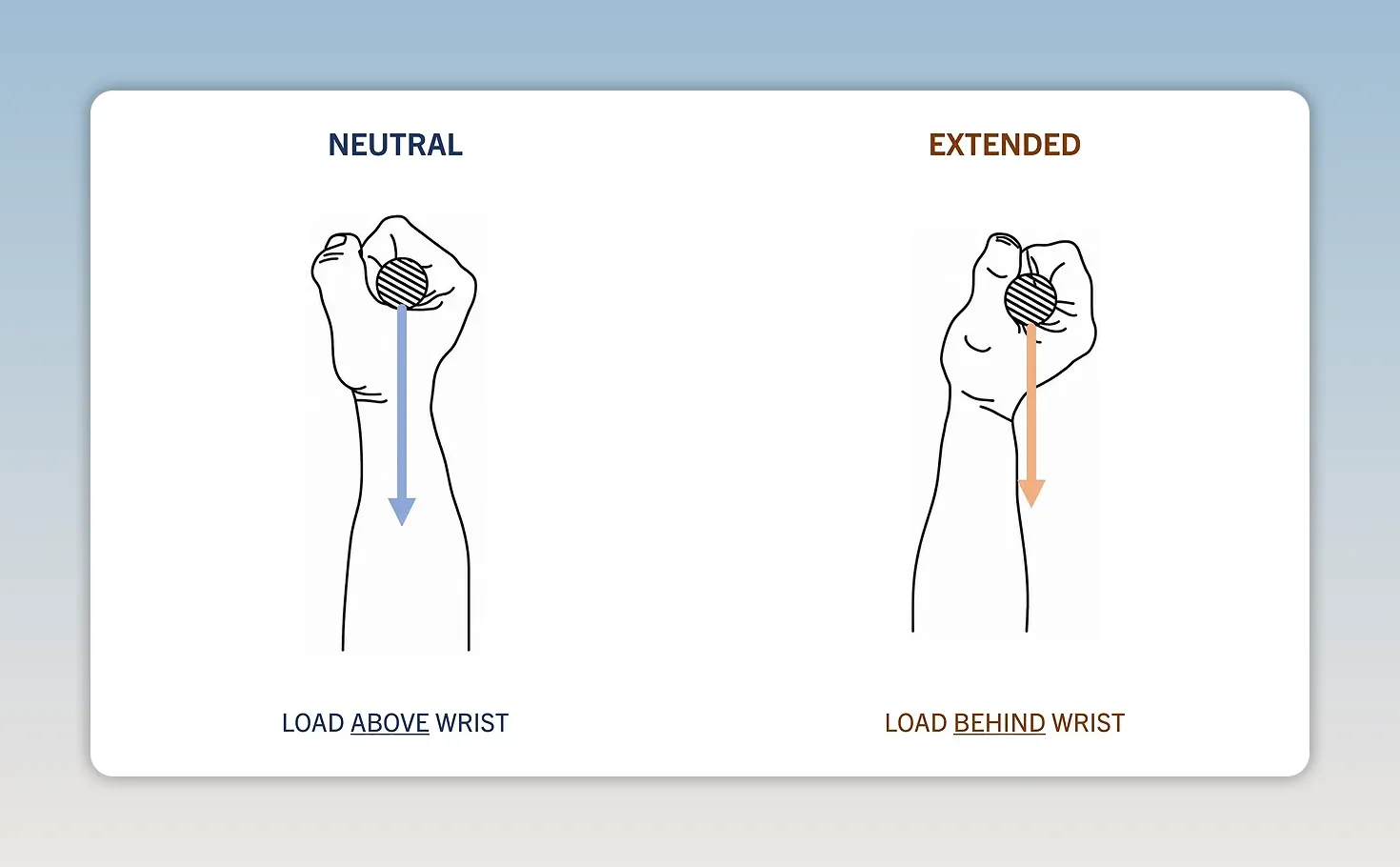
If you experience wrist discomfort during pressing, check where the bar or dumbbell sits in your hand and whether your wrist is bending back under the load. Adjusting the grip to improve this alignment may help.
Allow an appropriate scapular rhythm
Scapular movement refers to movement of the shoulder blades. A common recommendation is to squeeze them back and together, then hold that position for the entire repetition.
The rationale is that retraction creates a more stable shoulder position and may reduce strain on certain tissues. However, there is also a mobility trade-off.
The shoulder blade normally moves together with the upper arm, a relationship known as scapulohumeral rhythm. Preventing the scapula from moving forward limits how far we can reach and bring the arm across the body. Holding it rigidly in place may therefore feel restrictive or irritating for some people.
For general hypertrophy training, my default suggestion is to allow a natural scapular rhythm rather than force either retraction or protraction. There will generally be some retraction toward the bottom and some protraction toward the top.
If this produces shoulder discomfort, you can experiment with maintaining a retracted position and assess whether it feels better. Neither approach should be treated as a universal solution for every shoulder.
There is also a strength-specific consideration: maintaining retraction can reduce the distance the bar travels and may help you lift more weight. That makes it a potentially useful strategy when maximum bench press performance is the primary goal.
How much should you arch your back?
A larger spinal arch reduces the distance the bar or dumbbells need to travel. This typically allows a heavier load to be lifted, which is why pronounced arches are used in competitive powerlifting.
Whether arching meaningfully changes muscle growth is less clear. I am not aware of studies directly comparing long-term hypertrophy between flat-back and arched-back bench pressing.
A study of 15 competitive strength athletes compared the two techniques across several loads. Arching reduced bar travel slightly and allowed a slightly greater one-repetition maximum. Upper and lower chest muscle activity was similar between techniques, while triceps activity was slightly higher with an arch.
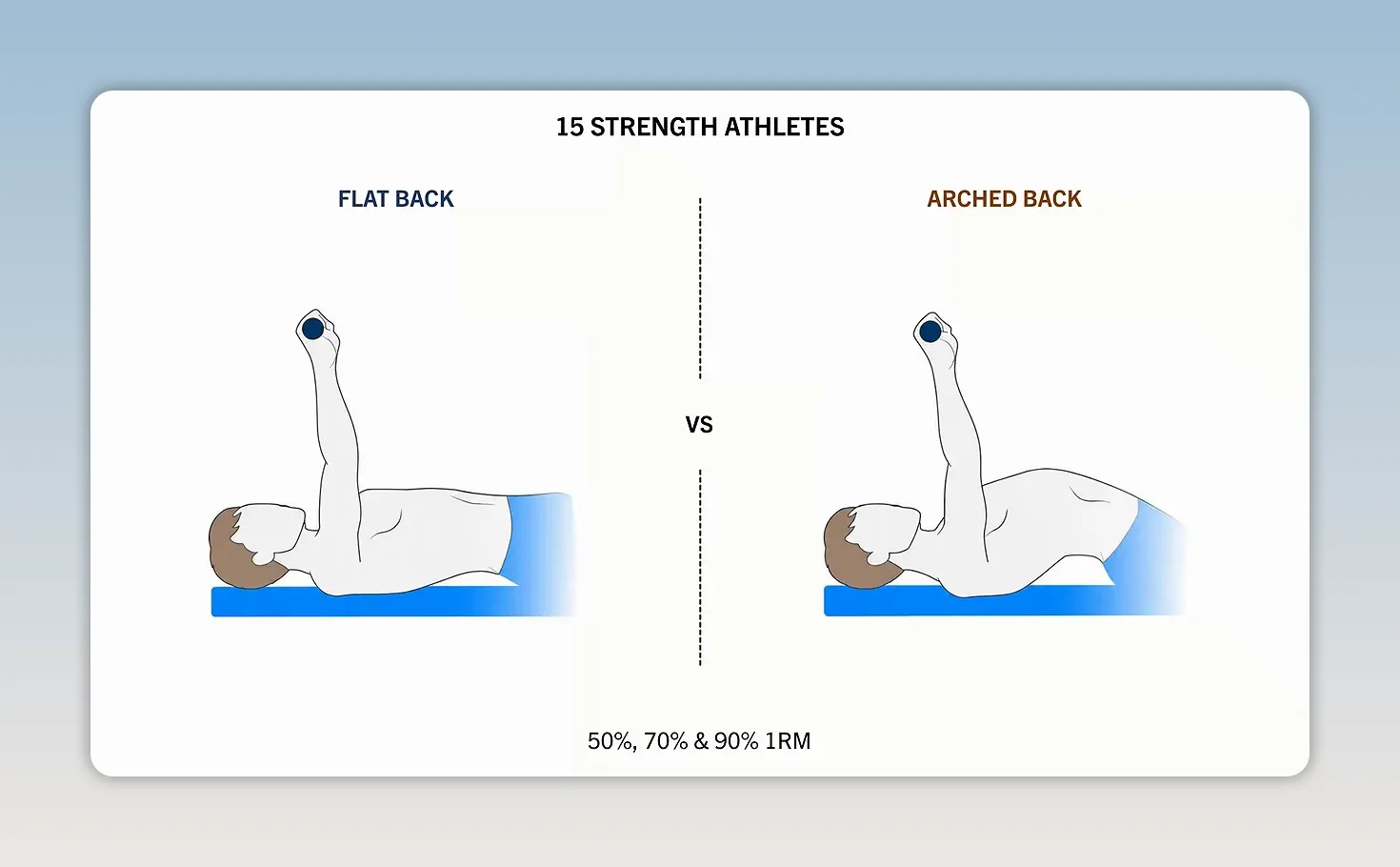
For most people training primarily for muscle growth, I would default to a relatively flat, comfortable back position rather than deliberately creating a large arch. A slight arch is something you can experiment with if it feels more natural or comfortable.
If the objective is to lift the greatest possible weight, a more pronounced arch becomes a relevant technique strategy. That is a performance decision, not evidence that the larger arch produces more chest growth.
Programming the Bench Press for Muscle Growth
Include a combination of pressing angles
A flat bench press is effective for overall chest development, but changing angles can help distribute the training stimulus across the different pec regions.
For maximizing development, I would include a combination of pressing angles within the training program. Flat, low incline, moderate incline, and decline variations can all have a role.
The important point is the regional emphasis: incline pressing slightly favors the upper chest, decline pressing slightly favors the lower chest, and flat pressing provides broad chest involvement. The purpose of variety is to complement the training stimulus, rather than assume one angle perfectly maximizes every region.
Use fractional sets to estimate training volume
Weekly sets per muscle group are a useful way to quantify hypertrophy training volume. Compound exercises make this less straightforward because all the involved muscles are not necessarily trained to the same extent.
Instead of counting one bench press set as one full set for the chest, shoulders, and triceps, we can use fractional sets.
For a standard bench press, I would generally count each set as:
- Chest: One full set.
- Shoulders: Half a set, reflecting the front delt contribution.
- Triceps: Half a set.
For example, four sets of bench pressing would contribute four sets toward chest volume, but approximately two sets toward front delt volume and two sets toward triceps volume.
This is a practical accounting method, not an exact measurement of the stimulus each muscle receives. It helps avoid treating indirect work as though it were identical to dedicated training for every muscle involved.
Add exercises that directly train the supporting muscles
The bench press is unlikely to maximize growth of all the muscles involved, particularly the shoulders and triceps. Additional exercises allow us to train those muscles more directly and accumulate volume that pressing alone may not provide.
Relevant isolation exercises include:
- Chest flies for additional chest work.
- Triceps extensions for direct triceps training.
- Lateral raises for additional shoulder development.
Exercise selection also affects how practical it is to train close to muscular failure. With a barbell bench press, a failed repetition can leave you pinned under the bar if there is no spotter or suitable safety setup.
Many isolation exercises make reaching muscular failure more manageable because a failed repetition does not create the same trapping risk. They can therefore complement pressing when the goal is to push the target muscle hard without the same safety concern.
This does not make every isolation exercise or failure technique risk-free. The useful distinction is that we can choose exercises where ending a repetition is easier to manage, rather than relying on unsupported barbell pressing to reach complete failure.
A Practical Default for Hypertrophy-Focused Bench Pressing
For most people, a useful starting point is a flat or low incline press, a grip slightly wider than shoulder width, and a full, comfortable range of motion. Keep the load stacked over the wrists, allow shoulder movement that feels natural, and use a comfortable back position without assuming a large arch is necessary.
From there, adjust the setup to match the goal. Use a low incline to emphasize the upper chest, a narrower grip to emphasize the triceps, and a combination of angles for broader chest development. Count the supporting muscles' work realistically and include direct exercises where needed.
The fundamentals matter more than small technique refinements: train through an appropriate range, select variations for a clear purpose, and build a program that does not ask the bench press to do everything.


