How much we eat is one of the main ways we regulate body weight. Consistently eating more energy than we expend promotes weight gain, while eating less creates the calorie deficit required for weight loss.
But knowing how energy balance works does not mean we can follow a calorie target robotically. Restricting food can make us hungrier, more focused on eating, and less satisfied. At other times, we want food even when we do not seem particularly hungry.
To understand why, we need to separate two overlapping influences: the physiological signals that regulate energy intake and the other reasons we feel driven to eat. Both matter when trying to manage body weight over time.
Key Takeaways
- A sustained calorie deficit causes weight loss, but appetite responses can make restriction difficult to maintain.
- Hormonal signals, stomach fullness, and body-fat stores all influence physiological hunger and satiety.
- Pleasure, social occasions, and scheduling can drive eating independently of an immediate need for energy.
- Mindful eating helps distinguish physical hunger from other motivations without making every eating decision a rigid rule.
Table of Contents
- Why Calorie Restriction Is Simple on Paper but Difficult in Practice
- How Physiological Hunger and Satiety Work
- Why We Want to Eat When We Are Not Physically Hungry
- Using Mindful Eating to Recognize What Is Driving Appetite
- The Bigger Picture: Appetite Is More Than a Calorie Target
Why Calorie Restriction Is Simple on Paper but Difficult in Practice
A basic mathematical approach to weight loss has three steps:
- Estimate how much energy you expend each day.
- Create a meal plan that provides fewer calories than that amount.
- Follow the plan consistently for multiple weeks or months.
If that process produces a sustained calorie deficit, body weight will decrease. The difficulty is not that energy balance stops working. It is that our physiological and emotional responses can make the plan increasingly difficult to follow.
An extreme illustration comes from the Minnesota Starvation Experiment. Young men had their usual calorie intake reduced by roughly half for 24 weeks. They lost substantial weight, but the consequences extended well beyond changes on the scale.
Reported effects included:
- Depression.
- An excessive preoccupation with food.
- Reduced sexual interest.
- Declining cognitive function.
- Self-harm in one case.
This was severe restriction, not a model for an ordinary weight-loss diet. Nevertheless, it demonstrates an important point: the body does not respond passively to a major shortage of energy. It generates responses that encourage us to eat.
How Physiological Hunger and Satiety Work
Three useful areas to consider are hormonal appetite regulation, physical stomach fullness, and the influence of body fat. These are connected processes rather than completely separate systems.
1. Hormones communicate energy availability
Two important hormones involved in appetite regulation are ghrelin and leptin.
- Ghrelin helps stimulate hunger and promote food intake.
- Leptin helps signal energy sufficiency and supports the regulation of food intake and energy expenditure.
Broadly speaking, periods without food shift us toward hunger, while eating shifts us toward satiety. Ghrelin commonly rises during fasting and falls after a meal. Leptin also responds to energy availability, although it is better understood as part of the broader energy-regulation system than as a simple, immediate meal-fullness switch.
For example, a study of fasting and post-meal hormone levels examined responses to breakfast after an overnight fast. In healthy adults, active ghrelin decreased after the meal, while leptin increased over the measured period.
The amount of energy consumed also influences these responses. A small meal may provide some temporary satisfaction without suppressing the drive to eat as much, or for as long, as a higher-energy meal.
Energy intake matters, not just the act of eating
One study of appetite responses to short-term energy changes compared three conditions on separate occasions:
- A meal providing approximately 500 calories.
- A restricted meal providing approximately 100 calories.
- A 100-calorie meal followed by another 364 calories delivered intravenously over five hours.
The two higher-energy conditions produced greater ghrelin suppression than the low-calorie meal alone. Across the measurement period, they also produced a more favorable leptin response, whereas leptin decreased overall following the low-energy meal.
The intravenous condition is particularly useful for understanding the principle. The additional energy did not arrive as a larger meal in the stomach, yet it still affected the hormonal response.
Our appetite-regulation system responds to energy availability, not simply to whether we have put something in our mouths.
2. Stomach fullness helps bring a meal to an end
Food, fluids, and gas physically expand the stomach. Receptors that respond to this stretching contribute to the sensation of fullness and can help limit how much we eat during a meal.
However, physical fullness is not the same thing as meeting our energy needs.
If stomach expansion were the only important mechanism, we could consume large volumes of calorie-free food or drink and remain satisfied indefinitely. In reality, the body still needs energy. Mechanical fullness can help explain why we stop eating now, but it does not fully explain how soon we will want to eat again.
A large, low-calorie meal may fill the stomach while providing relatively little energy. Hunger can therefore return sooner than it would after a meal of the same volume that contains more calories.
The same-volume milkshake experiment
A study comparing equal-volume milkshakes provides a clear example. Ten healthy adults consumed three different strawberry milkshakes on separate occasions after an overnight fast.
Each drink contained 530 ml of liquid, but the calorie content differed:
- Low calorie: 223 calories.
- Moderate calorie: 504 calories.
- High calorie: 1,000 calories.
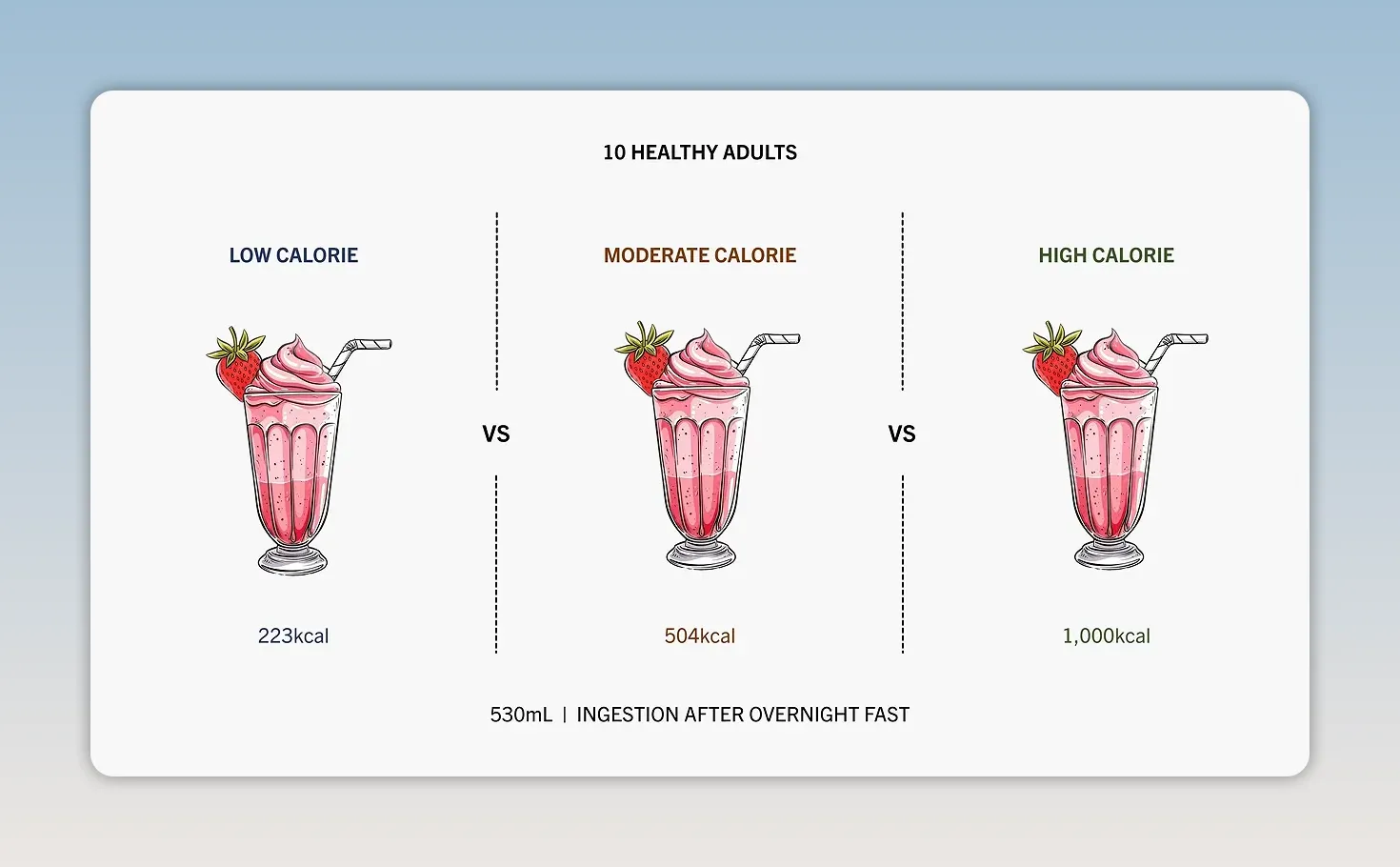
Leptin was not measured, but ghrelin suppression differed substantially. The highest-calorie drink produced the greatest suppression, while the lowest-calorie drink produced the least.
Because the drinks had the same volume, stomach filling alone could not explain the difference. Their energy content mattered.
This does not mean higher-calorie meals are automatically better for weight management. It means that feeling physically full and having a reduced biological drive to eat are related, but not identical, experiences.
3. Body fat influences the longer-term drive to eat
Appetite responds not only to recent meals but also to stored energy. As body fat becomes very low, the physiological pressure to consume energy tends to increase.
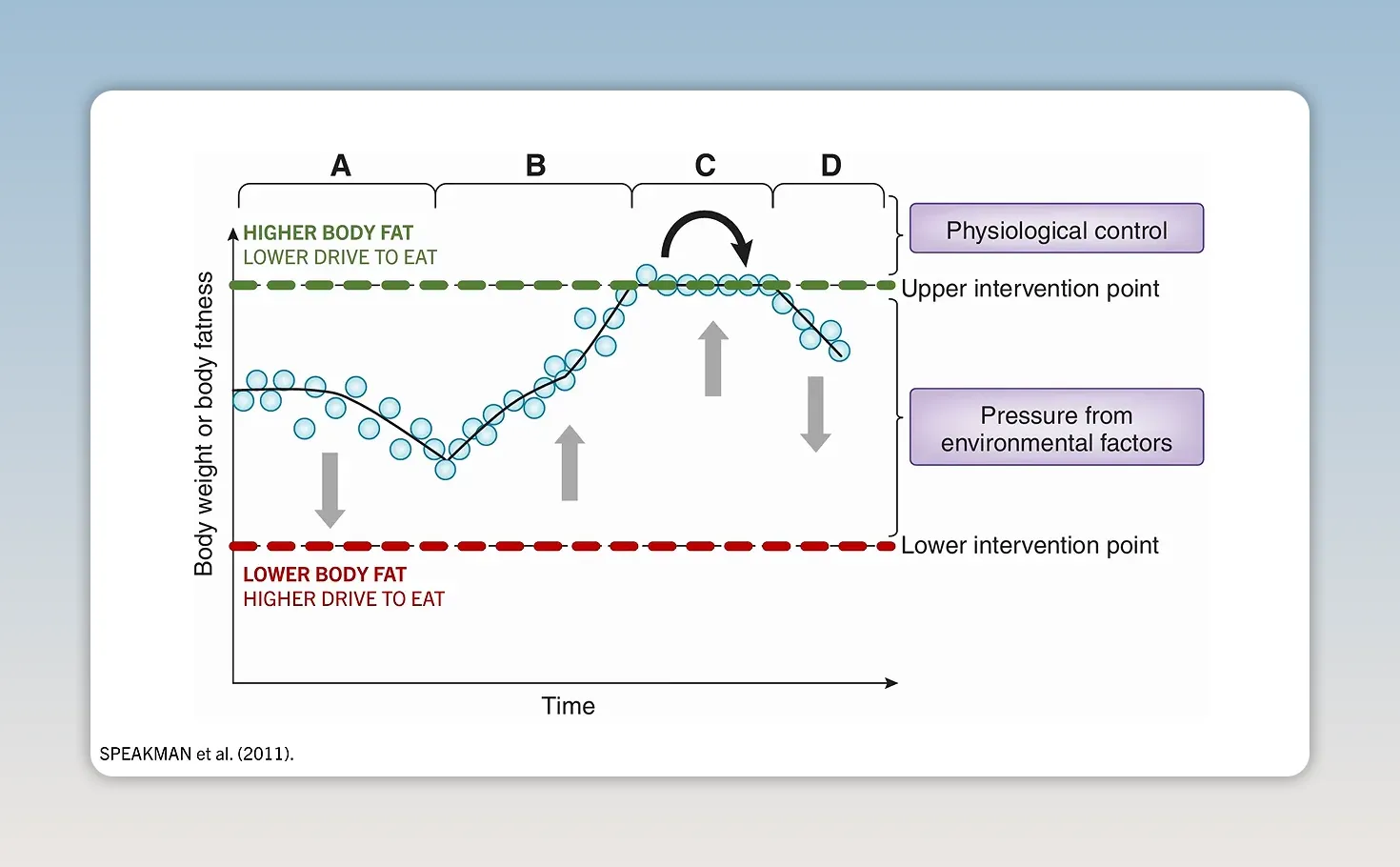
The dual intervention point model of body-weight regulation offers a framework for thinking about this. Rather than proposing one precisely defended body weight, it describes a range bounded by lower and upper intervention points.
- Below the lower intervention point, physiological pressures favor greater energy intake and reduced expenditure.
- Above the upper intervention point, physiological pressures may favor reduced intake and increased expenditure.
- Between those points, environmental influences can play a substantial role in changes in body weight.
Hormones help communicate these differences in stored energy. People with more body fat typically have higher baseline leptin levels and lower ghrelin levels than leaner individuals.
In the fasting hormone comparison discussed earlier, participants with obesity had higher leptin and lower active ghrelin than healthy-weight participants. Participants with anorexia nervosa showed the opposite pattern: lower leptin and higher ghrelin.
However, hormone concentrations do not tell the whole story. More leptin does not necessarily translate into proportionally greater satiety. In obesity, leptin resistance can reduce the brain's responsiveness to the signal. This helps explain why greater energy stores do not always result in a consistently lower appetite.
At the other extreme, very low body fat can create a strong, persistent drive to eat. From a survival perspective, depleted energy reserves are a reason to restore intake, not suppress it.
Broad reference ranges sometimes used in this discussion are approximately 10% to 25% body fat for men and 18% to 35% for women. These are rough guides, not diagnostic boundaries or exact thresholds at which hunger changes. The practical point is that becoming excessively lean can amplify hunger, while prolonged excess body fat can be associated with disrupted appetite regulation, including leptin and insulin resistance.
Why We Want to Eat When We Are Not Physically Hungry
Biological energy needs are only part of the picture. We also eat because food is enjoyable, because other people are eating, or because our schedule makes it sensible.
These motivations are real, but they are not necessarily signals of an immediate energy shortage.
Hedonic eating: food is pleasurable
Hedonic eating means eating for enjoyment. Tasty food feels good to eat, and that rewarding experience encourages us to repeat the behavior.
This makes sense from an evolutionary perspective. For much of human history, food availability was uncertain. Enjoying calorie-dense foods when they were available could support survival.
In environments where food is now abundant and easily accessible, that same drive can encourage us to eat beyond our immediate energy needs. Our appetite systems did not develop around constant access to highly appealing food.
The important distinction is simple: wanting the pleasure of a particular food is not always the same as needing energy.
Social eating: food is part of the occasion
Family gatherings, parties, and restaurant meals often revolve around food. We may eat because we are participating in the occasion, even if we were not particularly hungry beforehand.
There is nothing inherently wrong with this. Eating is part of social life. However, it helps to recognize when the occasion, rather than physical hunger, is driving intake.
Practical eating: the schedule comes first
Sometimes eating before hunger develops is a sensible logistical decision.
For example, you might eat breakfast before work or school even though you are not especially hungry. If the next opportunity to eat is lunchtime, breakfast may help avoid spending the whole morning hungry.
Again, this is not necessarily a problem. It is simply a different reason to eat.
Pleasure, emotions, social connection, and practical constraints can all influence food intake. When those opportunities repeatedly add energy beyond our needs, they can contribute to excess body-fat gain over time.
Using Mindful Eating to Recognize What Is Driving Appetite
Mindful eating, in this context, means becoming more aware of hunger and satiety and trying to eat more in line with those signals.
The first step is not changing what is on the plate. It is identifying why you want to eat.
Physical hunger usually builds gradually
Common features of physiological hunger include:
- A sensation that is often first noticed in the stomach.
- A gradual increase in intensity over time.
- A feeling that persists until energy is consumed.
- A willingness to eat a range of foods, including fairly plain options.
A food craving may appear suddenly
A desire to eat for another reason often has a different pattern:
- It follows seeing, smelling, or thinking about food.
- It appears relatively suddenly.
- It may fade when attention shifts elsewhere.
- It often centers on a specific food rather than food in general.
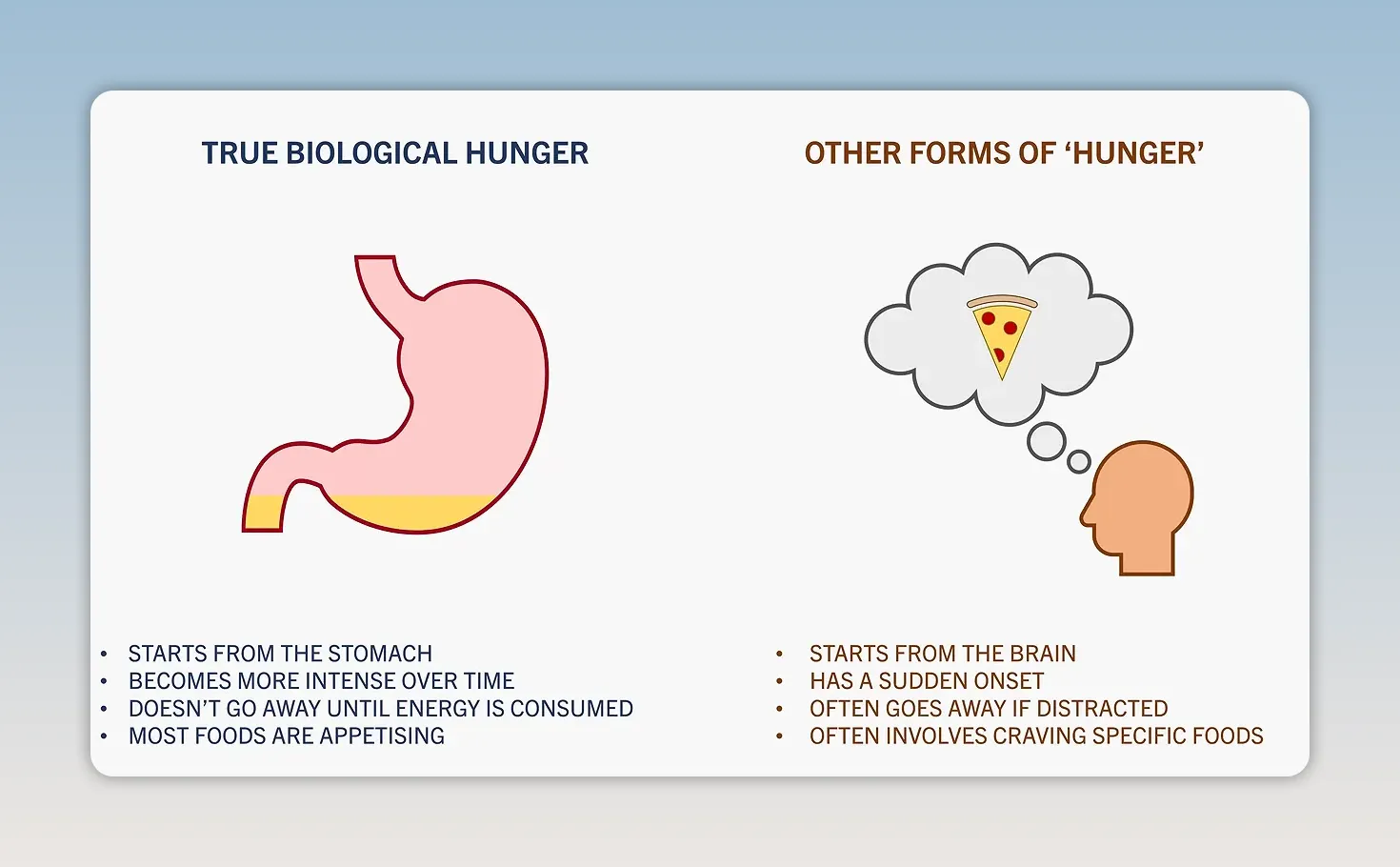
These patterns are useful clues, not a perfect test. Their purpose is to help distinguish a developing need for energy from a desire prompted by a particular experience.
Putting that awareness into practice
- Pause before eating. Notice whether the urge developed gradually or followed a specific cue.
- Identify the main reason. Is it physical hunger, enjoyment, emotion, social participation, or planning around your day?
- Respond to physical hunger. When your body is asking for energy, eating is appropriate.
- Consider a short delay for a passing craving. If you are not physically hungry, you may choose to wait and notice whether the desire persists.
- Pay attention as hunger subsides. Aim to recognize satisfaction rather than automatically continuing to eat.
A subjective hunger scale can make this easier to notice. One suggested approach uses roughly 7 to 8 out of 10 hunger before eating and around 3 out of 10 hunger afterward, with higher numbers representing greater hunger. The useful principle is the change in sensation, not treating those numbers as compulsory targets or forcing yourself to tolerate uncomfortable hunger.
Social commitments and daily schedules will not always align neatly with appetite. That is fine. Practical eating already illustrates why waiting for physical hunger is not always the best fit for the situation.
The goal is greater awareness, not a rule that every meal must be justified by strong hunger. Eating for pleasure or social connection is not automatically a mistake.
The Bigger Picture: Appetite Is More Than a Calorie Target
Our desire to eat reflects both physiological regulation and the environment around us. Hormones communicate energy availability, stomach expansion contributes to short-term fullness, and body-fat stores influence the longer-term pressure to eat.
At the same time, food offers pleasure, supports social connection, and has to fit around everyday life. Those influences help explain why a calorie prescription can be mathematically straightforward but behaviorally difficult.
Understanding appetite does not replace energy balance. It explains why maintaining it can take more than choosing a number. Becoming more aware of hunger, satisfaction, and the reasons behind eating can help us make decisions that better match our energy needs over time.
|