How heavy you should lift depends on what you want your training to achieve. Maximizing strength requires relatively heavy loads on the lifts you want to improve. Building muscle gives you considerably more flexibility.
However, rep ranges are only part of the answer. Technique, progressive overload, and joint tolerance all influence the weight you should use. A heavier lift is not automatically a more effective lift, particularly when the goal is hypertrophy.
The key distinction is this: for strength, load is a central performance goal. For muscle growth, load should largely be the result of your chosen reps, technique, and proximity to failure.
Key Takeaways
- Heavy loads and low reps are most useful for maximizing strength on specific lifts.
- Muscle growth can be similar across roughly 5 to 30 reps when training close to failure.
- For hypertrophy, choose effective technique first and adjust the weight to match.
- Progress reps and load over time while adapting training to joint tolerance.
Table of Contents
- 1. Choose Your Rep Range Based on Your Goal
- 2. Let Your Technique Determine the Load
- 3. Increase Reps and Load Over Time
- 4. Account for Joint Stress and Irritation
- Practical Recommendations: How to Choose Your Working Weight
1. Choose Your Rep Range Based on Your Goal
The relationship between load and reps is fairly intuitive. Assuming you train relatively close to failure, heavier weights allow fewer repetitions, while lighter weights allow more.
Most forms of resistance training can improve both strength and muscle size. But the rep ranges you use can emphasize one adaptation over the other.
For strength, heavier loads are generally better
A systematic review and network meta-analysis of resistance training loads compared three loading categories:
- Light: loads allowing more than 15 repetitions to failure.
- Moderate: loads allowing 9 to 15 repetitions to failure.
- Heavy: loads allowing eight or fewer repetitions to failure.
For strength development, the pattern was clear. Heavy loads outperformed light loads, moderate loads outperformed light loads, and heavy loads outperformed moderate loads.
In practical terms, around 1 to 5 reps per set is a useful range for maximizing strength on your key lifts. This does not mean every exercise in your program needs to be trained that way. Apply the low-rep emphasis to the lifts you actually want to become strongest at.
For muscle growth, a wide range of reps can work
The hypertrophy findings were different. The same meta-analysis found no clear advantage when comparing light, moderate, and heavy loading categories.
Essentially, muscle growth can be similar across a broad range of loads, provided sets are taken close to failure. But this does not mean the effective range is unlimited.
At the very heavy end, extremely low-rep sets may provide less growth per set. In an eight-week study comparing heavy and moderate loads, 19 resistance-trained men completed full-body training three times per week. One group used 8 to 12 reps, while the other used 2 to 4 reps.
Both groups increased muscle thickness in the biceps, triceps, and lateral quadriceps. However, increases generally favored the moderate-rep group.
At the other extreme, loads can become too light. A study comparing loads from 20% to 80% of one-rep maximum involved 30 untrained men performing single-leg leg presses and biceps curls. One limb trained with 20% of one-rep maximum, or 1RM. The opposite limb trained with 40%, 60%, or 80% of 1RM, with volume load matched between limbs.
All loads produced growth, but the limbs trained with 40% to 80% of 1RM achieved greater increases in biceps and quadriceps cross-sectional area than those trained with 20%.
The practical interpretation is that roughly 5 to 30 reps can produce similar muscle growth when sets are sufficiently close to failure. Treat this as an approximate working range, rather than a precise boundary.
A practical rep-range starting point
Although a broad range works for hypertrophy, I would generally use 5 to 15 reps for most exercises, most of the time. It is a practical middle ground that avoids making every set either extremely heavy or very long.
- Key strength lifts: around 1 to 5 reps.
- Compound lifts for muscle growth: often around 5 to 8 reps.
- Isolation lifts for muscle growth: often around 10 to 15 reps, sometimes up to 20.
These are starting points, not compulsory ranges. The exercise and your training goal should guide the choice.
2. Let Your Technique Determine the Load
Two sets with the same number of reps can involve very different weights simply because the technique is different.
Using momentum on a curl can increase the load you move. Shortening a compound lift's range of motion can do the same. Tempo also influences how much weight you can use.
So, before deciding whether a weight is appropriate, establish how you intend to perform the exercise. Three important considerations are range of motion, strictness, and lifting mechanics.
Range of motion: train for the adaptation you want
For strength, practice the range of motion used in your strength test. If your goal is to squat the most weight possible to parallel, your training should include squatting to that depth.
Technique can also reduce the distance a weight must travel. In the bench press, for example, arching the back and retracting the shoulder blades can shorten the bar's range of motion. For competitive strength, this can be useful when it remains within the relevant rules.
For hypertrophy, the priority is different. A full range of motion is generally a good default because it typically includes loading the muscle in a more lengthened position. That stretched position appears particularly useful for muscle growth.
A study comparing full and partial squat training illustrates the distinction. Seventeen untrained men trained squats twice per week for 10 weeks:
- The full-depth group squatted to approximately 140 degrees of knee flexion.
- The partial-depth group squatted to approximately 90 degrees of knee flexion.
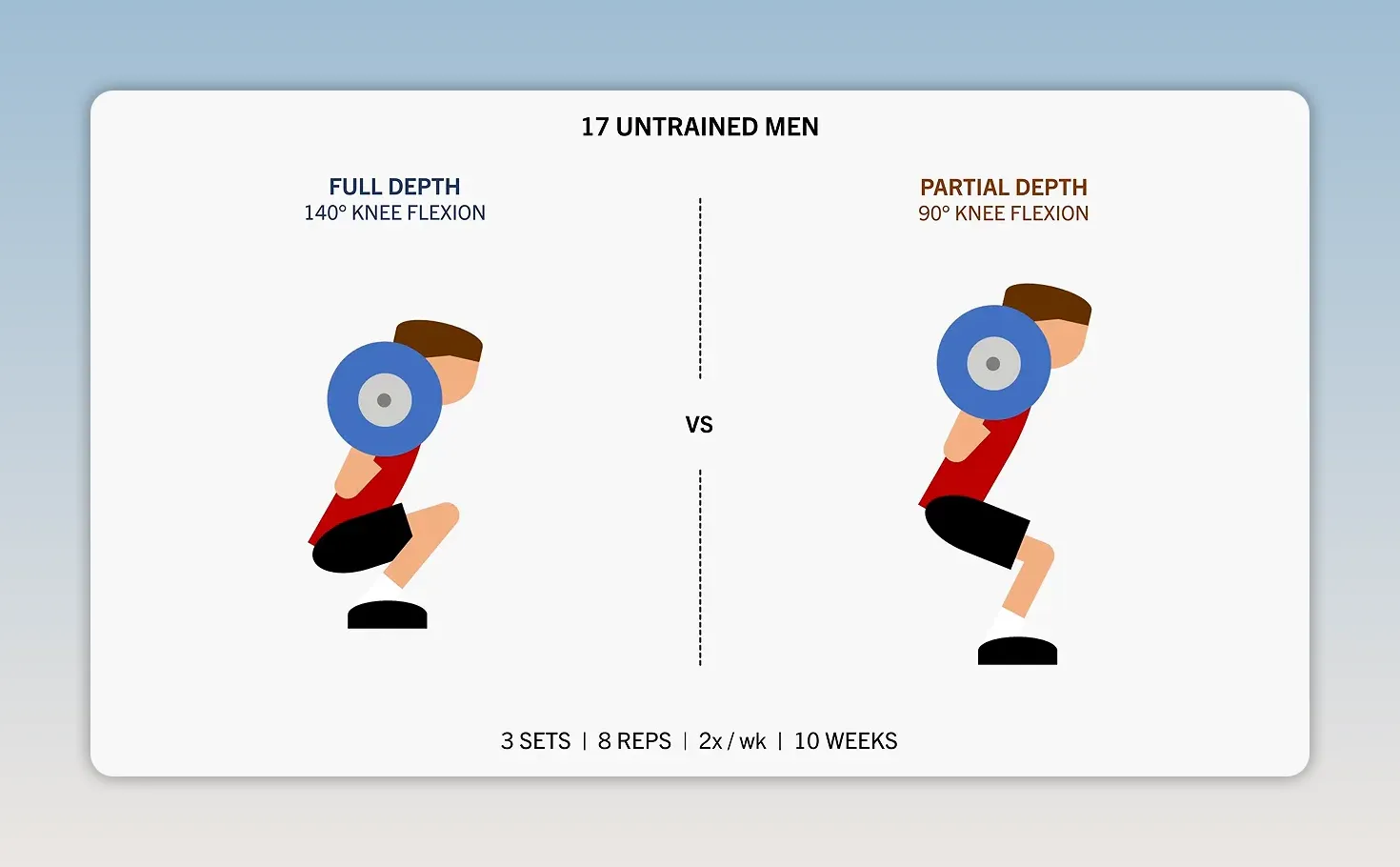
As expected, the partial-squat group used heavier loads. But deeper squats produced greater muscle-volume increases in the adductors and gluteus maximus. The extra weight used in partial squats did not translate into greater growth in those muscles.
Strength improvements were specific to the movement practiced. Full-depth squat training produced better improvements in full-depth squat strength, while partial-depth training produced better improvements in partial-depth squat strength.
For hypertrophy, do not remove the lengthened portion of an exercise simply to lift more weight. Use a full range of motion, or a partial range that includes the lengthened portion, and select the load accordingly.
Strictness: more weight does not necessarily mean more growth
Strict technique minimizes assistance from other joints and body movements. Using external momentum usually allows you to move more weight, but does it improve muscle growth?
A study comparing strict form with cheat repetitions tested this in 30 untrained men and women. Participants completed four sets of single-arm biceps curls and triceps pushdowns twice per week for eight weeks.
One arm used strict technique, keeping the elbow close to the body and minimizing torso movement. The other arm used cheat repetitions, allowing torso movement and elbow flare.
Both approaches increased biceps and triceps thickness, with no notable differences between them.
This suggests that strictness alone may not have a major influence on hypertrophy in these exercises when sets use a full range of motion and are taken close to failure. It does not mean that every form of loose technique is equally effective. The target muscle still needs to receive the intended training stress.
For strength, the question is whether momentum is allowed in the task you are testing. Olympic weightlifting, for example, relies on precisely coordinated acceleration of the bar. If momentum is part of the lift, learning to use it effectively is part of developing performance.
Lifting mechanics: move the most weight or challenge the target muscle?
Lifting kinematics refers to how the movement is performed, including stance, grip, bar path, and joint angles.
For strength, the aim is generally to find the most mechanically efficient technique that allows you to lift the most weight within your chosen standards. A low-bar squat with an appropriate forward torso lean is one example of how powerlifters organize their technique around performance.
For hypertrophy, the aim is to place a high demand on a particular muscle, not simply move the largest external load. This can mean choosing a position that gives the target muscle less mechanical advantage, so it must work harder with less weight.
This distinction is especially relevant for compound exercises because several muscle groups contribute to the movement. Technique can shift the emphasis:
- Conventional versus stiff-leg deadlifts: conventional deadlifts involve more knee flexion and quadriceps contribution, while stiff-leg deadlifts place greater emphasis on the hamstrings.
- Rows pulled toward the stomach: a lower pulling path with the shoulders allowed to reach forward can bias the lats.
- Rows pulled toward the chest: a higher pulling path, more flared elbows, and greater shoulder-blade retraction can bias the traps and rear delts.
On isolation exercises, this is usually less complicated because the target muscle is already likely to be the limiting factor. Even so, making the target muscle work harder can allow you to achieve substantial muscular stress with less external load, potentially reducing loading demands elsewhere.
For muscle growth, adjust the weight to accommodate effective technique, not the technique to accommodate a heavier weight. If you change your range of motion or muscular emphasis, the appropriate load may need to change too.
3. Increase Reps and Load Over Time
The right weight is not a permanent number. As you adapt, training needs to become more challenging to remain sufficiently stimulative. This is progressive overload.
Two straightforward ways to achieve it are adding repetitions and increasing load. Both can support long-term strength and muscle development.
Rep progression and load progression can both work
An eight-week study comparing repetition and load progression involved 38 university students with approximately four years of resistance-training experience.
Participants performed four sets of back squats, leg extensions, standing calf raises, and seated calf raises twice per week. Both groups began in the 8 to 12 rep range, but progressed differently:
- Load progression: increase the weight once the upper end of the rep range was reached.
- Rep progression: keep the weight constant and perform more repetitions over time.
Overall quadriceps and calf muscle-thickness gains were similar between groups. The load-progression group achieved slightly greater improvements in squat 1RM, which is consistent with practicing heavier lifting.
However, adding reps indefinitely is not an ideal long-term strategy. Eventually, every exercise becomes a very high-rep exercise. That can be impractical and unpleasant, and once loads become extremely light, growth per set may be less favorable.
Rep increases are useful incremental progress. Over time, load increases help keep that progress within a productive and practical rep range.
Use double progression
A double-progression model combines the two approaches:
- Select an appropriate rep range for the exercise and your goal.
- Choose a challenging load that allows you to complete every working set within that range.
- Build repetitions over time while maintaining your intended technique.
- Increase the weight by a small increment once every set reaches the top of the range.
- Return toward the lower end of the range and build repetitions again.
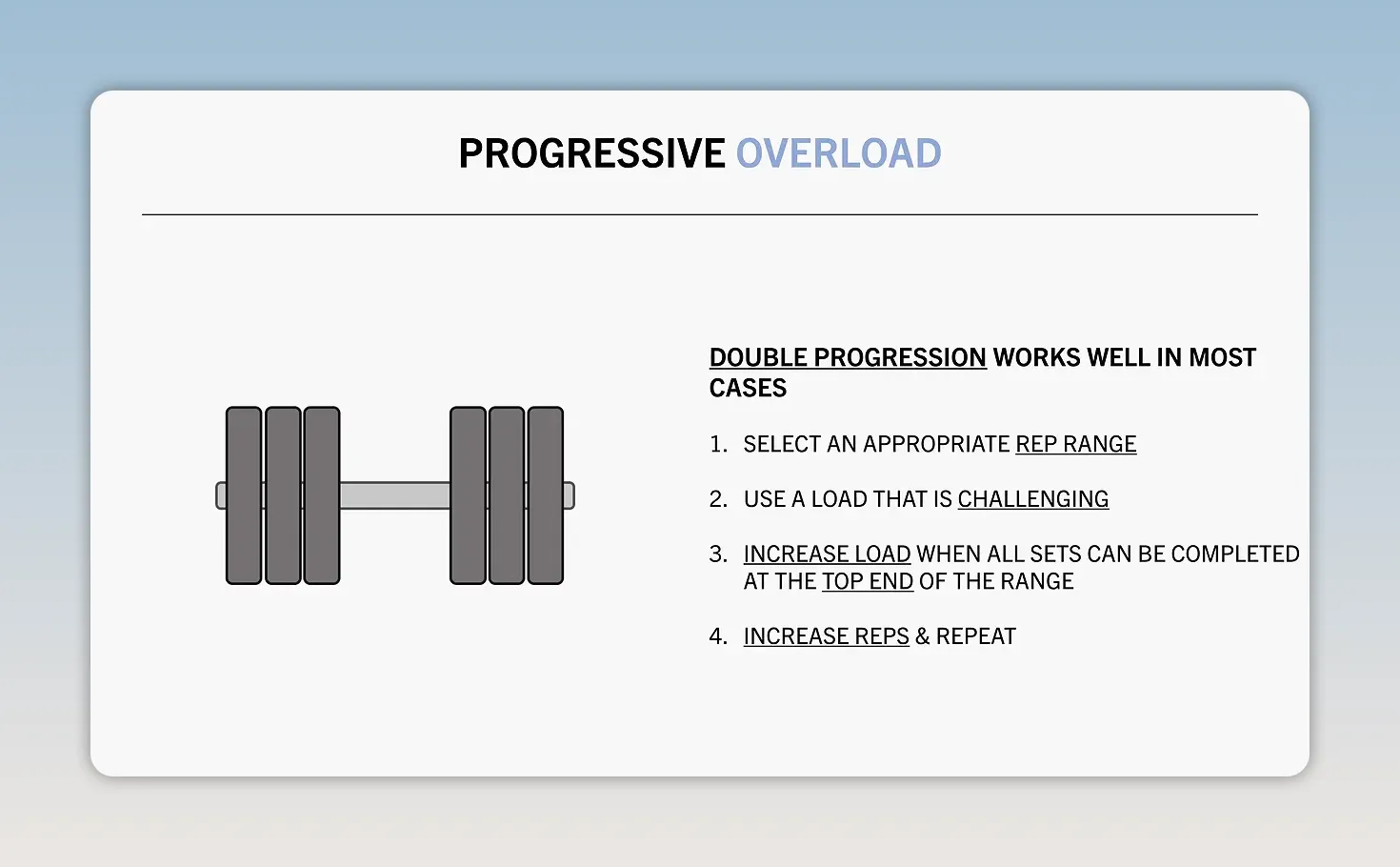
This gives load selection a clear purpose. You are not adding weight simply because another session has passed. You are increasing it when your performance shows you can complete the prescribed work.
4. Account for Joint Stress and Irritation
Joint tolerance also influences how heavy you should lift. Heavier loading, or increasing loads too quickly, can be associated with more joint pain or irritation. There is little reason to make every exercise as heavy as possible at all times.
Appropriate rep ranges and technique help manage these demands, but they do not eliminate every problem. Injuries and irritation can also arise from activities outside the gym and affect what you can tolerate during training.
In these situations, you may need to reduce load temporarily.
Lighter training can still support muscle growth
For hypertrophy, reducing weight does not necessarily mean compromising results. Within the broad effective loading range, lighter weights can still provide a strong growth stimulus when sets are taken close to failure.
The trade-off is that you will need more repetitions. Other strategies that can make lighter loads challenging include:
- Drop sets.
- Pre-fatiguing the target muscle.
- Shorter rest periods.
These are ways to reduce the average load used, not reasons to push through an injury. Any approach still needs to accommodate the symptoms or limitation that prompted the change.
Peak strength requires heavier loading
For maximal strength, the compromise is greater. Heavy-load exposure is important, so if you cannot tolerate heavy lifting for a period, you are unlikely to be at peak strength during that time.
That does not make the training period unproductive. Temporarily emphasizing muscle growth can still contribute to future strength development by building more muscle tissue to produce force when heavier training resumes.
This is one reason to plan periods with different loading emphases. You can strategically organize heavier and lighter phases around the time you want strength to peak, which is part of periodization. Alternatively, you can make those adjustments reactively in response to symptoms.
Practical Recommendations: How to Choose Your Working Weight
If your priority is strength
- Use relatively heavy loads, often for around 1 to 5 reps, on the key lifts you want to improve.
- Practice the range of motion and movement standards used in your strength test.
- Use mechanically efficient technique that complies with your federation's rules or your own established standards.
- Progress loading over time without trying to lift maximally heavy on every exercise.
- Adjust your loading emphasis when joint tolerance or your training schedule requires it.
If your priority is muscle growth
- Use approximately 5 to 15 reps for most exercises, while recognizing that roughly 5 to 30 reps can be effective.
- Include the lengthened portion of the movement through a full range of motion or an appropriate partial range.
- Choose technique that challenges the intended muscle rather than merely increasing the weight moved.
- Select a load that brings the set close to failure within your chosen rep range.
- Use rep and load progression together, adjusting weight when technique or joint tolerance changes.
The main point is not that heavy lifting is good or bad. It is that the appropriate load depends on the job you want it to do. Train heavy to improve heavy-lifting performance. For muscle growth, establish the reps, range of motion, muscular emphasis, and effort first, then use the weight that fits.
|