Progressive overload means making training more challenging over time. The principle stays the same throughout your lifting career, but the way you apply it should change as you become more experienced.
A beginner can often add reps or weight each week. An intermediate lifter usually needs smaller, less predictable increases. For an advanced lifter, progress can be slow enough that normal daily performance fluctuations hide genuine improvements.
The goal is to keep providing an effective muscle-building stimulus, not simply to make the numbers in your training log increase at any cost.
Key Takeaways
- Increased reps or load indicate progress only when technique and training conditions remain comparable.
- Beginners can often use linear progression to increase reps or weight each week.
- Intermediate lifters can build reps within a target range before increasing the load.
- Advanced lifters should prioritize training quality and judge performance trends over longer periods.
Table of Contents
- What Is Progressive Overload, and Why Does It Matter?
- Progressive Overload for Beginners: Linear Progression
- Progressive Overload for Intermediate Lifters: Double Progression
- Progressive Overload for Advanced Lifters: Prioritize the Stimulus
- Match Your Progression Strategy to Your Training Experience
What Is Progressive Overload, and Why Does It Matter?
Resistance training provides a stress that your body adapts to. Initially, a particular combination of exercises, sets, reps, and loads may be enough to produce muscle growth. But if you repeat exactly the same training indefinitely, that stimulus eventually becomes less challenging relative to your capabilities.
Once you have adapted to the task, there is less reason for your body to build additional muscle tissue to perform it. Training therefore needs to become more demanding over time to continue stimulating growth.
In hypertrophy training, we typically apply progressive overload by increasing:
- Repetitions: performing more reps with the same load.
- Load: lifting more weight for a comparable number of reps.
- Both: gradually building reps and then increasing weight.
These are valid, measurable ways to progress. For broader supporting context, the American College of Sports Medicine’s position stand on progression in resistance training discusses how progression strategies relate to training goals and experience.
More Reps or Weight Only Mean Progress When the Conditions Are Comparable
An increase in performance does not automatically represent a genuine improvement in your capacity. You might perform more reps because you rested longer, moved an exercise earlier in the workout, or changed your technique.
Those changes can improve the number you record without demonstrating that you have become more capable under the same conditions.
To make performance comparisons meaningful, keep the relevant variables consistent:
- Exercise technique and range of motion.
- Rest periods between sets.
- Exercise order within the session.
- The effort level used to complete each set.
This also helps clarify the relationship between progressive overload and muscle growth. We perform stimulating training, which produces adaptation. As muscle tissue increases, we can perform more reps or lift more load. That greater capacity then allows us to continue providing a challenging stimulus.
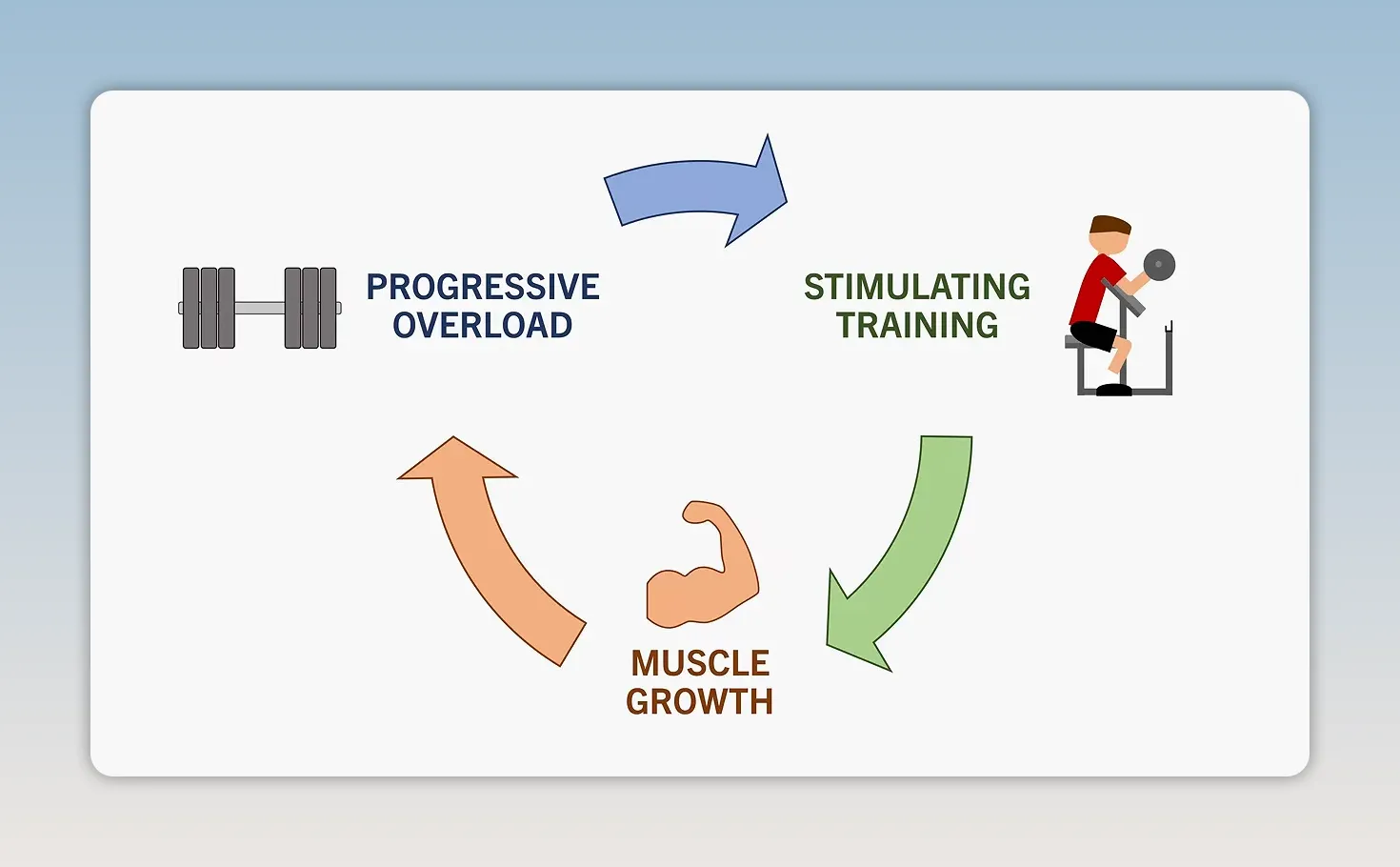
Performance improvements are useful evidence of adaptation, rather than a number we should force upward regardless of how we achieve it.
Progressive Overload for Beginners: Linear Progression
Beginners have the potential to build muscle at the fastest rate because resistance training is a new stimulus. A wide variety of resistance-training approaches can produce noticeable growth, even when they do not provide the most effective possible hypertrophic stimulus.
Beginners also do not need to train especially close to muscular failure to grow. In practice, they may not yet have the technical skill, coordination, or neuromuscular capacity to push a muscle close to its true limit.
For these lifters, progressive overload serves two purposes: it increases the training challenge and gradually develops the ability to train closer to failure.
How Linear Progression Works
Because improvements occur relatively quickly, beginners can often increase reps or load each time they repeat the same workout, commonly from one week to the next. This approach is called linear progression.
In many cases, some form of progression is possible across all sets and exercises in the workout. The rate of improvement can also be predictable enough to plan several weeks of target reps and loads in advance.
These targets still need to represent genuine progression. Adding weight while allowing technique to deteriorate does not satisfy the same purpose.
Example: Eight Weeks of Seated Cable Rows
A beginner’s seated cable row progression might look like this:
- Week 1: 3 sets of 8 reps with 30 kg.
- Week 2: 3 sets of 9 reps with 30 kg.
- Week 3: 3 sets of 10 reps with 30 kg.
- Week 4: 3 sets of 11 reps with 30 kg.
- Week 5: 3 sets of 12 reps with 30 kg.
- Week 6: Increase to 32.5 kg and perform 3 sets of 10 reps.
- Week 7: 3 sets of 11 reps with 32.5 kg.
- Week 8: 3 sets of 12 reps with 32.5 kg.
The exact numbers are illustrative. The important feature is that reps or load increase regularly while the exercise remains comparable.
Progressive Overload for Intermediate Lifters: Double Progression
Intermediate lifters generally have better movement competency and can train their muscles closer to true muscular failure. Coordination, technique, and neuromuscular efficiency are less likely to end a set before the target muscles are sufficiently challenged.
However, resistance training is no longer a novel stimulus, so muscle growth and performance improvements occur more slowly.
At this stage, expecting to add reps or load to every set each week is usually unrealistic. Progress becomes smaller and more incremental, and its timing is harder to predict.
A double progression model allows improvement to happen at the lifter’s individual rate.
How to Use Double Progression
- Choose a target rep range for the exercise.
- Select an appropriate load that allows you to complete at least the lower end of the range with the intended effort and technique.
- Keep the load consistent while gradually increasing reps across your sets.
- Reach the top of the range on all sets before increasing the load.
- Add the smallest available weight increment and allow reps to return toward the bottom of the range.
- Repeat the process without predetermining how quickly each improvement must occur.
Example: Bench Press in a 6 to 10 Rep Range
Suppose you bench press 50 kg for three sets, stopping each set with one rep in reserve. This means you estimate that you could complete one more rep before reaching muscular failure.
Your first several weeks might progress as follows, with each number representing one set:
- Week 1: 8, 7, and 6 reps.
- Week 2: 9, 7, and 6 reps.
- Week 3: 9, 8, and 6 reps.
- Week 4: 9, 8, and 7 reps.
- Week 5: 10, 8, and 7 reps.
You then continue building reps at 50 kg until you can perform 10, 10, and 10 at the same intended effort level.
At that point, you might increase the load to 52.5 kg and perform three sets of six. From there, you work back toward three sets of 10 before increasing the load again.
Unlike beginner linear progression, you are not expecting every set to improve at once. An additional rep on just one set can represent meaningful progress.
Progressive Overload for Advanced Lifters: Prioritize the Stimulus
Advanced lifters take much longer to build noticeable amounts of muscle and demonstrate clear performance improvements. This makes short-term lifting performance a less reliable indicator of muscle growth.
The issue is the size of the expected improvement relative to normal variability. Small changes in technique, mental effort, rest periods, and daily readiness can affect performance more than the actual improvement we would expect over a week.
In other words, the normal fluctuation in performance can be larger than the underlying gain.
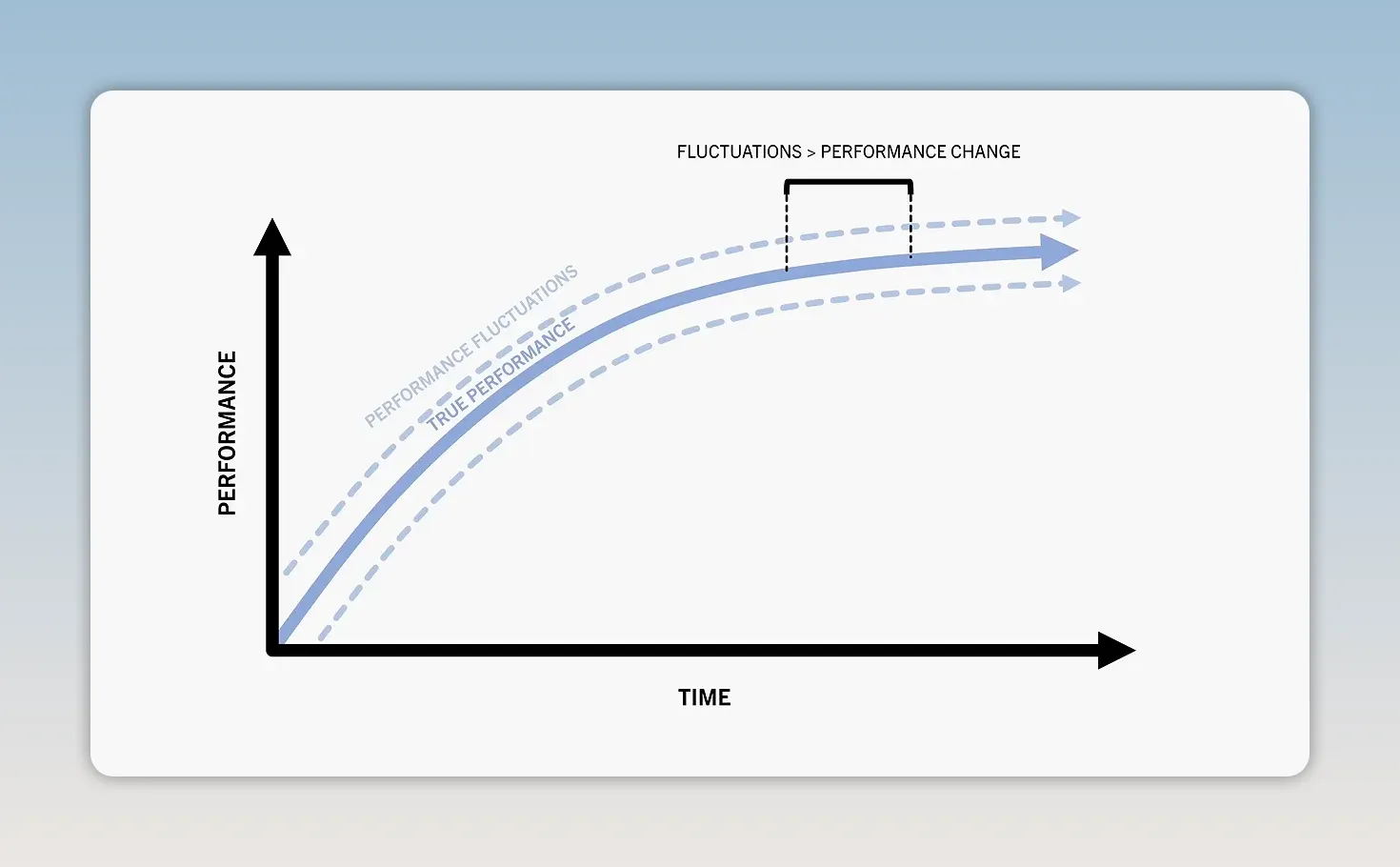
A detectable trend may take multiple months, and in some cases years, to emerge. That does not mean performance becomes irrelevant. It means that individual sessions need to be interpreted with more caution.
Make Effective Training the Priority
For advanced lifters, progressive overload becomes more integrated into the training process itself. Rather than demanding a predetermined performance increase, we aim to provide an effective stimulus and allow performance to reflect our current capacity.
The priorities are to:
- Perform sufficient training volume.
- Take working sets close to muscular failure.
- Maintain effective exercise technique.
- Use appropriate exercises for the muscles being trained.
If performance improves over time under comparable conditions, that is useful evidence that training is likely producing muscle growth. But a lack of improvement from one week to the next is not enough to conclude that the program has stopped working.
Do Not Force Progress by Compromising Technique
Tracking performance can become counterproductive when the desire to beat a previous number starts dictating changes that reduce training quality.
For example, shortening your range of motion or adding external momentum might help you complete another rep or two. But those extra reps do not demonstrate improved performance of the same task.
They also do not necessarily provide a better hypertrophic stimulus. In some circumstances, changing technique to lift more may reduce the stimulus or increase joint stress.
This is not an argument against trying to improve. Advanced lifters should still aim to increase reps and load over time. The distinction is that those increases should not come at the expense of the variables that make the exercise effective.
Match Your Progression Strategy to Your Training Experience
The principle of progressive overload does not change, but realistic expectations do.
- Beginners: Use a simple linear progression model while regular increases in reps or load remain achievable.
- Intermediate lifters: Use double progression to accumulate smaller improvements within a target rep range before adding weight.
- Advanced lifters: Prioritize a high-quality hypertrophic stimulus and assess performance over longer periods.
Across every stage, the same rule applies: make training progressively more demanding without changing the task simply to record a better number. The quality of the stimulus matters more than the appearance of progress.
|