Calories in versus calories out is often presented as a simple explanation for body weight change. Consume more energy than we expend, and weight increases. Expend more than we consume, and weight decreases.
From a fundamental energetics perspective, this is true. But that does not mean we can precisely predict weight change by entering a few numbers into a calculator.
Energy balance is a valid principle. Accurately measuring and predicting both sides of that balance is the difficult part. Food absorption, digestion, daily movement, and the body's response to exercise all influence the result. Meanwhile, changes in water retention can make the scale appear to contradict what we would expect.
Key Takeaways
- Energy balance governs long-term tissue changes, but daily scale weight also reflects fluid fluctuations.
- Food absorption and digestion costs vary, so equal calorie totals can produce different net energy outcomes.
- Exercise may increase daily expenditure by less than expected because of energy compensation.
- Average body weight trends over weeks and months help identify maintenance, a deficit, or a surplus.
Table of Contents
- Why Energy Balance Determines Long-Term Weight Change
- Tissue Weight and Water Weight Are Not the Same Thing
- Calories In: We Do Not Absorb Every Calorie We Eat
- The Thermic Effect of Food: Digestion Uses Energy Too
- Calories Out: The Three Main Components of Energy Expenditure
- Exercise Energy Compensation: More Exercise Is Not Always Fully Additive
- How to Tell Whether You Are in a Deficit, Surplus, or Maintenance
- The Bottom Line
Why Energy Balance Determines Long-Term Weight Change
Our tissues contain stored energy. They are also alive and functioning, which means they require a continuous energy supply to maintain themselves and carry out their biological roles.
That energy comes from the food and drinks we consume. As described by the first law of thermodynamics, energy cannot be created or destroyed. It can only be transformed from one form into another.
If our diet does not provide enough energy to meet the body's requirements, the difference must come from somewhere. The body draws on its own stores, including glycogen and body fat, to supply the missing energy.
When this continues over an extended period, stored tissue energy decreases and we lose tissue mass. In simple terms, the body uses some of itself for fuel.
The opposite occurs when we consume more energy than we require. The excess can be stored for later use, generally as glycogen and body fat.
- Calorie deficit: Energy expenditure exceeds energy intake.
- Calorie surplus: Energy intake exceeds energy expenditure.
- Maintenance: Energy intake and expenditure are approximately balanced over time.
The important distinction is that this describes changes in stored tissue energy over time, not every change we see on the scale from one morning to the next.
Tissue Weight and Water Weight Are Not the Same Thing
All tissues contain water because our cells contain fluid. However, the amount of fluid outside our cells, known as extracellular fluid, can also fluctuate.
These changes affect body weight without representing a corresponding change in stored energy. Water has no caloric value, so retaining more water does not mean we have stored more body fat.
For example, we could be in a calorie deficit today and still weigh more tomorrow because of a change in fluid retention.
Factors that influence fluid retention include:
- Water intake
- Sodium intake
- Carbohydrate intake
- Hormonal activity
- Exercise
Day-to-day fluctuations can be around 1 to 2 kg. That is enough to obscure the relatively small amount of tissue change occurring over a short period.
A single weigh-in cannot reliably tell us whether we are in a calorie deficit or surplus. Average body weight trends across multiple weeks and months provide a much clearer picture than individual daily readings.
Calories In: We Do Not Absorb Every Calorie We Eat
The amount of food energy we consume is the main influence on energy intake. However, the energy contained in food is not necessarily identical to the energy our body absorbs from it.
Some food passes through the digestive tract without all of its nutrients and energy being extracted. That unabsorbed energy is eventually excreted.
As a general estimate, around 90% to 97% of dietary energy is absorbed. To illustrate the scale of this, a diet containing approximately 2,500 calories might supply roughly 2,300 to 2,400 absorbed calories, depending on the foods involved. These are approximate figures, not a precise conversion rule.
Food Type and Preparation Affect Energy Availability
Absorption varies with the foods we eat and how they are prepared.
- Whole foods generally have lower energy availability than highly processed foods.
- Highly processed foods generally allow more of their energy to be extracted.
- Cooking can increase the energy available from food compared with its raw form.
This means two diets with the same calculated calorie content may not provide exactly the same amount of absorbed energy.
These differences do not invalidate calories in versus calories out. They explain why a simple calculation may not capture the actual energy entering the body.
The Thermic Effect of Food: Digestion Uses Energy Too
Absorbing food is not the end of the process. It also takes energy to digest, absorb, and store the nutrients we consume.
This temporary increase in energy expenditure is called the thermic effect of food, or TEF. Although it helps explain why the net energy available from a meal differs from its calorie content, TEF belongs on the expenditure side of the energy balance equation.
Protein Has the Highest Thermic Effect
The energy cost of processing food differs between macronutrients:
- Protein: Approximately 20% to 30% of its energy value.
- Carbohydrate: Approximately 5% to 10% of its energy value.
- Fat: Approximately 0% to 3% of its energy value.
As a result, a higher-protein diet generally requires more energy to process than a higher-fat diet, even when both contain the same total calories.
Consider two illustrative 2,500-calorie diets. One is higher in protein and lower in fat. The other is lower in protein and higher in fat, with moderate carbohydrate intake in both.
Using estimated thermic effects for each macronutrient, the example produces a difference of about 81 calories per day in the energy required to process the diets. Equal calorie intake does not necessarily mean equal digestion-related expenditure.
Less Processed Foods Can Require More Energy to Digest
The degree of processing can also influence the thermic effect of a meal. Highly processed foods appear to require less digestive work because some of that processing has already occurred before we eat them.
A study comparing less and more processed meals examined this in 17 healthy adults. Participants consumed cheese sandwiches made with either:
- The less processed meal: Multigrain bread and cheddar cheese.
- The more processed meal: White bread and processed cheese.
During the following six hours, energy expenditure rose further above baseline after the less processed meal. The total difference between the meals was approximately 64 calories.
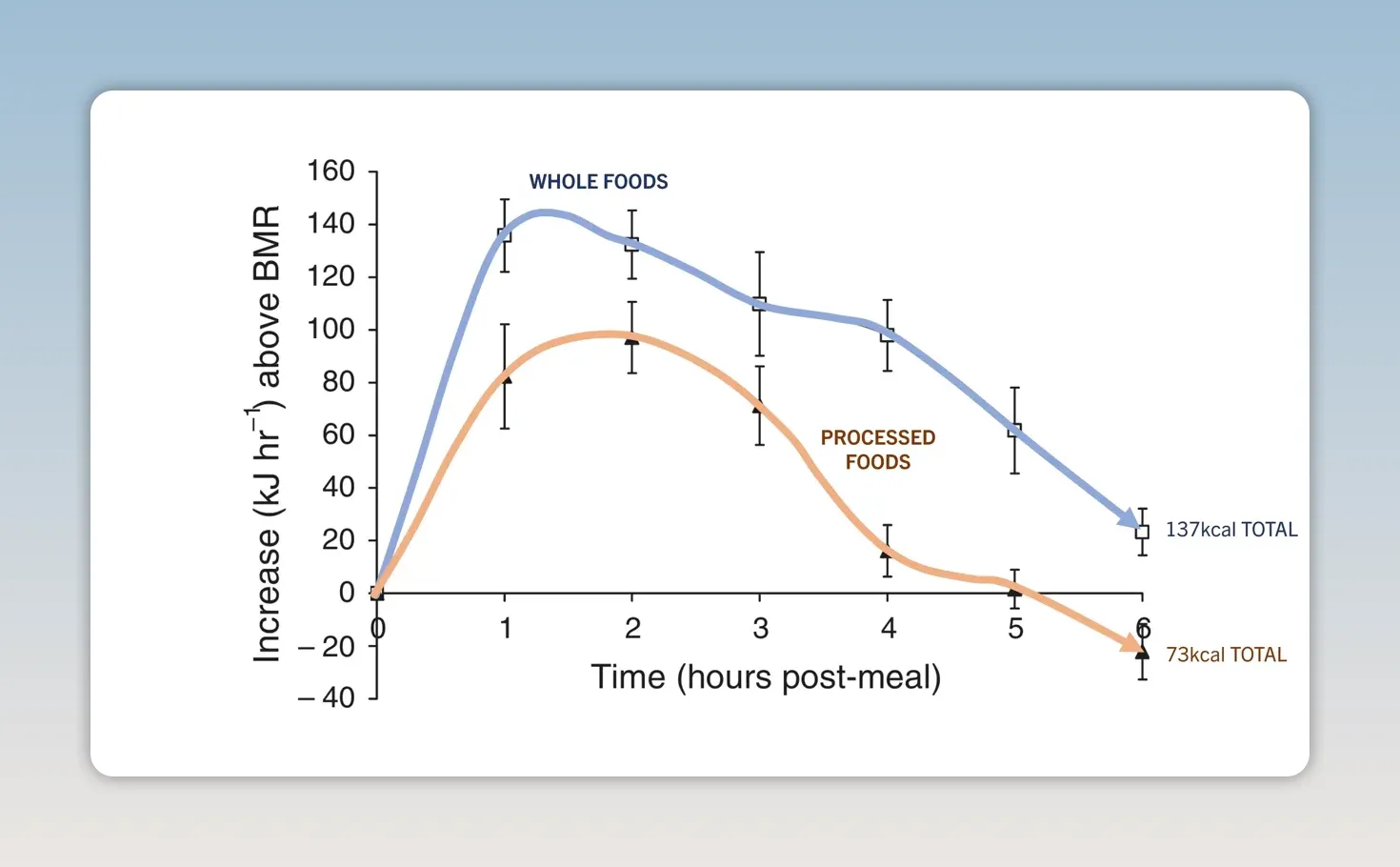
The practical point is not that these differences are enormous. It is that absorption and digestion can create modest differences between diets that appear equivalent on paper. Across substantially different diets, differences on the order of 100 calories or so are possible, and small differences can matter over time.
Calories Out: The Three Main Components of Energy Expenditure
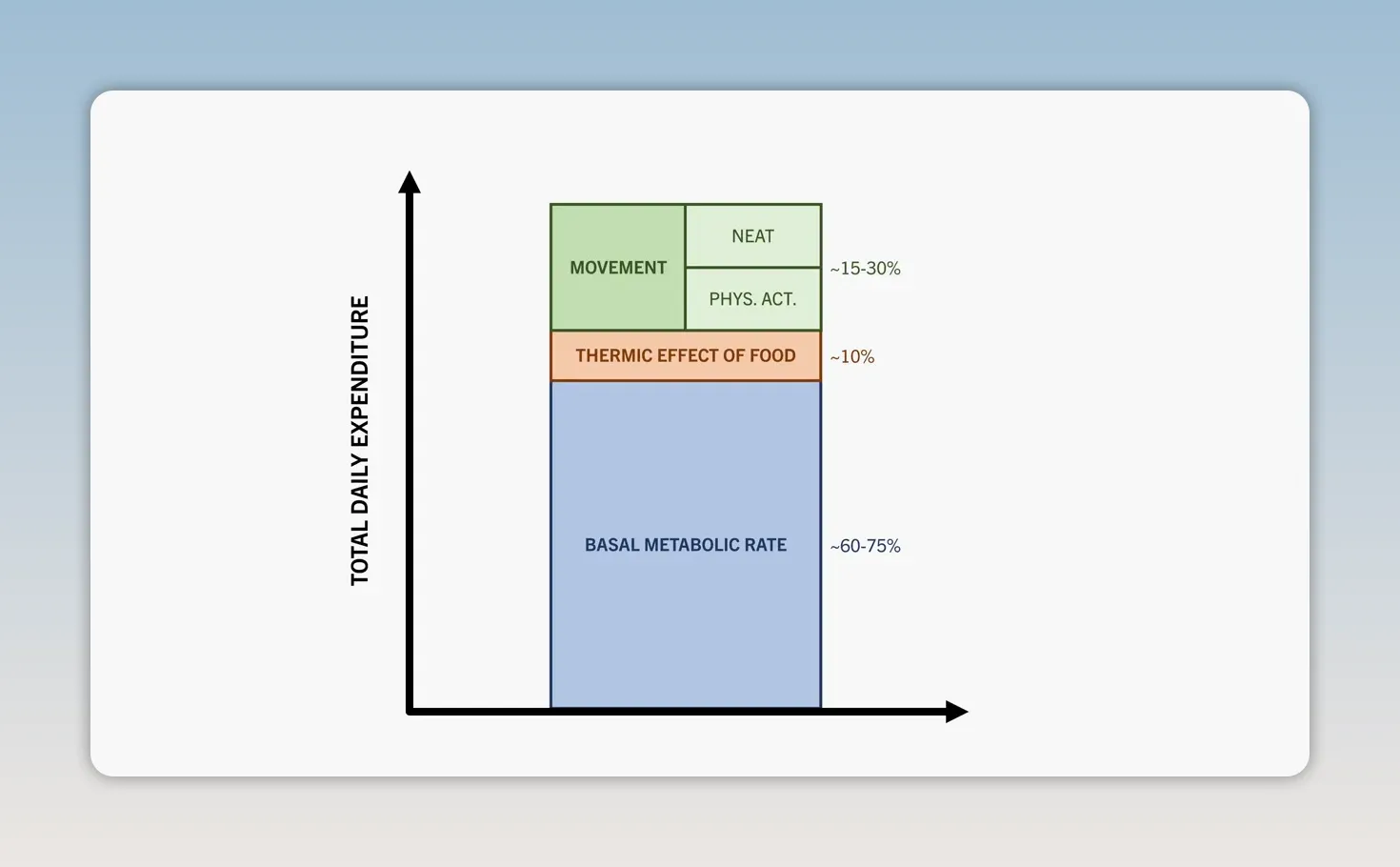
Calories out refers to total daily energy expenditure, not simply the calories burned during a workout. It consists of three main components: basal metabolic rate, the thermic effect of food, and movement.
1. Basal Metabolic Rate
Basal metabolic rate, or BMR, is the energy required to support essential biological functions. These include breathing, the heartbeat, hormone regulation, reproductive functions, and immune function.
A useful way to think about BMR is the energy we would require if we lay still in bed for 24 hours. Even without deliberate movement, the body has substantial energy needs.
BMR typically makes up approximately 60% to 75% of total daily energy expenditure, making it the largest component for most people.
Body size is a major influence. Heavier individuals generally expend more energy at rest because they have more tissue to support. Body composition also matters: at the same body weight, someone with a greater proportion of lean mass will typically have a somewhat higher BMR.
2. The Thermic Effect of Food
The thermic effect of food usually contributes around 10% of total daily energy expenditure, although this varies with the amount and types of food consumed.
Eating more total food generally increases the total energy required to process it. Diet composition matters too, with higher-protein and less processed diets generally requiring more energy to digest than higher-fat and more processed diets.
3. Movement
Movement includes far more than structured exercise. We can separate it into three useful categories:
- Subconscious movement: Small movements such as fidgeting, hand gestures, and head movements, which contribute to non-exercise activity thermogenesis, or NEAT.
- Consequential physical activity: Movement performed as part of daily life rather than specifically for exercise, such as walking around the supermarket or doing manual work.
- Intentional exercise: Planned sessions such as running or weight training.
Movement commonly contributes around 15% to 30% of daily energy expenditure. However, this component varies considerably between people. A highly active person can expend substantially more energy through movement than someone who is mostly sedentary.
This is why exercise calories alone cannot tell us a person's total daily expenditure. What happens during the rest of the day matters too.
Exercise Energy Compensation: More Exercise Is Not Always Fully Additive
It is tempting to assume that adding exercise increases total daily expenditure by exactly the number of calories used during the session.
That is an additive model: all other expenditure stays the same, and exercise simply goes on top.
Exercise energy compensation describes the possibility that an increase in exercise is partly offset by a reduction in other forms of expenditure. Under this model, total daily expenditure still rises, but by less than a straightforward calculation would predict.
Research on constrained total energy expenditure provides context for this idea. However, the circumstances, mechanisms, and magnitude of compensation are not entirely clear.
Where Might Compensation Come From?
One possibility is that we move less outside our exercise sessions. After a demanding workout, we might spend more time sitting on the couch or make fewer subconscious movements such as fidgeting.
Another proposed mechanism is a reduction in metabolic expenditure elsewhere in the body as a way to conserve energy. These are possible explanations, rather than a complete account of what happens in every person.
An analysis of energy expenditure data from more than 1,700 adults estimated average compensation at approximately 28%. In that analysis, around 72% of activity-related energy expenditure translated into additional total daily expenditure.
This should not be treated as a universal correction factor for every workout. It is an average estimate from a dataset, not a precise prediction of an individual's response.
The most reasonable conclusions are:
- More physical activity will likely increase total daily energy expenditure.
- Some compensation appears to occur in certain circumstances.
- The additional expenditure may be smaller than a simple additive calculation suggests.
- Exactly when compensation occurs, and by how much, remains uncertain.
How to Tell Whether You Are in a Deficit, Surplus, or Maintenance
With all these interacting factors, calculating energy balance precisely becomes difficult. Fortunately, assessing the overall result is much simpler.
Look at average body weight trends over multiple weeks and months. The trend reflects the combined outcome of food intake, absorption, digestion, resting expenditure, movement, and any compensation occurring.
- Average weight remains stable: We are approximately at maintenance.
- Average weight increases: We are generally in a calorie surplus.
- Average weight decreases: We are generally in a calorie deficit.
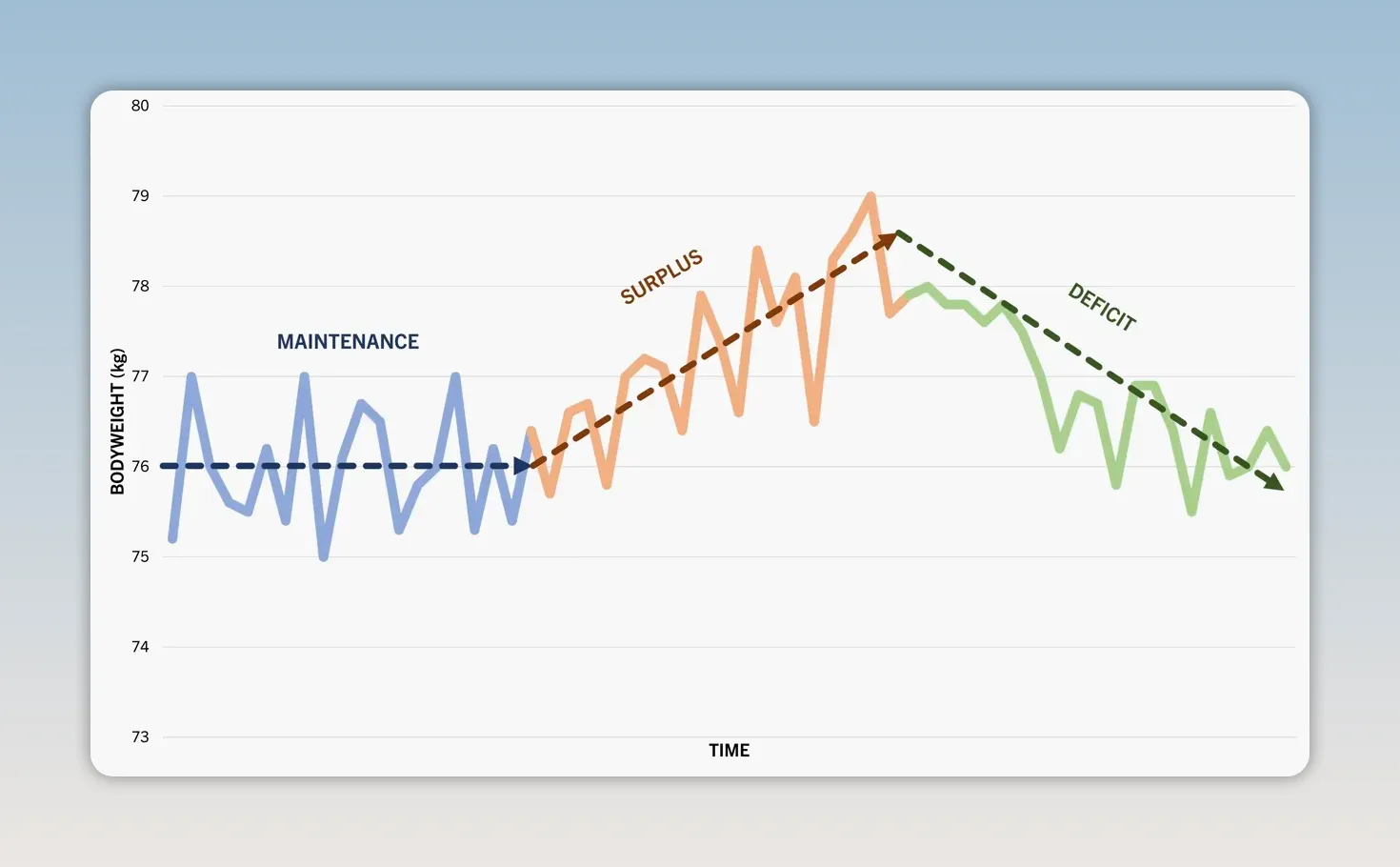
The emphasis is on the average direction over time. A temporary increase in scale weight does not cancel out a deficit, just as a temporary decrease does not prove that our current approach is producing sustained tissue loss.
Once the trend is clear, we can adjust diet and exercise behaviors to move toward the energy balance state we want.
The Bottom Line
Calories in versus calories out does determine changes in stored body energy. But it is a biological principle, not a perfectly predictable calculation based on food totals and exercise estimates.
We do not absorb all the energy contained in food. Different meals require different amounts of energy to process. Daily expenditure includes essential biological functions and everyday movement, not just workouts. Exercise may also cause compensatory changes elsewhere in the system.
None of this overturns energy balance. It explains why the numbers can be difficult to predict.
Use long-term average body weight trends to assess the result, then adjust your behaviors accordingly. That is more useful than expecting every daily weigh-in to match a calculator.
|