Our bodies begin adapting almost as soon as we start exercising. But that is not quite the same as seeing a change in the mirror or lifting noticeably more weight.
How long gym results take depends on which result we mean. Muscle growth, fat loss, and strength gains all follow slightly different timelines. Training experience also matters, particularly when we are trying to build more muscle or become stronger.
As a general guide, beginners may notice strength gains within about one week, visible fat loss within roughly one month, and some visual muscle growth within one to two months. These are useful expectations, rather than deadlines. Here is what sits behind each timeline.
Key Takeaways
- Beginners can often measure strength gains within one week, before visible physique changes develop.
- Visible muscle growth may appear within one to two months, while major changes usually require years.
- Noticeable fat loss often takes about one month at an appropriate rate of weight loss.
- Muscle and strength gains generally slow with experience, unlike fat loss at a comparable relative deficit.
Table of Contents
- Muscle Growth: Expect Small Changes Before Major Physique Changes
- Fat Loss: Noticeable Changes Can Happen Within About a Month
- Strength Gains: Often Measurable Within the First Week
- Set Expectations Around the Result You Want
Muscle Growth: Expect Small Changes Before Major Physique Changes
The processes that support muscle growth begin early in a resistance training routine. However, the actual increase in muscle size over a few weeks is small. We are generally talking about millimeters of additional muscle thickness, not a dramatic transformation.
Of the three outcomes, noticeable muscle growth is probably the slowest.
What six months of muscle growth can look like
A 24-week bench press study provides a useful example. Seven untrained men performed bench press training three times per week, progressively increasing the loads they used.
Over the study, pectoralis major muscle thickness increased progressively:
- On average, the increase was approximately 1 mm every three weeks.
- The total increase over 24 weeks was around 9 mm.
- Relative to the starting measurement, this represented approximately a 43% increase in muscle thickness.
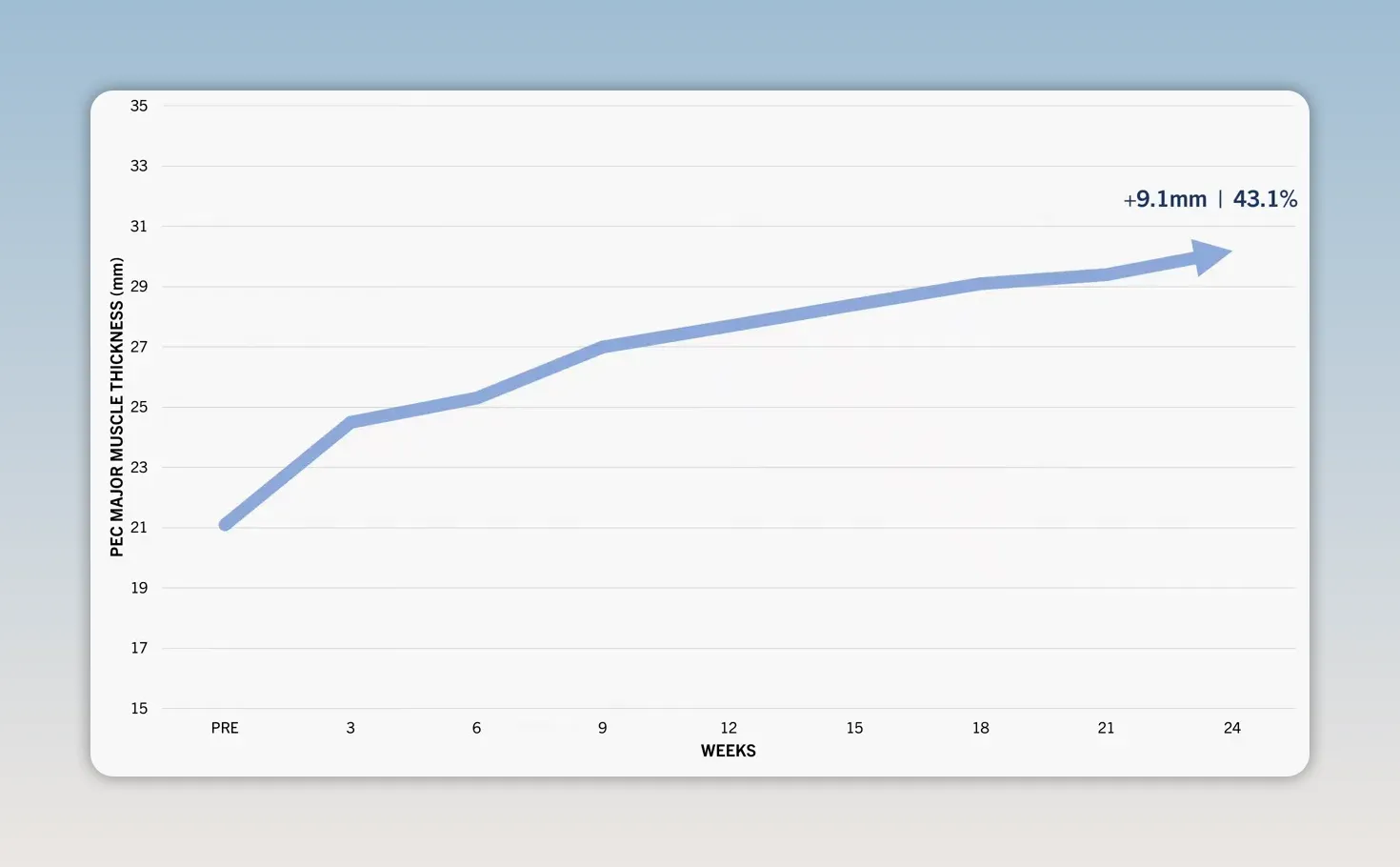
A 43% increase sounds substantial, and it is a large relative change. But that does not mean the entire chest looks 43% bigger. This is a measurement of thickness at a particular muscle, not a measurement of overall visual appearance.
Exactly how an extra 9 mm of chest muscle thickness looks will differ between individuals. On a relatively lean physique with some existing muscular development, that additional thickness may be noticeable. With more body fat covering the muscle, the same growth may be less obvious.
Measurable muscle growth and visible muscle growth are related, but they are not interchangeable.
Why muscle growth slows with experience
Muscle growth generally follows a pattern of diminishing returns. With other factors held equal, we would expect to gain more muscle in our first year of training than in our tenth.
That does not mean everyone's progress follows a perfectly smooth curve. In practice, our training and diet rarely remain unchanged for years. We accumulate knowledge, change goals, deal with injuries, and adjust to different life circumstances.
As a result, real progress often comes in periods of faster growth and slower growth. Improving a previously ineffective routine can change the trajectory. Nevertheless, the general principle remains: the more muscle we have already built, the longer additional noticeable growth usually takes.
A realistic muscle growth timeline
For someone starting resistance training, a rough sequence might be:
- First one to two months: Some visual muscle growth may become noticeable.
- Another two to four months: Further noticeable changes may develop.
- Another four to eight months: Additional visible growth may require a longer period again.
These progressively longer intervals illustrate diminishing returns. They are not a precise formula for predicting an individual's progress.
For major physique changes driven by muscle growth, two to three years of consistent training is a more realistic expectation for most people. At an advanced level, additional visual growth can be subtle enough that it is difficult to notice even across multiple years.
Fat Loss: Noticeable Changes Can Happen Within About a Month
The aim of a fat loss phase is to lose body weight while retaining as much lean mass as possible, so that most of the tissue lost comes from body fat.
Compared with building muscle, fat loss can happen much faster and often produces a larger short-term change in appearance. The timeline depends largely on the rate of weight loss.
A faster rate generally produces earlier visual changes. A slower rate means those changes take longer to accumulate. However, the fastest possible approach is not necessarily the most appropriate one.
Choose an appropriate rate of weight loss
Extreme calorie deficits can produce changes over very short periods, potentially within days. That is not a useful target for most people. Very rapid weight loss is generally not recommended because of the longer-term behavioral and psychological difficulties it can create.
For most people in most circumstances, I would suggest losing no more than around 1% of body weight per week. That is an upper guideline, not a rate everyone needs to pursue.
A more moderate example is losing approximately 0.5% of body weight per week while continuing resistance training to help retain lean mass.
Over about 10 weeks, that would amount to roughly 5% of total body weight. If most of that loss comes from fat, we would generally expect a noticeable difference in appearance.
What a 5% weight loss might look like
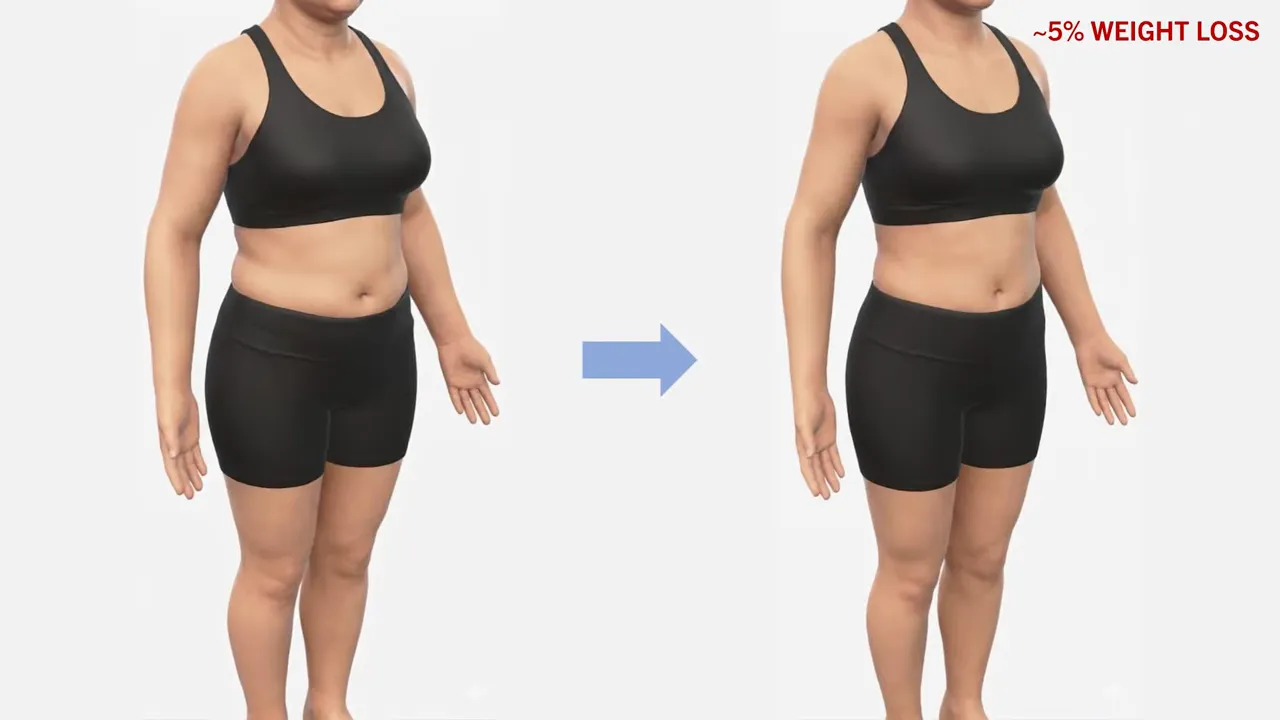
Consider a man starting at around 20% body fat or a woman starting at around 30% body fat. Losing approximately 5% of total body weight, primarily from fat, could create a clear visual change in either case.
The generated comparison below illustrates the female example. It is an illustration of a possible change, not a measured result or a prediction of exactly how someone will look.
Does fat loss take longer for advanced lifters?
Fat loss does not follow the same training-experience-related diminishing returns as muscle growth. An advanced lifter does not automatically need longer to lose fat simply because they have spent more years in the gym.
Assuming a comparable relative calorie deficit and rate of weight loss, a beginner and an advanced trainee can lose fat over similar time frames.
With a sensible approach, around one month is often enough to notice some visual fat loss. If a similar rate of loss continues, further noticeable changes can accumulate over subsequent months. The useful comparison is the sustained rate of loss, rather than how experienced someone is at lifting.
Strength Gains: Often Measurable Within the First Week
Strength gains are usually the fastest of these three outcomes to detect. A complete beginner may demonstrate an improvement the next time they repeat an exercise after their first workout.
That improvement might mean:
- Performing more repetitions with the same weight.
- Lifting a heavier weight for the same number of repetitions.
During the early stages of training, beginners can often improve on many exercises each time they repeat the same workout, commonly from one week to the next. Strength typically continues improving rapidly over the first few months.
Why some exercises improve faster than others
The rate of improvement differs between exercises. Two relevant factors are the coordination required to perform the movement and the absolute load being lifted.
Exercises with a substantial technical learning curve offer more scope for early improvements as we become better at performing them. Movements that allow heavier absolute loads also tend to show larger increases in the amount of weight lifted.
This commonly includes compound free weight exercises such as:
- Squats.
- Bench presses.
- Overhead presses.
- Deadlifts.
By comparison, exercises with lower coordination demands or lighter absolute loads may show slower increases in the weight used. Examples include machine chest presses, leg extensions, leg curls, and chest-supported rows.
This is a difference in how strength progress can appear across exercises, not a reason to expect identical increases on every movement.
What long-term strength research shows
Like muscle growth, strength gains usually slow as we become more experienced. A long-term study of strength development examined training records from more than 14,000 adults at a private exercise company.
The trainees used a minimal-dose approach: one set of several key exercises, taken to failure in the four to six repetition range, once per week.
Across the three exercises analyzed, the same broad pattern appeared. Training loads increased rapidly during the first few weeks, then continued increasing over multiple years at a progressively slower rate.
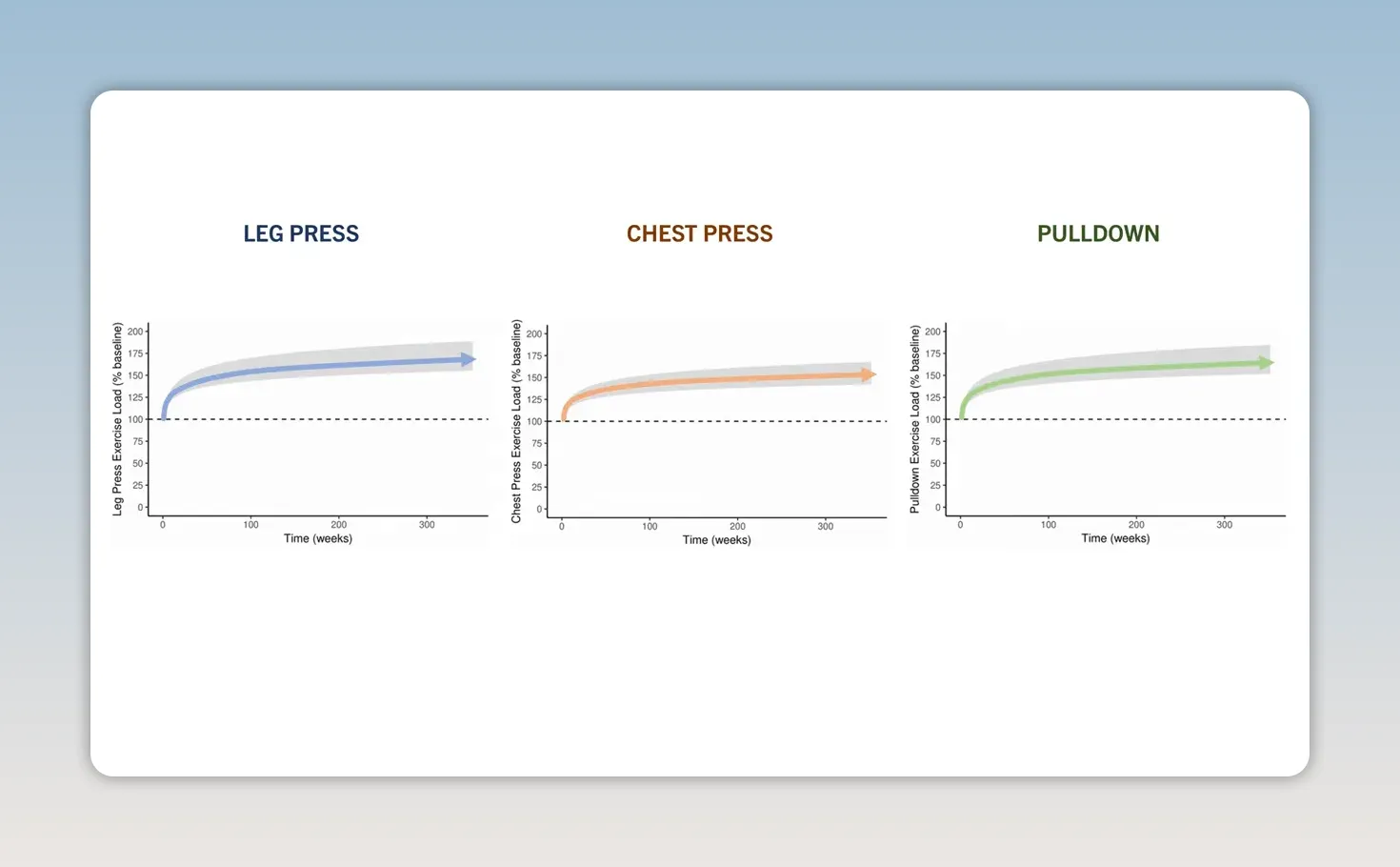
There is an important qualification here: these results came from a very low-volume, low-frequency training approach. They do not establish a fixed ceiling for how quickly someone can improve under every program.
If progress begins to stall with one set per exercise once per week, doing more sets or training more frequently may help increase the rate of strength gains.
The general expectation is still straightforward: measurable strength gains can appear within about one week for beginners, followed by rapid early progress and increasingly slower gains as training experience accumulates.
Set Expectations Around the Result You Want
There is no single timeline for gym results because getting stronger, building muscle, and losing fat are different outcomes.
Early strength improvements can appear well before a major change in physique. Fat loss can create visible changes within roughly a month when weight is being lost at an appropriate rate. Muscle growth demands more patience, particularly once the beginner stage is behind us.
The important distinction is between the first noticeable improvement and a major transformation. A few weeks may be enough to establish measurable progress. Building a substantially more muscular physique is usually a project measured in years.
|