Lifting technique can make a large difference to how much weight you move. But does the technique that lets you lift the most weight also produce the most muscle growth?
Not necessarily. Strength, hypertrophy, and fatigue give us three different ways to evaluate technique. A technique that improves performance on a competition lift may not be the best choice for an accessory exercise. Similarly, a lighter load does not automatically mean a smaller muscle-building stimulus.
The useful question is not whether a technique is universally good or bad. It is whether that technique serves the purpose of the exercise.
Key Takeaways
- For strength performance, use the technique that maximizes your lift within the applicable rules.
- For hypertrophy, prioritize challenging the target muscle rather than maximizing the external load.
- Including lengthened positions and controlling eccentrics may offer modest muscle-growth advantages.
- Avoid technique choices that add unnecessary fatigue without improving the hypertrophic stimulus.
Table of Contents
- Lifting Technique for Strength: Maximize Performance Within the Rules
- Lifting Technique for Hypertrophy: Prioritize the Target Muscle
- How Lifting Technique Influences Fatigue
- Practical Recommendations: Match Technique to the Exercise’s Purpose
Lifting Technique for Strength: Maximize Performance Within the Rules
When the goal is strength performance, the principle is fairly straightforward: use the technique that allows you to lift the most weight within the constraints of a valid lift.
For example, a low-bar, powerlifting-style squat will usually allow heavier loads than a high-bar squat performed with a more upright torso and greater depth. If the outcome we care about is the weight lifted, that mechanical advantage matters.
However, performance only means something within a defined set of rules. Each strength sport and federation establishes its own criteria for acceptable technique.
For the bench press, requirements outlined in the 2024 IPF technical rules include touching the chest with the bar, remaining motionless until the press command, and pressing to fully extended elbows. The feet must remain flat on the ground, and the buttocks must stay in contact with the bench. These are examples of the constraints that shape competition technique, rather than an exhaustive rules checklist.
The same principle explains why kipping pull-ups are used in CrossFit events that permit them. They allow more repetitions to be completed efficiently than strict pull-ups. The movement is being optimized for the task and its rules.
If you train for general strength without competing, you can choose your own technique constraints. Within those constraints, a mechanically efficient technique allows you to:
- Lift the heaviest weight for a given number of repetitions.
- Perform the most repetitions with a given submaximal load.
Competition lifts and accessory lifts have different jobs
This performance-focused approach applies to the lifts on which you want to demonstrate strength. It does not automatically apply to every exercise in your program.
If improving the bench press is your goal, it makes sense to develop a bench press technique that allows you to lift heavy loads. But if you perform triceps pushdowns to grow the triceps and support your bench press, maximizing the number on the cable stack is not the objective.
The competition lift is about expressing strength. The accessory exercise may be about developing the muscle that contributes to it. Those purposes can justify different techniques.
Lifting Technique for Hypertrophy: Prioritize the Target Muscle
For hypertrophy, the goal shifts from moving the greatest external load to providing a strong training stimulus to the target muscle.
Technique can influence that stimulus, but the evidence is more nuanced than a simple distinction between perfect form and ineffective form. A wide variety of techniques can produce substantial muscle growth when sets are taken close to failure.
Four technique variables are particularly relevant: range of motion, repetition tempo, strictness, and adjustments intended to emphasize particular muscles or muscle regions.
Range of Motion: Include the Lengthened Position
On average, training through a larger range of motion tends to produce slightly greater muscle growth than partial-range training. This pattern appears in a systematic review and meta-analysis of full versus partial range of motion.
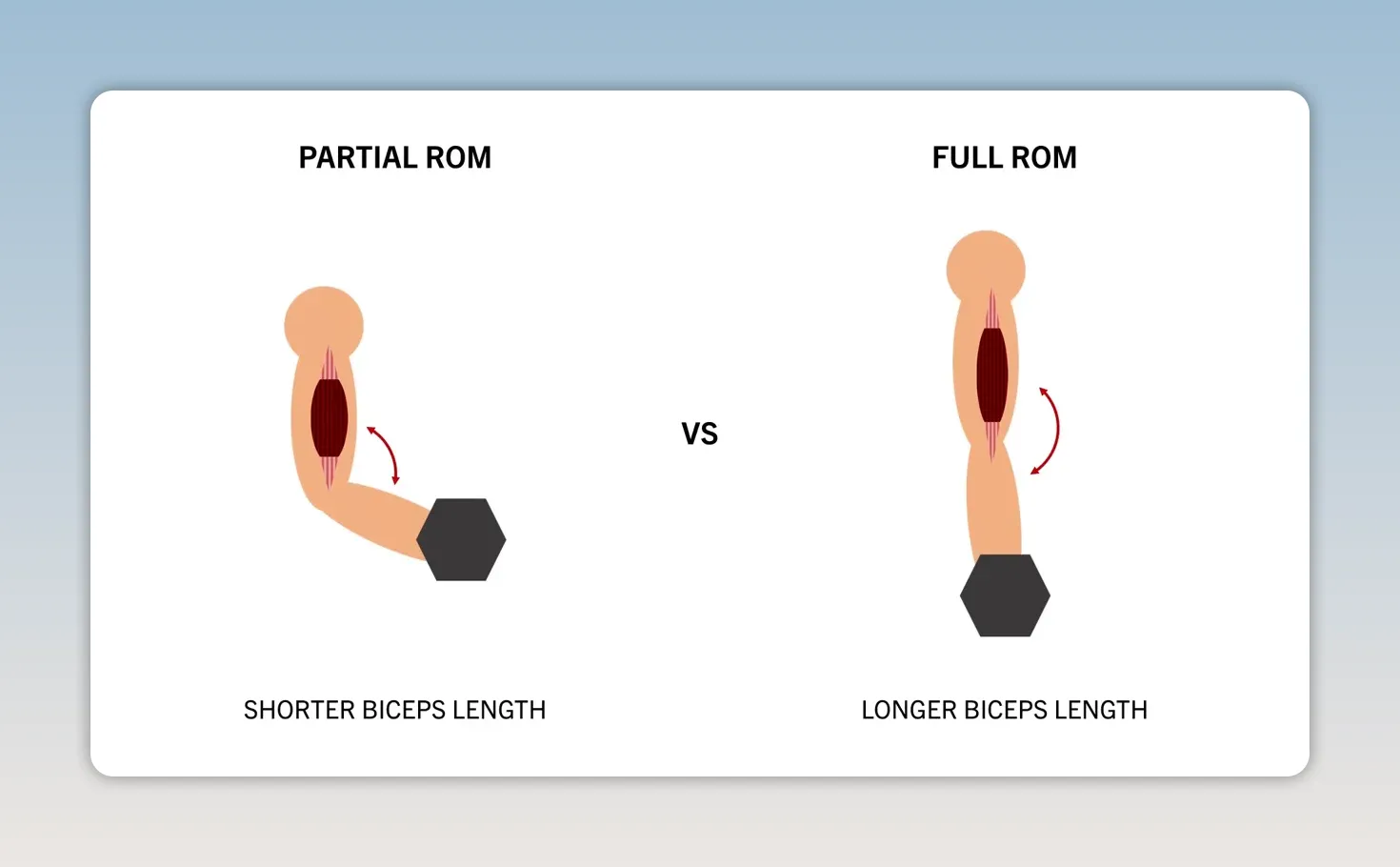
A likely explanation is that a larger range of motion often takes the target muscle into a more lengthened position.
Consider a biceps curl. Lowering the weight farther and extending the elbow lengthens the biceps more than stopping partway down. The important distinction may therefore be less about the total distance the weight travels and more about whether the muscle is trained at longer lengths.
A leg extension study illustrates this distinction. It compared four approaches:
- Partial repetitions in the lengthened portion of the exercise.
- Partial repetitions in the shortened portion.
- Full-range repetitions.
- Alternating between lengthened and shortened partial ranges.
The conditions that included the lengthened portion produced similar increases in quadriceps cross-sectional area. Training only in the shortened portion produced somewhat less growth.
The practical implication is that including the stretched portion of an exercise appears more important than simply maximizing movement distance. Full-range repetitions are one way to achieve this. Lengthened partial repetitions are another.
Lengthened Partials Can Also Extend a Set
On some exercises, reaching failure with a full range of motion does not mean you are unable to perform any more useful work. You may still be able to complete partial repetitions in the lengthened portion.
This creates an opportunity to extend a set beyond full-range failure.
In a calf raise study, participants trained one leg with full-range repetitions to failure. With the other leg, they continued performing partial repetitions after full-range failure.
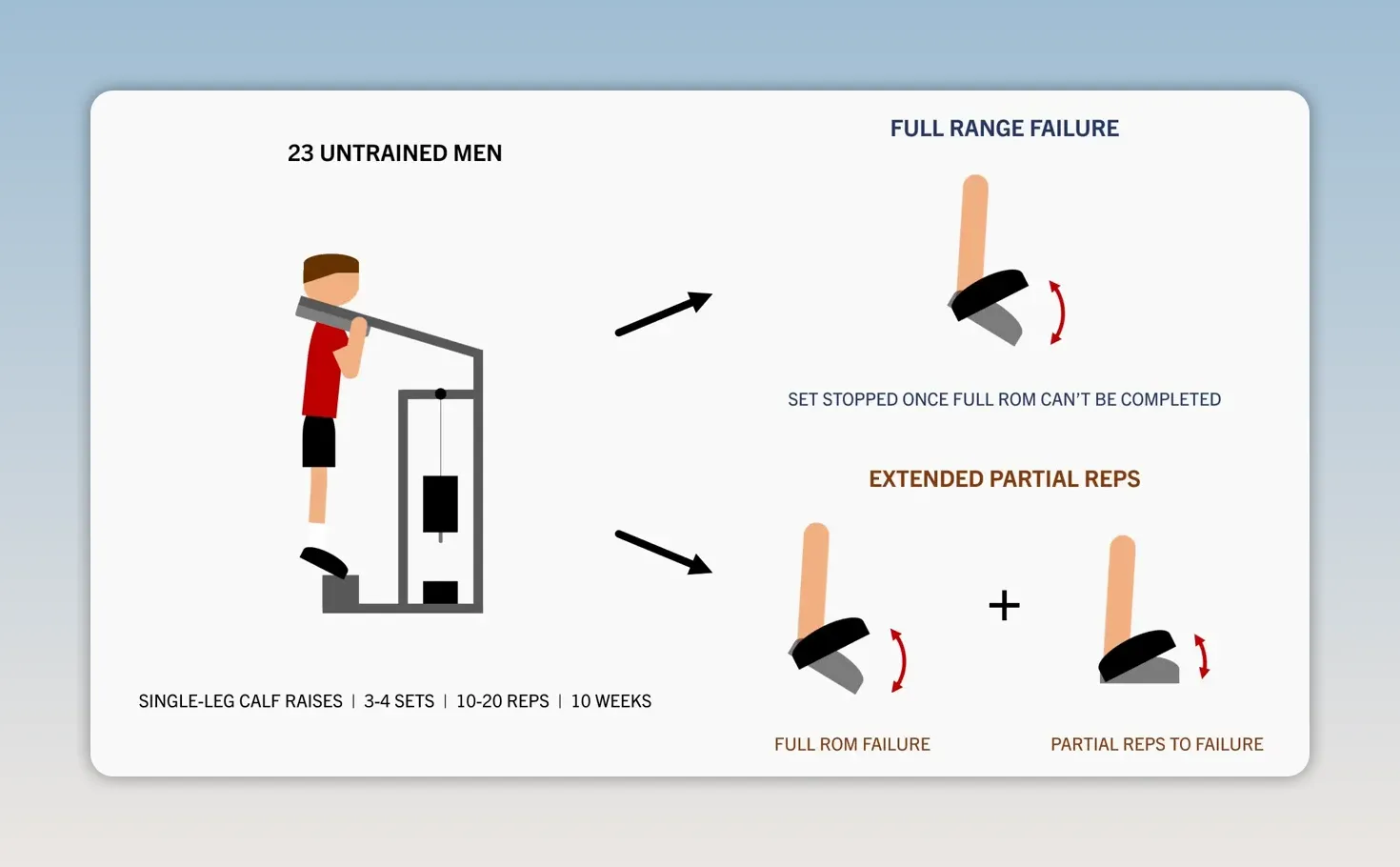
Both approaches increased gastrocnemius muscle thickness, but the extended partial-repetition condition produced slightly greater growth.
This suggests that lengthened partials may be useful both as a repetition strategy and as a way to extend certain sets. It does not establish that every exercise or every set needs to be taken beyond full-range failure.
Tempo: Separate the Lifting, Lowering, and Pausing Phases
Repetition tempo has three components:
- Concentric: the lifting phase.
- Eccentric: the lowering phase.
- Isometric: a pause or hold at a particular position.
Substantial muscle growth can occur across a variety of tempos when training is performed close to failure. However, each phase presents a slightly different question.
Concentric Tempo Becomes Less Controllable Near Failure
You can intentionally change the speed of the first few lifting phases in a set. As fatigue accumulates, however, the weight slows down regardless of how quickly you try to move it.
Eventually, you reach the point at which you cannot complete another concentric repetition.
This means that a prescribed lifting speed becomes less useful as you approach failure. You can still intend to lift quickly, but you cannot force the weight to maintain that speed once fatigue prevents it.
Slower Eccentrics May Offer a Small Advantage
The lowering phase is different. We are generally stronger eccentrically than concentrically, so we can still lower a weight under control even when we can no longer lift it.
As a result, eccentric tempo can be manipulated throughout a set. But does deliberately lowering more slowly improve hypertrophy?
The evidence is limited and not entirely conclusive, although there is a slight trend favoring slower, more controlled eccentrics:
- A preacher curl study comparing movement speeds found greater increases in biceps cross-sectional area with four-second eccentrics than with one-second eccentrics.
- A leg extension study comparing two-second and four-second eccentrics found substantial quadriceps growth with both, with marginally greater overall gains in the slower condition.
- A squat study comparing one-second and four-second eccentrics found similar overall quadriceps growth, again with a small overall advantage favoring slower lowering.
These findings do not establish four seconds as an optimal eccentric duration. They suggest that controlling the lowering phase, and perhaps slowing it slightly, may offer a small benefit.
Training close to failure remains more important than precisely timing every eccentric. Good muscle growth is possible across the tempos studied, and any advantage from slower lowering is unlikely to be dramatic.
Pauses in the Stretched Position Are Plausible, but Unproven
There is little direct evidence establishing whether adding pauses within dynamic repetitions improves muscle growth.
A reasonable hypothesis is that pausing in the stretched position could help by accumulating more time under tension at longer muscle lengths. That would be consistent with the evidence favoring training in lengthened positions.
However, a plausible explanation is not the same as a demonstrated benefit. Stretched-position pauses are something to experiment with, rather than a requirement for effective hypertrophy training. If they do provide an advantage, it may be very small.
Strictness: Is the Target Muscle Still Limiting the Set?
Strictness refers to how much movement comes from muscles and joints other than those directly targeted by the exercise.
For example, a row involving substantial hip movement is less strict than one in which movement occurs mainly through the shoulders and arms.
Direct research on strictness and hypertrophy is sparse. One study compared biceps curls and triceps pushdowns performed with strict technique against the same exercises performed with external momentum. Overall, biceps and triceps muscle thickness increased by similar amounts.
That is not enough evidence to conclude that strictness never matters. It does suggest that some additional movement does not automatically remove the muscle-building stimulus.
A useful condition is that the target muscle should still be what limits performance as the set approaches failure.
Whether extra movement helps or hurts depends on the exercise:
- Seated cable rows: allowing some forward lean may place the lats in a more stretched position and could theoretically improve the stimulus.
- Abdominal exercises: excessive movement at the hips may shift more of the work toward the hip flexors rather than the abdominal muscles you intend to train.
Rather than treating all additional movement as a mistake, evaluate what that movement does to the exercise.
Can Technique Bias Particular Muscles or Regions?
Technique adjustments are often recommended to emphasize one muscle over another. For example, leaning farther forward during a squat is commonly suggested to emphasize the glutes, while maintaining a more upright torso is suggested to emphasize the quadriceps.
Both muscles are trained across squat variations. The harder question is how much these adjustments change long-term muscle growth.
Direct evidence is limited. One relevant study compared calf raises with the feet pointed outward, inward, or forward:
- Pointing the feet outward produced greater growth in the medial gastrocnemius.
- Pointing the feet inward produced greater growth in the lateral gastrocnemius.
- Pointing the feet forward produced more evenly distributed gains between the two regions.
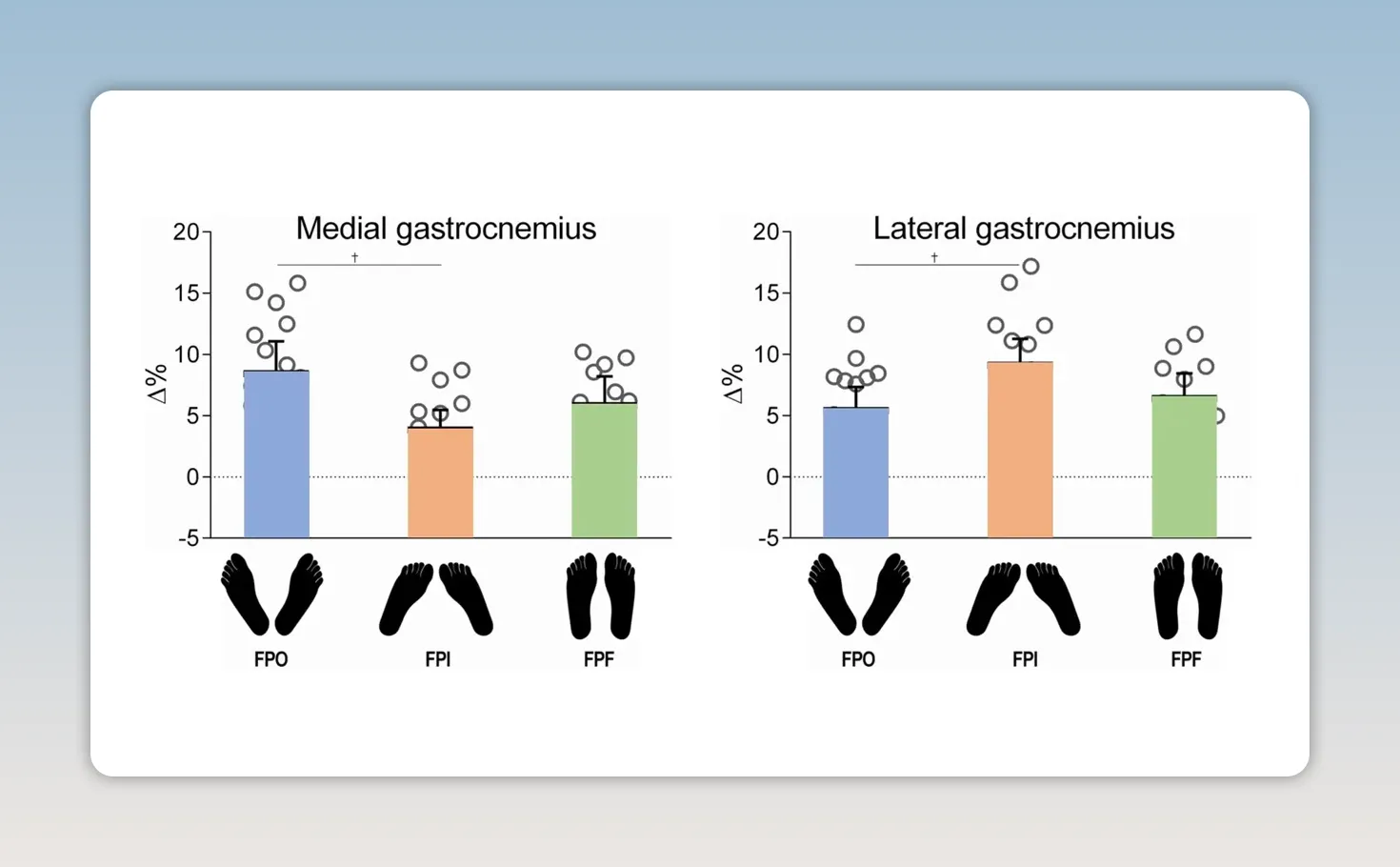
This provides some evidence that technique can influence regional hypertrophy. It does not tell us that every proposed technique adjustment produces a meaningful growth difference.
For other exercises, functional anatomy can help guide experimentation. During a row, pulling lower toward the hip with a more flexed spinal position could theoretically emphasize the lats by emphasizing shoulder extension. Pulling higher with more flared elbows and a more extended spinal position could theoretically emphasize the midback through greater shoulder horizontal extension.
I think these adjustments are worth experimenting with when you want to emphasize a particular area. Just keep the certainty and likely magnitude of the benefit in perspective. Anatomical reasoning is useful, but the actual difference in muscle growth remains unclear.
How Lifting Technique Influences Fatigue
Even when two techniques produce similar muscle growth, they may come with different fatigue costs.
A major reason is that technique changes how much external load you can lift. In general, heavier loads become possible with:
- More mechanically efficient positions.
- A shorter range of motion.
- A faster repetition tempo.
- More external momentum.
A larger range of motion, slower tempo, and less momentum usually reduce the load you can use. For hypertrophy, that reduction is not necessarily a disadvantage.
For example, a study comparing full-depth and partial squats found that the partial-squat group used heavier average loads. Nevertheless, the deep-squat group experienced slightly greater overall lower-body muscle growth despite using lighter weights.
The extra load did not automatically translate into a better hypertrophic stimulus.
Three Potential Costs of Heavier Loading
Using heavier external loads can increase the demands of training in several ways.
- Greater joint and connective tissue stress. This may increase the likelihood of pain or irritation, particularly when the additional loading is not providing a useful benefit.
- Greater cardiorespiratory demand and perceived effort. The overall difficulty of a set may make it harder to continue until the target muscle is as close to failure as intended.
- Longer recovery between sets. Greater cardiorespiratory and psychological fatigue may require longer rest periods, potentially reducing the number of sets you can complete within a limited training window.
These are reasons to consider the cost of a technique, not reasons to fear fatigue or avoid heavy training.
For hypertrophy, if two approaches provide a similar stimulus, or the lighter approach provides a slightly better one, I would generally choose the technique that avoids unnecessary fatigue.
For strength performance, the trade-off is different. Using the technique that allows the heaviest valid lift remains important, even when it comes with greater fatigue. That cost is part of training for the outcome.
Practical Recommendations: Match Technique to the Exercise’s Purpose
When Strength Performance Is the Priority
- Use the technique that gives you the best performance on the lift you want to improve.
- Stay within your federation’s rules or your own clearly defined standards.
- Recognize that heavier loading can carry a greater fatigue cost.
- Do not assume accessory exercises should use the same load-maximizing approach.
When Muscle Growth Is the Priority
- Train close to failure while keeping the target muscle central to the exercise.
- Use a range of motion that includes the lengthened portion, whether through full repetitions or appropriate lengthened partials.
- Control the lowering phase without assuming a precise eccentric duration is essential.
- Use enough strictness to keep the intended muscle limiting the set.
- Experiment with muscle-biasing adjustments, but keep expectations proportional to the limited evidence.
- Avoid techniques that add substantial loading and fatigue without improving the muscle-building stimulus.
Technique certainly matters, but not always for the reason people assume. For strength, it directly affects performance. For hypertrophy, several techniques can work well, with potentially modest advantages from including longer muscle lengths, controlling eccentrics, and adjusting how an exercise targets particular muscles.
The best technique is the one that serves your goal, not simply the one that lets you put the most weight on the bar.
|