Men and women have some clear biological differences. But does that mean they need different resistance training programs?
For muscle growth, strength gains, and fat loss, the fundamental methods are largely the same. The more useful differences tend to involve individual goals, anatomy, and the management of symptoms associated with the menstrual cycle and menopause.
To understand why, we need to separate three things that are often mixed together: where someone starts, how they respond to training, and what they want to achieve. Differences in baseline muscle mass or hormone levels do not automatically mean that the training process needs to be different.
Key Takeaways
- Men and women generally achieve similar relative muscle growth, strength gains, and weight loss.
- Individual goals and anatomy should guide training priorities and technique more than sex-based averages.
- Menstrual cycle symptoms can justify training adjustments without requiring routine phase-based programming.
- Menopause reinforces the importance of resistance training without automatically requiring a completely different routine.
Table of Contents
- Biological Differences: Different Starting Points, Not Necessarily Different Methods
- Do Men and Women Respond Differently to Resistance Training?
- Training Goals Can Differ Without the Biology Requiring Different Programs
- Should Lifting Technique Differ Between Men and Women?
- Menstrual Cycle Training: Adjust for Symptoms, Not Assumed Advantages
- Does Resistance Training Need to Change After Menopause?
- Practical Recommendations: Train the Person, Not the Average
Biological Differences: Different Starting Points, Not Necessarily Different Methods
Before discussing average differences between men and women, an important qualification is needed: these are population trends, not rules for every individual. Some women will have characteristics more commonly associated with men, and vice versa. There is substantial variation within each sex.
Height, Weight, and Body Composition
Men are generally taller and heavier than women, although the averages vary across populations and ethnicities. The CDC body measurement data cited for 2021 to 2023 put average American adult height at approximately 175 cm for men and 161 cm for women, with average body weights of roughly 90 kg and 78 kg, respectively.
Men also tend to carry a greater proportion of muscle mass and a lower proportion of body fat. An analysis of a US body composition database found that average body fat percentage was approximately 11 percentage points lower in men, with a correspondingly higher proportion of fat-free mass.
Part of this difference relates to essential fat, which is the fat required to support basic physiological functions. Commonly cited estimates are around 2% to 5% of body weight for men and 10% to 13% for women, with the greater requirement in women associated with reproductive functions. These figures describe essential fat estimates, not recommended body fat targets.
The distribution of muscle and fat also differs:
- Muscle distribution: Both sexes carry more total muscle in the lower body than the upper body. However, men tend to carry a larger share of their muscle in the upper body, while women carry a larger share in the lower body.
- Fat distribution: Men tend toward an android pattern, with more fat around the abdomen and lower back. Women tend toward a gynoid pattern, with more fat around the hips, thighs, and buttocks.
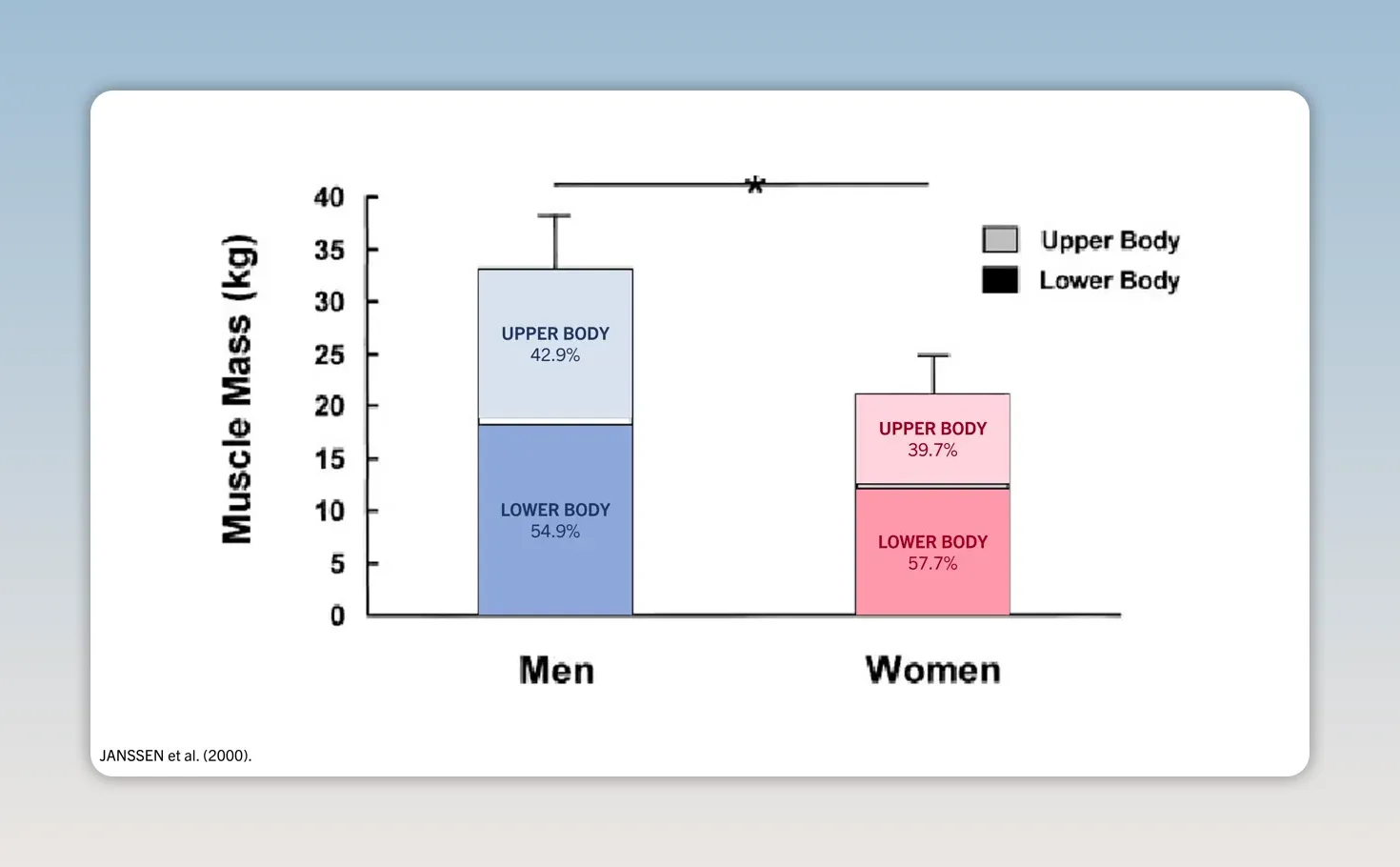
The distinction between total amounts and relative proportions matters. A greater lower body share in women does not mean women necessarily carry more lower body muscle in absolute terms.
Bone Structure and Body Proportions
Women typically have a wider, shallower pelvis relative to body size, with a larger pelvic inlet. Men tend to have broader shoulders and a larger rib cage.
Average limb proportions also differ. Men tend to have longer arms and legs relative to their torso, while women tend to have a longer torso relative to their limbs. These differences can influence how a lift looks without changing the underlying principles of effective technique.
Hormones and the Menstrual Cycle
Men produce more testosterone, while women generally produce more estrogen and progesterone. Because testosterone is anabolic, it is often assumed that men must experience substantially greater muscle growth from the same resistance training program. However, that assumption needs to be tested against actual training outcomes.
Hormone levels fluctuate throughout the day in both sexes. Women who menstruate also experience hormonal fluctuations across the menstrual cycle. These can be accompanied by physical and emotional symptoms that affect training.
Menopause marks the end of the reproductive years and is defined as 12 months without a menstrual period. Its associated hormonal changes can also produce physical, emotional, and mental symptoms that may influence training.
Development and Aging
Girls generally go through puberty earlier than boys. The developmental changes in girls include a growth spurt, increased estrogen production, breast development, widening of the hips, and the beginning of menstruation. In boys, increased testosterone production supports muscle growth, facial and body hair development, and a deeper voice alongside the growth spurt.
Later in life, bone density becomes a particularly important consideration. Both sexes tend to lose bone density with age, but women typically experience a more rapid decline around menopause as estrogen levels decrease. This increases the risk of osteoporosis.
Women also tend to live longer. For example, the Australian life expectancy figures cited for 2024 were approximately 85 years for women and 81 years for men. That is a demographic difference, rather than a reason to prescribe different lifting methods.
Do Men and Women Respond Differently to Resistance Training?
Baseline biology clearly differs. The more relevant question for programming is whether those differences produce meaningfully different responses to the same training.
Muscle Growth: Absolute Versus Relative Gains
A meta-analysis of 29 studies on muscle growth compared resistance training responses between men and women. Its findings depend on how muscle growth is expressed:
- Absolute muscle growth: Men tended to gain modestly more muscle tissue.
- Relative muscle growth: When gains were expressed as a percentage of starting muscle mass, the difference was much smaller and was not statistically significant.
The relative comparison still showed a slight trend favoring men, but the estimated difference was less than one percentage point.
This is not particularly surprising. Men generally start with more muscle, so a similar proportional increase can produce a larger amount of new tissue. Women can build essentially as much muscle relative to their starting point as men.
There may still be a small average advantage for men in relative muscle growth, but the evidence does not support treating women as though they require a fundamentally different hypertrophy method.
Strength Gains: Broadly Similar Improvements
Both men and women can make substantial strength gains through resistance training. A systematic review and meta-analysis of sex differences in resistance training found no significant overall difference in lower body strength gains.
For upper body strength, there was a small but statistically significant effect favoring women. Overall, the evidence suggests similar relative improvements, with women potentially experiencing slightly greater relative gains in some circumstances.
One possible explanation is that women in some study populations may begin with less training experience, leaving more room for improvement. However, that remains speculative rather than an established explanation.
Fat Loss: Calorie Needs Differ More Than the Process
Fat loss is not strictly a resistance training adaptation, but it is a common body composition goal.
Men are generally heavier and more muscular, so they tend to have a higher basal metabolic rate and total energy expenditure. As a result, they can often eat more calories while remaining in an energy deficit. Women, on average, may need a lower total calorie intake to achieve a comparable rate of weight loss.
However, this looks different when the comparison is relative to maintenance requirements and starting body weight. In one study, men and women assigned a calorie deficit of 30% below maintenance both lost approximately 5% of their starting body weight in around nine weeks.
The useful comparison is therefore not whether two people eat the same number of calories. It is the size of the deficit relative to their own energy needs, and the weight lost relative to their own starting weight.
Regional Fat Loss: No Clear Sex-Specific Pattern
Different baseline fat storage patterns do not appear to translate into a consistent difference in where fat is lost.
One study found fairly similar proportional losses from upper body, lower body, and abdominal subcutaneous fat. Women lost slightly more abdominal fat, while men lost slightly more lower body fat. Another study found slightly greater trunk fat loss in men and leg fat loss in women.
Those findings do not establish one reliable pattern that applies to all men or all women. Starting body fat levels may influence the results, but individual variation is likely more useful to consider than sex alone. Two men, or two women, may experience quite different changes in regional fat stores.
Bone Density: Useful Training, Limited Direct Comparisons
High-impact exercise and resistance training can help improve bone density or reduce its decline. Whether men and women respond differently to resistance training is less clear.
One direct comparison involved 10 men and 10 college-aged women completing the same resistance training program for 24 weeks, with another nine participants serving as nontraining controls. Men who trained showed clearer improvements in bone density than male controls. Among women, the training and control groups did not show clear differences.
Taken alone, this could suggest a stronger bone response in men. However, I would be cautious about drawing that conclusion from one small study.
Other research has demonstrated that women can improve bone density through resistance training. For example, a study in older women found that resistance training produced better improvements in hip bone density than aerobic training, which in turn performed better than no exercise.
The sensible conclusion is that resistance training remains valuable for bone health in both sexes. More direct comparative evidence is needed before making strong claims about differences in responsiveness.
Training Goals Can Differ Without the Biology Requiring Different Programs
Similar training responses do not mean everyone should follow the same routine. Programs should reflect the outcome someone wants.
Average preferences may differ between men and women, but this is better treated as a question of individual priorities than as a fixed biological distinction.
Which Muscle Groups Are the Priority?
A survey across American college gyms found that men placed more emphasis on upper body training, women placed slightly more emphasis on lower body training, and both sexes gave similar attention to trunk training.
That describes a trend, not a prescription. A man may want to prioritize his legs. A woman may want to prioritize her shoulders, back, or arms. Existing strengths and weaknesses also influence which muscles deserve more attention.
Regardless of sex, there are several ways to prioritize a muscle group:
- Increase its training volume: Perform more total sets, include more exercises for it, or train it more frequently to accommodate additional work.
- Train it earlier in the session: Give it attention before fatigue from other exercises accumulates.
- Train it closer to failure: Place greater emphasis on effort for the muscles that matter most to the current goal.
The method follows the priority. It does not need to be a separate method for men or women.
How Much Muscle Growth Is Desired?
A survey across UK university gyms found similar interest in general fitness and health among men and women. However, a greater proportion of men reported training for muscle growth and performance, while a greater proportion of women reported training for weight loss.
On average, men may therefore be more concerned with maximizing muscle growth. Many women also want to build muscle, but may not place the same emphasis on maximizing its magnitude.
Again, those are averages. Your program should reflect how much muscle you want to build and which outcomes matter to you, rather than what is typical for your sex.
Should Lifting Technique Differ Between Men and Women?
Anatomical differences can influence lifting technique. Pelvic shape, hip structure, limb length, shoulder width, and center of mass can all affect how someone performs an exercise.
However, the fundamental concepts remain similar. These include maintaining an appropriately neutral spine during most compound barbell lifts, generally using a full range of motion, and controlling the eccentric, or lowering, portion of the lift.
What may differ is how much each joint contributes to the movement.
The Squat as an Example
Someone with shorter legs relative to their torso can generally maintain a more upright squat. A relatively wider pelvis may also make a somewhat wider stance feel more comfortable. These characteristics are more common in women.
Someone with longer legs relative to their torso will often need more forward torso inclination. A relatively narrower pelvis may also make a narrower stance feel comfortable. These characteristics are more common in men.
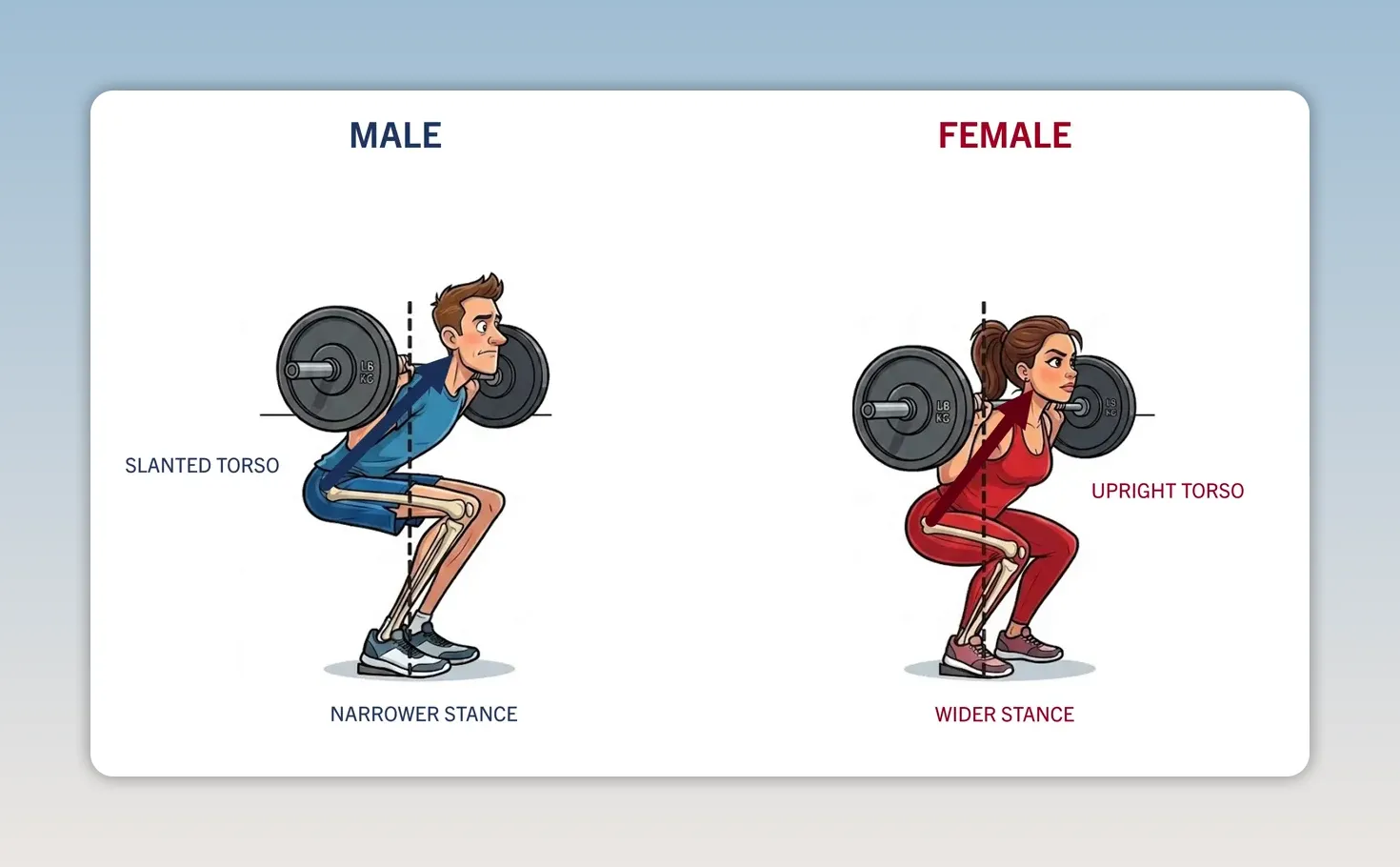
Practically, there is no need to force a “male” or “female” squat pattern. Many of these adjustments emerge naturally.
Follow sound technique principles, then use a movement pattern that feels effective and comfortable for your anatomy. The variation between two people of the same sex can be substantial.
Menstrual Cycle Training: Adjust for Symptoms, Not Assumed Advantages
Menstrual cycle periodization means adjusting training according to cycle phase. It is sometimes recommended on the assumption that hormonal fluctuations create phases that are substantially better for strength or muscle growth.
However, the evidence discussed here does not show a clear adaptation advantage from organizing training this way instead of keeping it consistent.
What a Phase-Based Training Study Found
A study of 24 women examined single-leg leg press and leg extension training over three consecutive menstrual cycles. Each leg was assigned to one of four conditions:
- No training: A control condition.
- Consistent volume: Moderate training volume throughout the study.
- Follicular-focused volume: More sets during the follicular phase and fewer during the luteal phase.
- Luteal-focused volume: More sets during the luteal phase and fewer during the follicular phase.
There were no significant differences in thigh lean mass between the training conditions. Neither phase-based approach showed a significant strength advantage over consistent training volume.
That does not support a blanket requirement to organize resistance training around menstrual cycle phases to improve results.
Symptoms Can Still Justify Adjustments
A lack of clear physiological advantage does not mean the menstrual cycle is irrelevant to training. Mood changes, pain, nausea, and discomfort can all influence what is manageable.
The distinction is between adjusting training to chase a presumed hormonal advantage and adjusting training to accommodate an actual symptom.
- When symptoms are absent or mild: More challenging training may be appropriate, including higher volume, heavier loads, or sets closer to failure.
- When symptoms are more severe: It may help to reduce volume, use lighter loads, or finish sets further from failure.
This is an individualized approach. If symptoms do not interfere with training, there may be no reason to change the program solely because a particular cycle phase has arrived.
Does Resistance Training Need to Change After Menopause?
From a body composition and physical function perspective, two important concerns around menopause are declining bone density and muscle mass. Resistance training is a key way to help counter these changes.
If someone is already lifting consistently, I would not say their entire routine needs to change solely because they have reached menopause. Performance may change over time, and symptoms may require adjustments, but there is no automatic need for a completely different training system.
If someone is not currently resistance training, incorporating regular weight training is particularly worthwhile to help address losses in bone, muscle, and strength.
The emphasis should be on continuing or establishing effective training, then adjusting it to the person's current capacity and symptoms.
Practical Recommendations: Train the Person, Not the Average
Men and women have different average starting points, but their relative responses to resistance training are remarkably similar. That makes individualization more useful than dividing programs into two separate categories.
- Use the same fundamental training methods. Muscle growth and strength development do not require completely different approaches for men and women. Fat loss follows the same broad energy-balance principles, with calorie needs tailored to the individual.
- Let goals determine emphasis. Allocate training volume and effort according to the muscles and performance outcomes you want to prioritize.
- Fit technique to anatomy. Use sound movement principles without forcing everyone into an identical stance, torso angle, or lifting style.
- Accommodate menstrual and menopausal symptoms when needed. Adjust training demands in response to how the person actually feels and performs, rather than assuming a complete program change is necessary.
- Keep resistance training central to long-term physical function. Its role in supporting muscle, strength, and bone health matters for both sexes, including after menopause.
Men and women do not generally need different training principles. They need training that matches their own goals, structure, and circumstances. Biological differences provide context, but the individual should guide the program.
|