Progressive overload is often reduced to adding more weight to the bar. That makes sense when the goal is to lift the greatest load possible, but it does not fully explain how we should progress training for muscle growth.
Strength and hypertrophy are closely related, yet they are not the same adaptation. Strength is a performance outcome. Hypertrophy is a structural change in muscle tissue. That distinction affects how we select exercises, prescribe sets and repetitions, and interpret progress.
Key Takeaways
- Strength is a lifting performance outcome, while hypertrophy is an increase in muscle size.
- Maximal strength training emphasizes specific lifts, heavy loads, and longer rest periods.
- Hypertrophy training prioritizes sufficient challenging sets and effective stress on the target muscle.
- Performance improvements are most informative when technique and proximity to failure remain consistent.
Table of Contents
- What Is Progressive Overload?
- Strength and Hypertrophy Are Different Adaptations
- How Strength and Hypertrophy Training Differ
- Progressive Overload for Strength: Intentionally Build Lifting Performance
- Progressive Overload for Hypertrophy: Keep the Target Muscle Challenged
- Match Progression to the Adaptation You Want
What Is Progressive Overload?
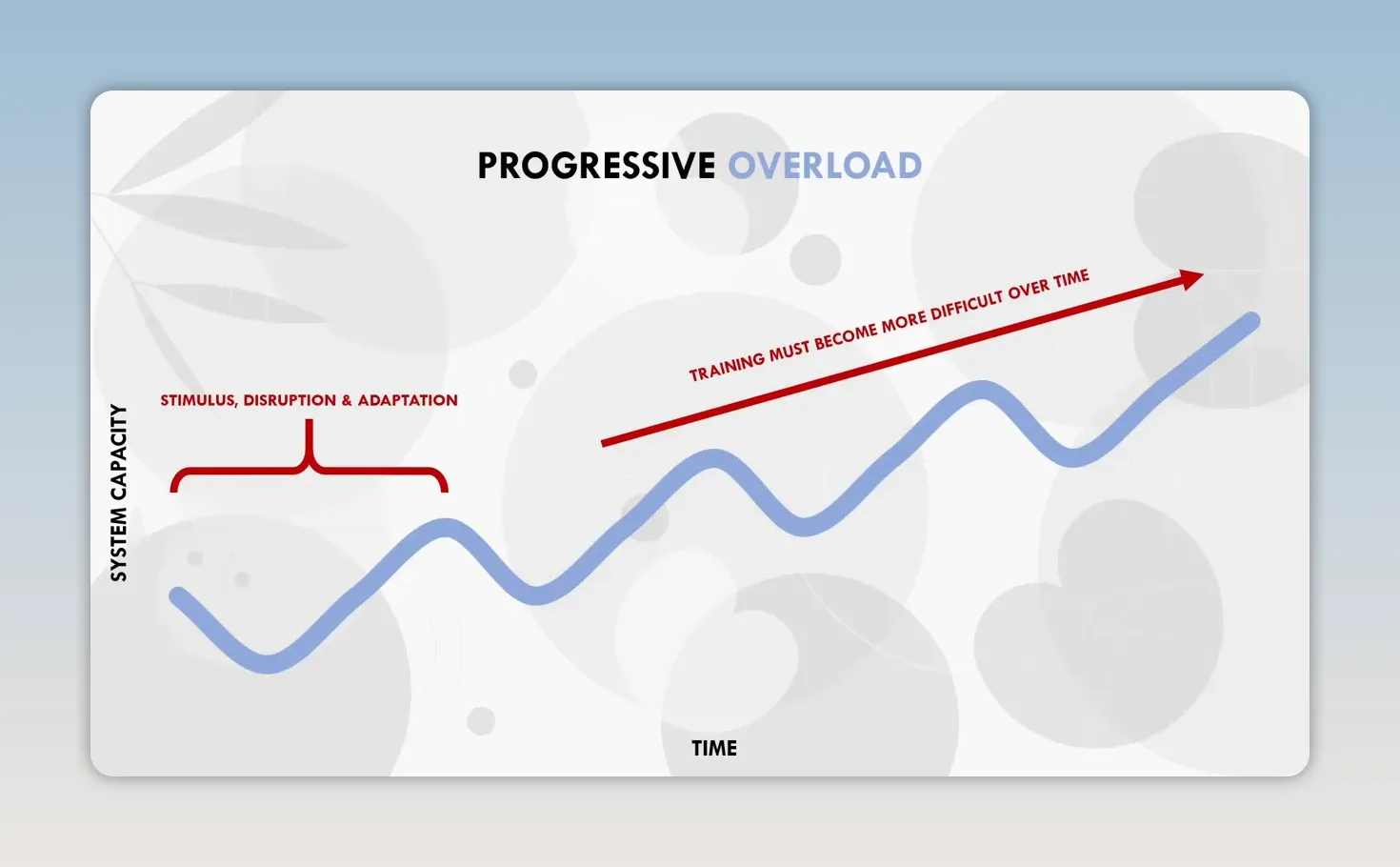
Progressive overload means increasing the training challenge over time so that the body continues to adapt.
A training stimulus must disrupt homeostasis, or the body's relatively stable internal state, enough to encourage adaptation. As we adapt to that stimulus, the same training becomes less challenging. Eventually, repeating exactly the same demand is more likely to maintain our existing level than produce further improvement.
For resistance training, this means the demands of training need to increase as our capabilities improve. However, “harder” does not necessarily mean putting more weight on the bar every week. The relevant progression depends on the adaptation we are trying to achieve.
Strength and Hypertrophy Are Different Adaptations
Hypertrophy changes the structure of the muscle
Muscle hypertrophy simply means an increase in muscle size. A major component is myofibrillar hypertrophy: an increase in the contractile material within muscle fibers.
Myofibrils are contractile structures inside muscle fibers. As more contractile material accumulates, individual fibers increase in diameter, contributing to a thicker overall muscle.
Other proposed contributors include sarcoplasmic hypertrophy and hyperplasia. Their prevalence and contribution to human muscle growth are less clearly understood, so the discussion here focuses on myofibrillar hypertrophy.
The important practical point is that hypertrophy training aims to build bigger muscles, not necessarily to maximize the weight lifted in a particular exercise. Exercise performance can help us assess training, but it is not the final outcome we are pursuing.
Strength improves through muscle growth and neural adaptations
Maximal strength refers to how much load we can lift, usually measured with a one-repetition maximum. Muscle size can contribute to that performance, but it is not the only factor.
Two major contributors are:
- Hypertrophy: Larger prime movers provide more contractile tissue that can contribute to force production.
- Neural adaptations: The nervous system becomes better at producing force with the muscle mass already available.
Neural improvements include changes in rate coding, motor unit recruitment, coordination, and lifting technique. In practical terms, we can become stronger without necessarily becoming bigger.
These adaptations are also specific to the task. To maximize strength in a particular lift, we need to practice that lift with heavy loads. Building muscle supports strength, but it does not replace the need to develop skill and neural efficiency in the movement itself.
How Strength and Hypertrophy Training Differ
Strength and hypertrophy training have substantial overlap. A program can develop both, and muscle growth is an important contributor to long-term strength. However, several training variables deserve different emphasis depending on the primary goal.
Exercise selection
For hypertrophy, there are no mandatory exercises. Exercise selection is a means of placing an effective demand on the target muscle. Different exercises for the same muscle group can produce comparable growth outcomes.
For strength, exercise selection is more specific. If we want to maximize performance in the back squat, we need to train the back squat. Other exercises can help build the muscles involved, but they do not fully replace practice of the exact movement.
This becomes especially important when preparing to express peak strength. The closer the goal is to a particular lifting performance, the more important specific practice becomes.
Rep ranges and load
Hypertrophy can occur across a broad range of loads and repetitions. Approximately 6 to 25 repetitions per set can produce similar muscle growth on a per-set basis, provided the sets are performed sufficiently close to failure.
This does not mean every load feels the same or serves every purpose equally. It means muscle growth does not require us to continually move toward the lowest possible rep range. A systematic review comparing lower- and higher-load resistance training provides further context for the distinction between muscle growth and maximal strength outcomes.
For maximal strength, heavier loads have a more direct role because of specificity. Training in the 1 to 5 repetition range is particularly relevant for developing neural efficiency and preparing to lift very heavy weights.
Training volume
Here, volume refers to the number of sets performed per muscle group or per lift each week.
Volume appears to have a dose-response relationship with hypertrophy: higher training volumes can produce faster muscle growth. When sets are performed sufficiently close to failure, the number of challenging sets is an important influence on the growth stimulus.
For strength, the role of volume depends partly on the timescale:
- Short-term neural development: Practicing the specific lift with heavy loads is more important than simply accumulating more sets.
- Long-term strength development: Sufficient volume remains important because building muscle increases the tissue available to produce force.
So volume is not irrelevant to strength. It simply serves a different role from the heavy, specific practice needed to maximize neural efficiency.
Rest between sets
For hypertrophy, rest duration appears less influential than performing sufficient challenging work. Longer rest periods may offer some benefit, but a general guideline is to rest approximately 1 to 3 minutes between sets.
For strength, rest periods have a more direct effect on performance. Fatigue can reduce the load we are able to lift, which interferes with the goal of practicing heavy lifting.
When maximizing neural efficiency is the priority, we want to allow enough recovery to perform the next set effectively. For many free-weight compound lifts, this means approximately 3 to 6 minutes between sets.
Progressive Overload for Strength: Intentionally Build Lifting Performance
The ultimate goal of strength training is to lift more weight. Progressive overload should therefore be organized around improving lifting performance over time.
This does not require adding weight every session or every week. It means that, across a meaningful training period, we are intentionally manipulating training to increase the loads we can handle.
Muscle growth, improved neural efficiency, and better technique can all contribute. For strength training, each is useful because it helps us lift more weight or perform more repetitions with a given weight.
Example: A 12-week back squat cycle
A lifter aiming to improve back squat strength might organize a 12-week cycle into three stages:
- Earlier weeks: Use relatively more sets and higher repetitions to place greater emphasis on building muscle.
- Middle weeks: Increase the load and move toward lower repetitions.
- Final weeks: Reduce the number of sets while emphasizing heavier loads and low repetitions to prepare for peak strength.
The progression deliberately shifts the emphasis from supporting muscle growth toward expressing strength through neural efficiency and specific practice.
The defining feature is intent: training variables are adjusted to improve the amount of weight the lifter can lift.
Progressive Overload for Hypertrophy: Keep the Target Muscle Challenged
For hypertrophy, the priority is different. We are trying to create an effective stimulus in the target muscle, not maximize the external load at any cost.
As muscles grow, they generally gain the capacity to produce more force. Over time, this should allow more repetitions with the same weight or heavier weights for similar repetitions.
The distinction is how we interpret and pursue that improvement. Better performance can be a result of muscle growth, rather than something we should force through any available means.
If we change technique or move into lower rep ranges solely to lift more weight, we may improve the number recorded without improving the stimulus to the target muscle. That would miss the purpose of hypertrophy training.
Instead, we should maintain strict, effective technique and an appropriate proximity to failure. If performance improves under those consistent conditions, it is a useful indication that the prime movers may have grown. It is not definitive proof, since neural and technical improvements can also increase strength.
Example: A 12-week leg press program
A hypertrophy-focused program could use the leg press rather than the back squat. The specific lift matters less because the goal is to challenge the target muscles, not maximize squat performance.
An illustrative prescription across 12 weeks is:
- Exercise: Leg press.
- Sets: Four.
- Load: 100 kg.
- Effort: Finish each set with approximately 1 to 2 repetitions in reserve.
- Repetitions: Allow the number performed to reflect the prescribed effort rather than fixing it in advance.
Repetitions in reserve, or RIR, describe how many additional repetitions we estimate we could complete before reaching failure.
In this example, the set count and load stay constant, but the work performed can still increase. As the lifter adapts, they may complete more repetitions before reaching the same 1 to 2 RIR endpoint.
Across an eight-week period, repetitions might fluctuate from week to week while still showing an overall upward trend. The important comparison is performance with the same load, consistent technique, and a similar proximity to failure.
This illustrates how progression can emerge from effective hypertrophy training without scheduling a heavier load every week. Keeping the load unchanged in this example does not mean load should never increase. It demonstrates that adding weight is not the only way training can progress.
Match Progression to the Adaptation You Want
Progressive overload matters for both strength and muscle growth, but the emphasis should match the goal.
For strength, deliberately organize training to improve performance in the specific lifts that matter. Heavy loads, specific practice, and sufficient recovery between sets support that objective.
For hypertrophy, prioritize challenging the target muscle through effective technique, sufficient volume, and sets performed close enough to failure. Track performance, but do not sacrifice the muscle stimulus just to record a heavier lift.
The goal is not simply to make the training numbers increase. It is to make those increases reflect the adaptation we actually want.


