For muscle growth, around 1 to 3 minutes between sets is a reliable starting point. For primary strength lifts, around 3 to 6 minutes is generally more appropriate. Neither range is a strict rule. The exercise, your strength level, and how much time you have available all influence how long it makes sense to rest.
Rest periods affect more than workout duration. They influence recovery, performance on subsequent sets, and the amount of productive work we can complete in a session. The challenge is balancing the benefit of greater recovery against the extra time it takes.
Key Takeaways
- Rest around 3 to 6 minutes for primary strength lifts to support high-quality performance.
- For muscle growth, 1 to 3 minutes between sets is a reliable general starting range.
- Shorter rests can improve training efficiency even when they slightly reduce the stimulus per set.
- Adjust recovery to the exercise, using either timed or self-selected rest periods.
Table of Contents
- How Rest Periods Affect Lifting Performance
- How Long Should You Rest for Strength?
- How Long Should You Rest for Muscle Growth?
- Rest Periods, Time Efficiency, and Training Density
- Adjust Rest Periods to the Exercise
- Should You Time Your Rest or Go by Feel?
- Practical Recommendations
How Rest Periods Affect Lifting Performance
The main purpose of resting between sets is to allow fatigue to dissipate before we perform the next set.
Longer rest periods give us more recovery time, which generally allows us to lift more weight or complete more repetitions. Shorter rest periods limit recovery, so performance on subsequent sets tends to decline.
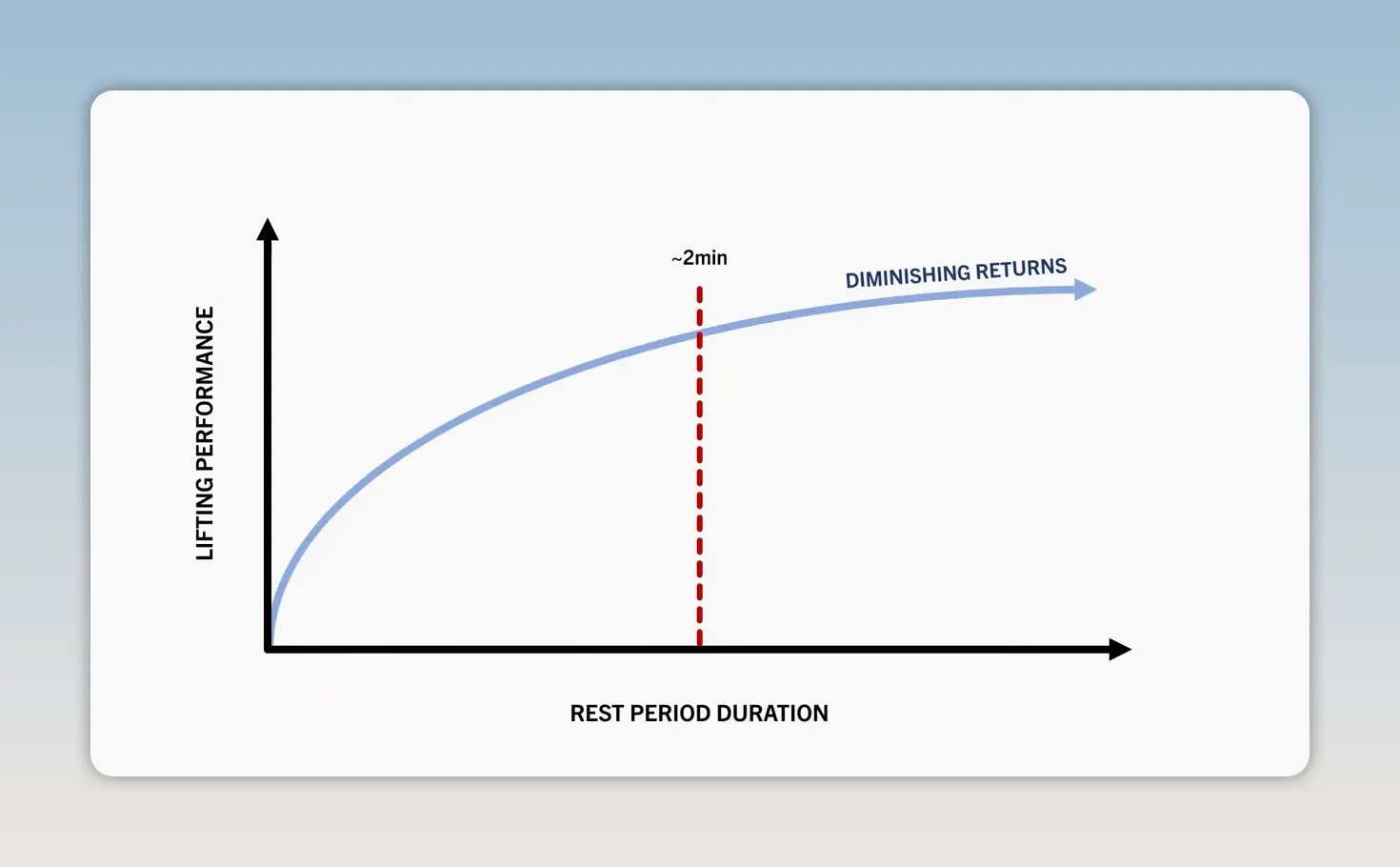
However, this relationship does not appear to be linear. Moving from a short rest period to a moderate one can provide a meaningful improvement in performance. Extending an already reasonable rest period may offer much less additional benefit.
For example, a study comparing 1, 2, and 3 minutes of rest had 16 resistance-trained men perform four sets of Smith machine squats and leg extensions under each rest condition on separate days. Total repetitions across the four sets were significantly higher with 2 minutes of rest than with 1 minute. Increasing rest to 3 minutes produced only a marginal further improvement.
A useful way to interpret this is that longer rest usually improves performance, but with diminishing returns. I would generally expect those diminishing returns to become more noticeable beyond approximately 2 minutes for many lifts, although this is a practical hypothesis rather than a universal cutoff.
The exercise matters here. Free-weight compound lifts tend to create more whole-body fatigue and may benefit from longer recovery. Isolation exercises usually place fewer demands on other systems, so the additional benefit of a long rest period may be smaller.
How Long Should You Rest for Strength?
For strength development, the answer is relatively straightforward: longer rest periods are generally preferable.
A systematic review of rest intervals and strength gains concluded that strength can improve across a range of rest durations. However, trained lifters generally need more than 2 minutes between sets to maximize strength gains. Untrained lifters appear able to achieve near-maximal improvements with shorter rests of around 1 to 2 minutes.
A more specific example comes from an 8-week study comparing 1-minute and 3-minute rest periods. Twenty-one resistance-trained men completed a full-body routine three times per week. Both groups improved their bench press and squat one-repetition maximum, but the group resting for 3 minutes made greater strength gains.
This makes sense. Longer recovery allows better lifting performance, and the loads and repetitions we perform are important for strength development. For the lifts where maximal output is the priority, we want enough recovery to produce a high-quality effort on each set.
Practical Strength Training Rest Periods
- Primary strength lifts: Around 3 to 6 minutes between sets is a reasonable general range.
- Very strong lifters performing heavy squats or deadlifts: Six minutes or longer may be needed to recover sufficiently.
- Novice lifters or less fatiguing lifts: Around 2 to 3 minutes may be enough to restore performance.
- Accessory exercises: Hypertrophy-oriented rest periods are usually appropriate because these lifts are generally included to develop the muscles supporting the primary lifts.
The goal is not to reach a particular number on a timer. It is to use a rest period that allows the performance you are trying to express.
How Long Should You Rest for Muscle Growth?
Rest periods are a little more complicated when the goal is hypertrophy.
Muscle growth is not directly proportional to lifting performance. Training sufficiently close to failure and completing enough weekly volume appear more important than the exact load or number of repetitions used.
This means a reduction in repetitions caused by shorter rest does not automatically translate into an equivalent reduction in muscle growth.
What the Overall Evidence Shows
A meta-analysis on rest intervals and muscle hypertrophy grouped training interventions into four categories:
- Short rests of 1 minute or less.
- Moderate rests of 1 to 2 minutes.
- Long rests of 2 to 3 minutes.
- Very long rests exceeding 3 minutes.
All four categories were effective for muscle growth. In the overall analysis, the shortest rest periods appeared slightly less effective, moderate rests had the largest effect size, and very long rests also had a slightly smaller effect size.
However, the subgroup analyses told a somewhat different story:
- Local muscle measurements: Measures such as arm and leg muscle thickness and cross-sectional area favored longer rest periods.
- Whole-body measurements: All three studies using measures such as DEXA or bioelectrical impedance favored rests shorter than 1 minute over rests longer than 1 minute.
It is not entirely clear why these measurement approaches produced different findings or what that discrepancy means in practice. We should therefore avoid treating the overall ranking as proof that one precise rest duration is optimal.
The most useful conclusion is that substantial muscle growth can occur across a broad range of rest periods. Very short rests may be slightly inferior on a per-set basis, while the additional benefit of very long rests over moderate rests remains uncertain.
Why Longer Rest May Help: More Work per Set
The clearest benefit of longer rest is better performance on subsequent sets. When sets are taken to or very close to failure, this generally allows more total volume load, or tonnage, to be lifted.
A single-leg extension study in 28 untrained adults helps illustrate this. Participants performed three sets with either 1 or 3 minutes of rest, completing as many repetitions as possible each set. The other leg used the opposite rest duration, with the number of sets adjusted to match the first leg’s volume load.
When the number of sets was held at three, 3-minute rests produced greater increases in quadriceps cross-sectional area than 1-minute rests. However, when additional short-rest sets were performed to match the long-rest condition’s volume load, muscle growth was similar. Likewise, reducing the number of long-rest sets to match the short-rest workload produced similar growth.
So, longer rest can help us get more out of a fixed number of hard sets. Shorter rest may require more sets to achieve a similar result.
Why Proximity to Failure Changes the Comparison
There is an important distinction between performing maximum repetitions each set and stopping at a predetermined repetition target.
If we use the same load and complete the same prescribed repetitions regardless of rest duration, total tonnage stays the same. Shorter rests then make those repetitions more difficult because we begin each set with more residual fatigue.
In that situation, shorter rests may bring the sets closer to failure and potentially provide a greater hypertrophic stimulus. Longer recovery would not necessarily be better if it simply makes the same fixed workload easier.
This is why we should not judge hypertrophy training solely by total tonnage. The number of sufficiently hard sets matters more than simply accumulating the largest load total.
A study comparing traditional and pre-exhaustion training provides a useful illustration, although it was not a direct rest-interval comparison. Thirty-one previously trained men performed three sets of leg press to failure at 75% of their one-repetition maximum, twice per week for 9 weeks. Half also performed a set of leg extensions to failure immediately before the leg press work.
As expected, the pre-exhaustion group performed less total volume load. Nevertheless, increases in quadriceps and gluteus maximus muscle thickness were broadly similar between groups. Lower tonnage did not necessarily mean less growth.
Do Short Rests, Muscle Pumps, and Hormonal Responses Matter?
Shorter rest periods also tend to produce a greater acute stress response. This can include more muscle swelling, metabolic stress, inflammation, and transient hormonal changes.
These immediate responses are not the same as long-term muscle growth. Their exact contribution to hypertrophy remains uncertain.
For example, a study comparing two arm-training protocols had 20 untrained young adults perform three sets each of three biceps and three triceps exercises using either:
- A 20-repetition maximum load with 30 seconds of rest.
- An 8-repetition maximum load with 3 minutes of rest.
The lighter-load, shorter-rest group experienced more immediate arm swelling, essentially a bigger pump, and a larger growth hormone response during the following hour. That group also had greater increases in arm muscle cross-sectional area after 8 weeks.
However, both load and rest duration differed between the protocols, so the result cannot be attributed to rest periods alone. Nor does it demonstrate that the pump or hormonal response caused the additional growth.
Some hypotheses propose that metabolic stress contributes to hypertrophy. Others suggest it is mainly a response associated with effective training. For now, these mechanisms do not establish a clear reason to make every rest period as short as possible.
Rest Periods, Time Efficiency, and Training Density
So far, we have mainly considered how effective each set is. Another question is how much productive training we can complete within the time available.
Training density is the amount of work completed in a given duration. Rest intervals have a major influence on it because much of a typical resistance training session is spent recovering rather than lifting.
Consider a simplified workout containing 20 sets, with each set lasting approximately 30 seconds. That gives us 10 minutes of actual lifting.
- With approximately 2 minutes of rest per set: Allowing 40 minutes for recovery gives a session of roughly 50 minutes. About 20% of the time is spent lifting and 80% resting.
- With approximately 1 minute of rest per set: Allowing 20 minutes for recovery gives a session of roughly 30 minutes. About one-third of the time is spent lifting and two-thirds resting.
These are simplified estimates, but they show how much rest periods can affect total session duration.
Reducing rest from 2 minutes to 1 minute may slightly compromise the stimulus from each set. Yet it also saves considerable time. We could use that time to perform additional sets, potentially offsetting the lower per-set stimulus, or simply accept the trade-off and finish sooner.
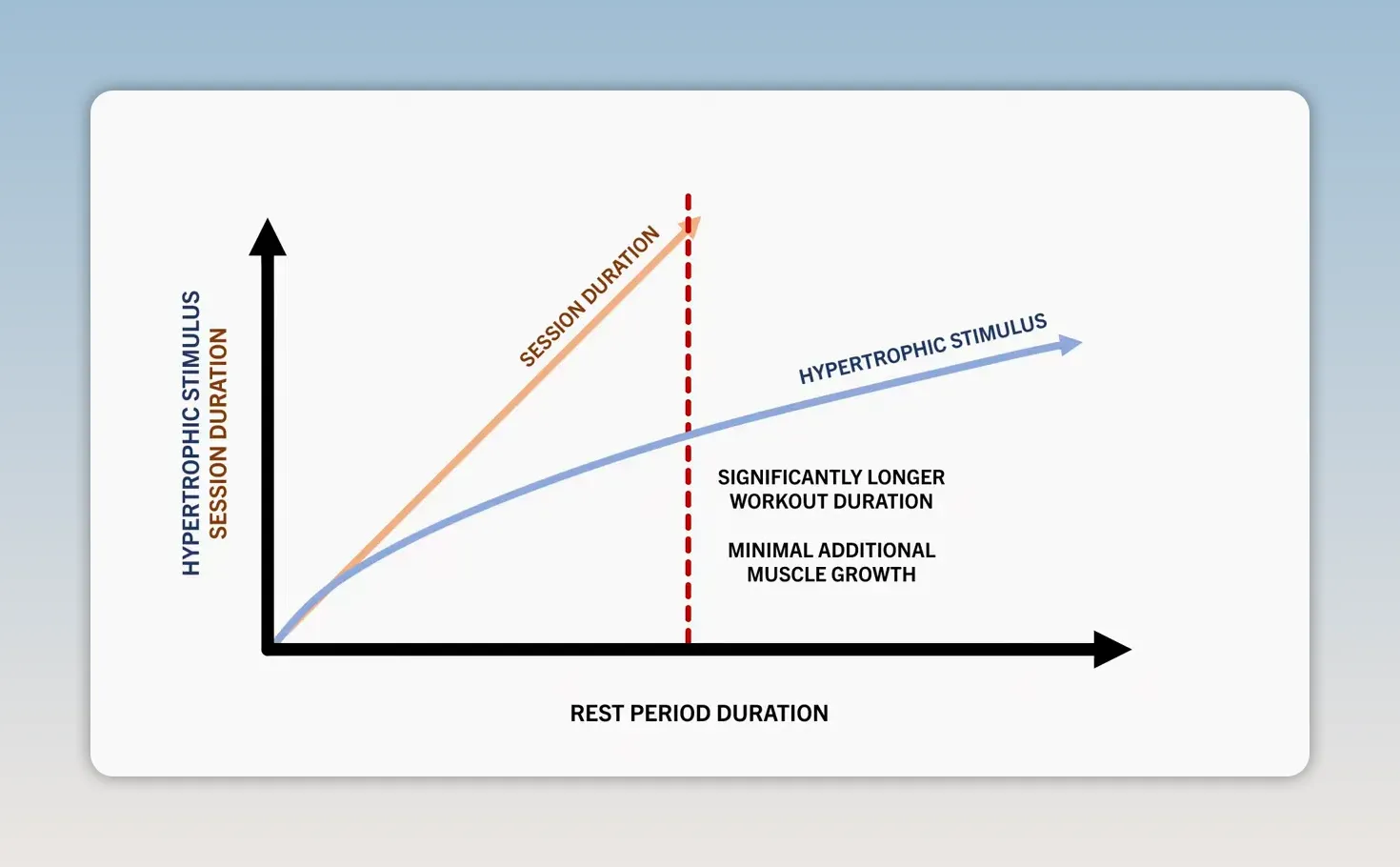
I would expect workout duration to increase roughly linearly as rest periods get longer, while the hypertrophic benefit shows diminishing returns. At some point, additional recovery may add substantial time for very little extra stimulus.
Where we choose to sit on that spectrum depends on our priorities:
- Maximizing the stimulus from each set: Longer rest periods may be worth the extra session time.
- Getting a good stimulus efficiently: Somewhat shorter rests may provide a better practical balance.
- Completing more work within a fixed session: Shorter rests may make room for additional productive sets.
The best rest period for one set is not necessarily the best rest strategy for an entire workout.
Adjust Rest Periods to the Exercise
We do not need to use the same rest interval for every exercise. A demanding set of back squats and a set of biceps curls create different recovery needs.
Higher-Fatigue Exercises: Usually Rest Longer
Exercises that create more whole-body fatigue generally involve:
- More muscles and joints.
- Greater stability requirements.
- Higher technical demands.
- More cardiorespiratory fatigue.
Lower-body compound free-weight lifts, such as back squats, deadlifts, and split squats, commonly fit this description.
For these exercises, several systems may need to recover before we can perform another productive set. At least 2 minutes between sets is a sensible general starting point, with longer rests appropriate when performance or heavy strength work demands them.
Lower-Fatigue Exercises: Shorter Rests Can Work Well
Exercises with fewer stability, technical, and cardiorespiratory demands are often better suited to shorter rests. Examples include biceps curls, rear delt flies, calf raises, and many machine-based isolation exercises.
Because fewer other systems are heavily fatigued, the target muscle is more likely to remain the main limitation during the next set.
For these exercises, around 2 minutes or less will often be appropriate. There may be little reason to take the same long recovery you would use before a heavy squat.
Should You Time Your Rest or Go by Feel?
Discussing rest in minutes can make it sound as though every interval needs to be measured precisely. For most people, that is not essential.
An alternative is to autoregulate rest periods: recover until you feel reasonably ready to perform another set, then continue.
A study comparing fixed and self-selected rest intervals examined 33 resistance-trained men performing the same upper-body workout with either a fixed 75-second rest or a self-selected rest duration.
The self-selected group rested for around 2 minutes on average. Their rest periods also tended to increase as the workout progressed, likely reflecting accumulated fatigue. They completed more total repetitions across the three sets of each exercise than the fixed-rest group.
Muscle growth was not measured, and both groups improved one-repetition maximum strength by a similar amount. The findings therefore support self-selected rest as a workable approach, rather than proving it produces better long-term results.
Benefits of Timed Rest Periods
- Consistency: Rest intervals are accurate, predictable, and standardized.
- Time management: A timer can prevent distractions from turning reasonable recovery into unnecessarily long breaks.
Benefits of Autoregulated Rest Periods
- Practicality: There is no need to start and stop a timer after every set.
- Flexibility: Rest can be shorter or longer according to perceived recovery needs.
Either approach can work well. Timed rests may help keep a session efficient, while self-selected rests can adapt more naturally to changing fatigue. The choice is mainly a matter of preference and context.
Practical Recommendations
We do not need one perfect rest interval for every situation. We need a strategy that matches the goal of the exercise and the constraints of the session.
- For primary strength lifts: Start with around 3 to 6 minutes and allow more when a very demanding lift requires it.
- For hypertrophy: Around 1 to 3 minutes is a reliable general range, with sufficient effort and weekly volume remaining important.
- For demanding compound exercises: Favor the longer end of the range so whole-body fatigue does not unnecessarily limit the next set.
- For less fatiguing isolation exercises: Around 2 minutes or less will often be sufficient.
- For shorter workouts: Reduce rest strategically, recognizing that a slightly lower per-set stimulus may be an acceptable trade-off.
- For implementation: Use a timer when consistency and time management help, or autoregulate when flexibility is more useful.
Rest long enough to perform the next set productively, but not automatically longer than your goal requires. Longer rests generally support better performance. Whether that extra performance is worth the extra time depends on what you are trying to achieve.
|