Losing weight puts us at an increased risk of losing muscle. Ideally, we want the weight we lose to come from body fat, not the muscle tissue we have worked to build.
The solution is not simply to make the scale move as quickly as possible. It is to combine a sensible calorie deficit with enough protein, productive resistance training, and cardio that supports rather than compromises our lifting.
With the right approach, we may even build some muscle while losing fat. But that outcome depends on more than effort alone.
Key Takeaways
- Keep average weight loss below about 1% of body weight per week to support muscle retention.
- Consume more than around 1.5 grams of protein per kilogram of body weight daily while dieting.
- Continue resistance training with the intent to build muscle throughout the calorie deficit.
- Use manageable cardio to supplement dietary control without compromising lifting performance.
Table of Contents
- Can You Build Muscle While Losing Weight?
- Set a Calorie Deficit That Supports Muscle Retention
- Consume Enough Protein, Without Making the Diet Unsustainable
- Keep Resistance Training Focused on Building Muscle
- Use Cardio to Support Fat Loss, Not Replace the Diet
- Practical Recommendations for Retaining Muscle During Weight Loss
Can You Build Muscle While Losing Weight?
Gaining muscle while losing fat is known as body recomposition. It is possible during a calorie deficit, although some people are more likely to achieve it than others.
Four main factors influence the likelihood and magnitude of recomposition:
- Resistance training experience: Beginners generally have more potential to build muscle during a deficit. More advanced lifters may also achieve recomposition, but the amount of muscle gained is likely to be smaller.
- Current body fat: People with higher body fat generally have a better chance of building muscle while dieting than people who are already lean.
- Lifestyle and recovery: Good sleep, lower emotional stress, and manageable work, study, relationship, and family demands can create more favorable conditions for muscle growth. Poor sleep and high stress can make it harder.
- Training and nutrition: Our exercise and eating behaviors have a substantial influence on whether we gain, retain, or lose muscle.
We should train and eat in a way that gives muscle growth the best chance of occurring. However, recomposition is a possible outcome, not something we can guarantee. For an experienced, lean lifter, retaining muscle during a successful fat-loss phase may be a very good result.
Do Males and Females Respond Differently?
Biological sex may also influence muscle retention. A research review examining resistance-trained people during calorie restriction found different patterns in lean mass changes between males and females.
Most of the male study groups lost lean mass over the dieting period, whereas many of the female groups maintained or increased it. This suggests that females may, on average, retain muscle more successfully during a deficit.
These are patterns across studies, not predictions for every individual. Regardless of sex, the practical priorities remain the same: manage the deficit, consume sufficient protein, and continue resistance training.
Set a Calorie Deficit That Supports Muscle Retention
To lose weight, we need to consume fewer calories than we expend. But the size of that deficit matters.
A larger calorie deficit usually produces faster weight loss, while a smaller deficit produces slower weight loss. The trade-off is that a more aggressive deficit can also make it harder to retain or build muscle.
A meta-analysis of resistance training during energy deficiency examined the relationship between the size of a calorie deficit and changes in lean mass. Smaller deficits were more compatible with lean mass retention and growth, while larger deficits were associated with less favorable outcomes.
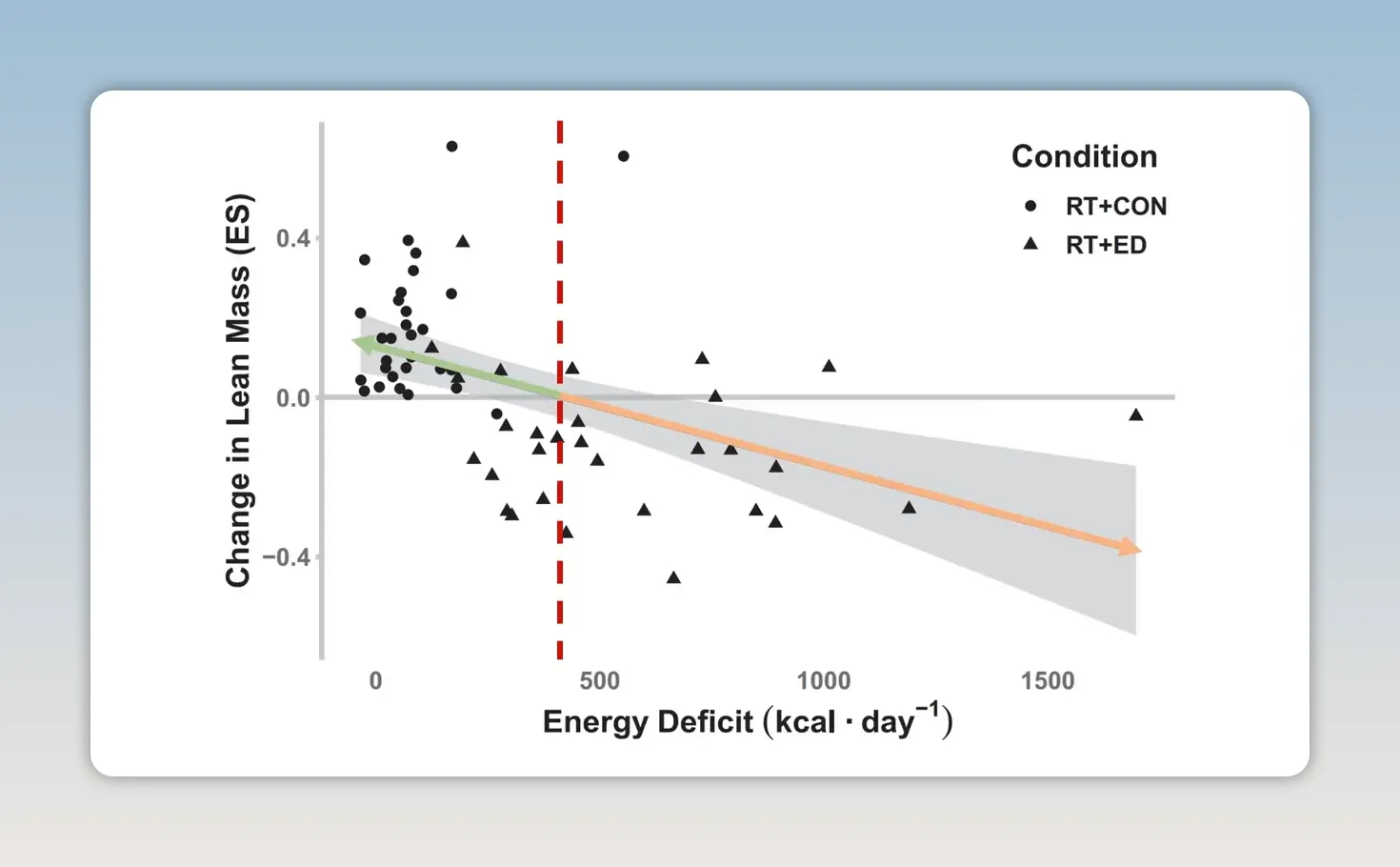
The average point at which the trend crossed from lean mass gain toward loss was around a 500-calorie daily deficit. That is useful context, but it is not a universal cutoff. A deficit below 500 calories does not guarantee muscle growth, and a deficit above it does not guarantee muscle loss.
A more scalable recommendation is to lose no more than around 1% of body weight per week on average. Adjust calorie intake so that the rate of weight loss stays within that limit, rather than treating one fixed calorie deficit as appropriate for everyone.
The goal is a small to moderate deficit that allows fat loss without making muscle retention unnecessarily difficult.
Consume Enough Protein, Without Making the Diet Unsustainable
Alongside calorie intake, total daily protein intake is one of the main nutritional variables influencing muscle retention during weight loss.
A four-week protein and exercise study illustrates why. Participants consumed approximately 33 calories per kilogram of lean body mass each day, equivalent to an average calorie deficit of around 40%.
The two groups consumed different amounts of protein:
- Moderate-protein group: 1.2 grams per kilogram of body weight per day.
- High-protein group: 2.4 grams per kilogram of body weight per day.
Carbohydrate intake was kept at around 3 grams per kilogram per day in both groups. This meant the moderate-protein group consumed more fat, while the high-protein group consumed less. Both groups also completed a demanding exercise program that included resistance training, plyometrics, and several forms of cardio.
After four weeks, both groups lost a similar amount of body weight. However, their body composition changes differed. The high-protein group increased lean body mass, while the moderate-protein group approximately maintained it. The high-protein group also lost more body fat.
The important distinction is that similar scale weight loss can come with different changes in fat and lean mass. Higher protein intake can help make the composition of that weight loss more favorable.
How Much Protein Should You Aim For?
As a general practical recommendation, aim for more than around 1.5 grams of protein per kilogram of body weight per day while dieting.
Protein has a diminishing-returns relationship with muscle growth. Increasing intake can help, but the additional benefit becomes progressively smaller. Around 1.5 grams per kilogram per day is a useful reference point for substantial diminishing returns, rather than a precise threshold that applies equally to everyone.
The high intake used in the study does not mean everyone needs to consume 2.4 grams per kilogram. Pushing protein very high may make a diet harder to sustain for relatively little additional benefit.
For fat loss, maintaining the calorie deficit is still essential. A high-protein target should support dietary adherence, not make it harder.
Keep Resistance Training Focused on Building Muscle
Resistance training provides the stimulus for muscle growth and retention. Protein intake alone does not replace that stimulus.
There is no need to adopt a fundamentally different style of lifting simply because calories are lower. Train with the intent to build muscle, even when retaining it is the main goal.
The same general principles that make training productive at maintenance or in a surplus remain relevant during a deficit.
- Weekly volume: Around 10 to 20 sets per muscle group per week is a general starting range.
- Effort: Take sets close to failure, leaving around 1 to 3 repetitions in reserve on average. In other words, finish most sets when you could complete only another one to three good repetitions.
- Repetition range: Approximately 5 to 20 repetitions per set can produce similar muscle growth on a per-set basis when effort is sufficiently high.
- Rest periods: Allow at least 2 minutes between sets of compound exercises and at least 1 minute between sets of isolation exercises.
- Exercise selection: Choose movements that load the target muscle through stretching and contraction, while feeling safe and comfortable on the joints. No individual exercise is mandatory.
- Technique: Use a full range of motion and a controlled lowering phase, and aim for the target muscle to be the limiting factor in the set.
These are general guidelines, not a requirement to force every trainee into the same program. The central point is to preserve a meaningful hypertrophy stimulus throughout the dieting phase.
Use Cardio to Support Fat Loss, Not Replace the Diet
Cardio can increase energy expenditure and help create a calorie deficit. However, using it poorly can make muscle retention more difficult.
There are three main considerations: how much energy cardio actually adds to daily expenditure, its potential interference with muscle growth, and the fatigue it creates.
1. Keep Cardio’s Calorie Contribution in Perspective
Energy expenditure occurs throughout the entire day, including when we are resting. A dedicated cardio session usually occupies only a small part of that time, often somewhere between 10 and 60 minutes.
Although energy expenditure can rise substantially during the session itself, that increase may be more modest when considered across a full 24 hours. A 40-minute cardio session contributes to daily expenditure, but it does not account for the majority of it.
For this reason, controlling food intake should generally be the primary method of establishing the deficit. Cardio can supplement that approach, but it is not a replacement for a calorie-controlled diet.
2. Manage the Potential Interference Effect
The interference effect refers to the possibility that endurance training reduces some of the muscle growth we would otherwise achieve from resistance training alone.
A meta-analysis of concurrent aerobic and resistance training suggested a small negative effect on muscle fiber hypertrophy compared with resistance training alone.
However, context matters. The evidence examined lower-body hypertrophy, and many of the studies used intensive endurance protocols. Those protocols are not necessarily representative of the moderate cardio a typical lifter might use to assist fat loss.
We can reduce the potential problem with a few programming choices:
- Favor low- to moderate-intensity cardio rather than relying on demanding endurance sessions designed to maximize aerobic performance.
- Separate high-intensity endurance work from lower-body lifting by at least a few hours, preferably placing them on different days.
- Lift first when sessions must be close together. If intense cardio and lower-body resistance training need to occur in the same session, prioritize resistance training before cardio.
The practical conclusion is not that cardio prevents muscle growth. It is that intensity, timing, and session order can help keep cardio compatible with the main training goal.
3. Avoid Fatigue That Compromises Lifting
Cardio can create fatigue in three relevant forms:
- Joint stress.
- Muscular fatigue.
- Systemic fatigue.
If those demands reduce lifting performance, cardio can indirectly make muscle retention harder. When the goal is to retain muscle during weight loss, resistance training should take priority over adding more calorie expenditure through cardio.
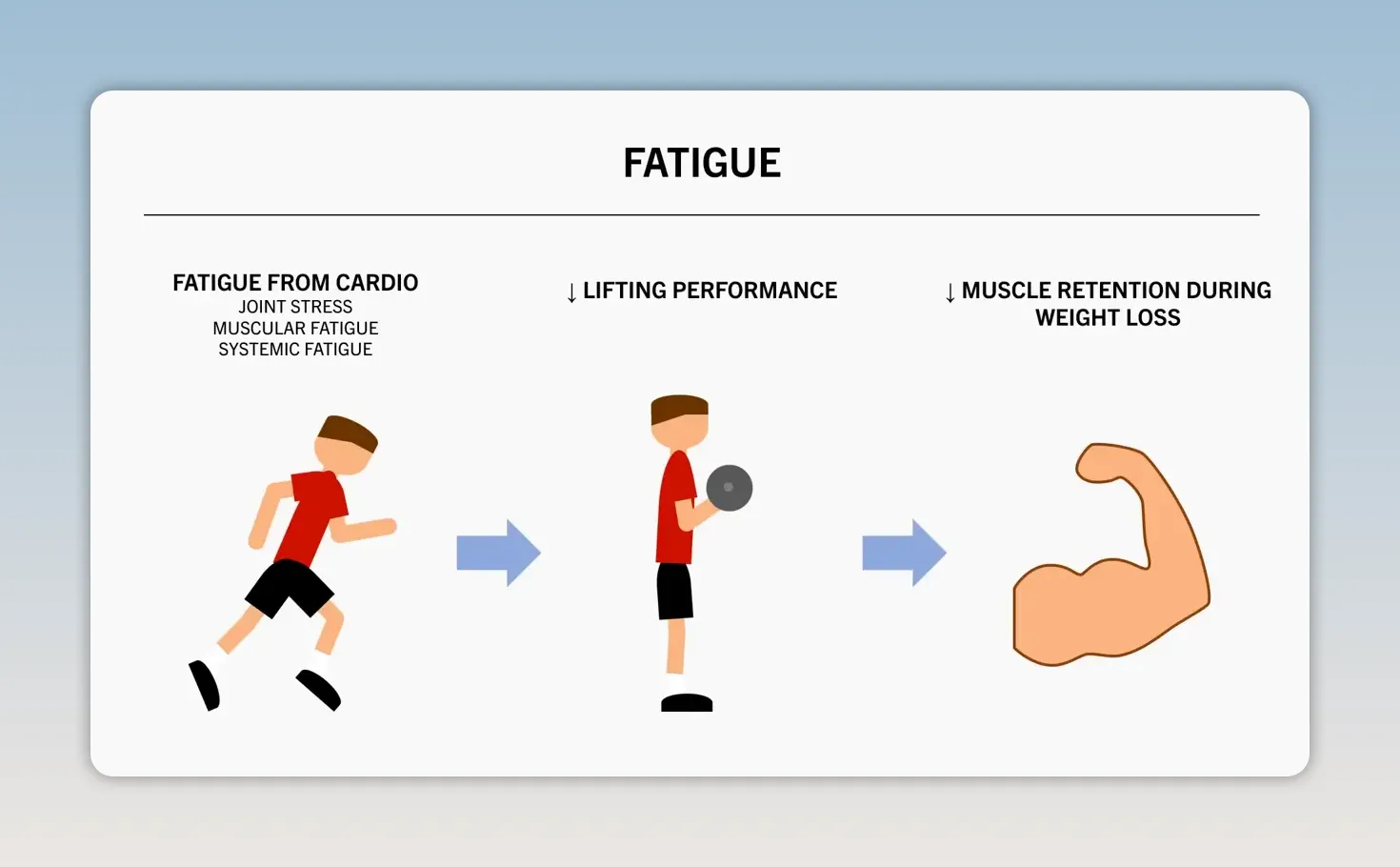
As a general guide, favor low-impact, low- to moderate-intensity cardio. This helps limit joint stress, fatigue, and the potential interference effect.
Enjoyment matters too. Choose cardio methods you like enough to sustain throughout the weight-loss phase. The aim is a useful supporting habit, not an exercise workload that undermines the rest of the plan.
Practical Recommendations for Retaining Muscle During Weight Loss
Our training experience, current body fat, lifestyle demands, and biological sex all influence the outcome of a dieting phase. We cannot simply choose how much muscle we will retain or gain, but we can make our behaviors more favorable.
- Use a small to moderate calorie deficit. Keep average weight loss to no more than around 1% of body weight per week.
- Consume sufficient protein. Aim for more than around 1.5 grams per kilogram of body weight per day without making the diet unnecessarily difficult to follow.
- Continue productive resistance training. Train with the same muscle-building intent you would use outside a deficit.
- Keep cardio supportive. Favor enjoyable, low-impact work at a manageable intensity, and avoid letting it compromise lifting performance.
- Set realistic expectations. Muscle growth during a deficit is possible, but retaining muscle while losing fat is still a successful outcome.
The objective is not just to lose weight. It is to lose fat while preserving the training stimulus and nutritional support that help keep muscle.
|