Strength and hypertrophy are two primary outcomes of resistance training. They are closely related, but they are not the same thing. Getting better at lifting a heavy weight involves more than growing bigger muscles, and stimulating muscle growth does not require maximizing the weight on the bar.
Most resistance training will improve both qualities to some extent. However, we can adjust exercise selection, load, volume, technique, and other variables to emphasize one outcome over the other.
The central distinction is that strength is a performance outcome, while hypertrophy is a structural adaptation. Understanding that difference makes the rest of the programming decisions much easier.
Key Takeaways
- Strength is task-specific performance, while hypertrophy describes the structural adaptation of growing larger muscles.
- Strength training prioritizes specific lifts, heavy loads, efficient technique, and frequent practice.
- Hypertrophy training emphasizes sufficient volume, close-to-failure sets, and exercises that fatigue the target muscle.
- Both goals are highly compatible, but maximizing each competes for limited training time and joint tolerance.
Table of Contents
- What Is the Difference Between Strength and Hypertrophy?
- Can You Train for Strength and Hypertrophy Together?
- Specificity: The Main Principle Behind Strength Training
- Proximity to Failure: More Important for Muscle Growth
- Training Volume: Count Sets for the Goal You Are Pursuing
- Progressive Overload: An Outcome for Strength, a Tool for Hypertrophy
- Reps and Load: Heavy for Strength, Flexible for Hypertrophy
- Exercise Selection: Practice the Lift or Target the Muscle
- Lifting Technique: Move More Weight or Stress the Target Muscle?
- Training Frequency: More Practice Matters More for Strength
- Rest Periods: Balance Set Quality With Training Time
- How to Prioritize Strength, Hypertrophy, or Both
What Is the Difference Between Strength and Hypertrophy?
Hypertrophy means muscle growth
Muscle hypertrophy refers to the adaptations that make muscles larger in response to resistance training. In most practical contexts, we can use hypertrophy and muscle growth interchangeably.
A primary mechanism thought to contribute to this growth is in-parallel myofibrillar hypertrophy. Muscle fibers contain myofibrils, which are structures involved in contraction. Adding contractile material in parallel increases the diameter of individual muscle fibers. As those fibers become larger, the overall muscle belly becomes larger too.
Other adaptations have also been proposed to contribute to muscle growth, including:
- In-series myofibrillar hypertrophy: growth involving contractile units arranged along the length of the fiber.
- Sarcoplasmic hypertrophy: enlargement of the noncontractile contents of muscle fibers.
- Hyperplasia: an increase in the number of muscle fibers.
How much these mechanisms contribute to overall muscle growth remains less clear. For programming purposes, the important point is simply that hypertrophy describes a change in the muscle itself.
Strength means performance in a specific task
Strength refers to the ability to produce force in a particular task. We often assess it with a one-repetition maximum, or 1RM, in exercises such as the squat, bench press, deadlift, or overhead press.
However, a one-rep barbell lift is not the only way to express strength. Bodyweight exercises, isometric holds, and maximum repetitions with a fixed weight can also serve as strength tests.
Different strength sports illustrate this clearly. Powerlifting tests a single maximal repetition in three specific lifts. Gymnastics requires moving and holding the body in demanding positions. Strongman includes a variety of dynamic lifts and static holds.
The adaptations supporting these performances fall into two broad categories:
- Structural adaptations: changes to muscle and connective tissue, including muscle growth, changes in muscle fiber pennation angles, and increased tendon stiffness.
- Efficiency adaptations: improvements in force production without necessarily changing tissue size or structure, including better technique, neuromuscular coordination, and neuromuscular drive.
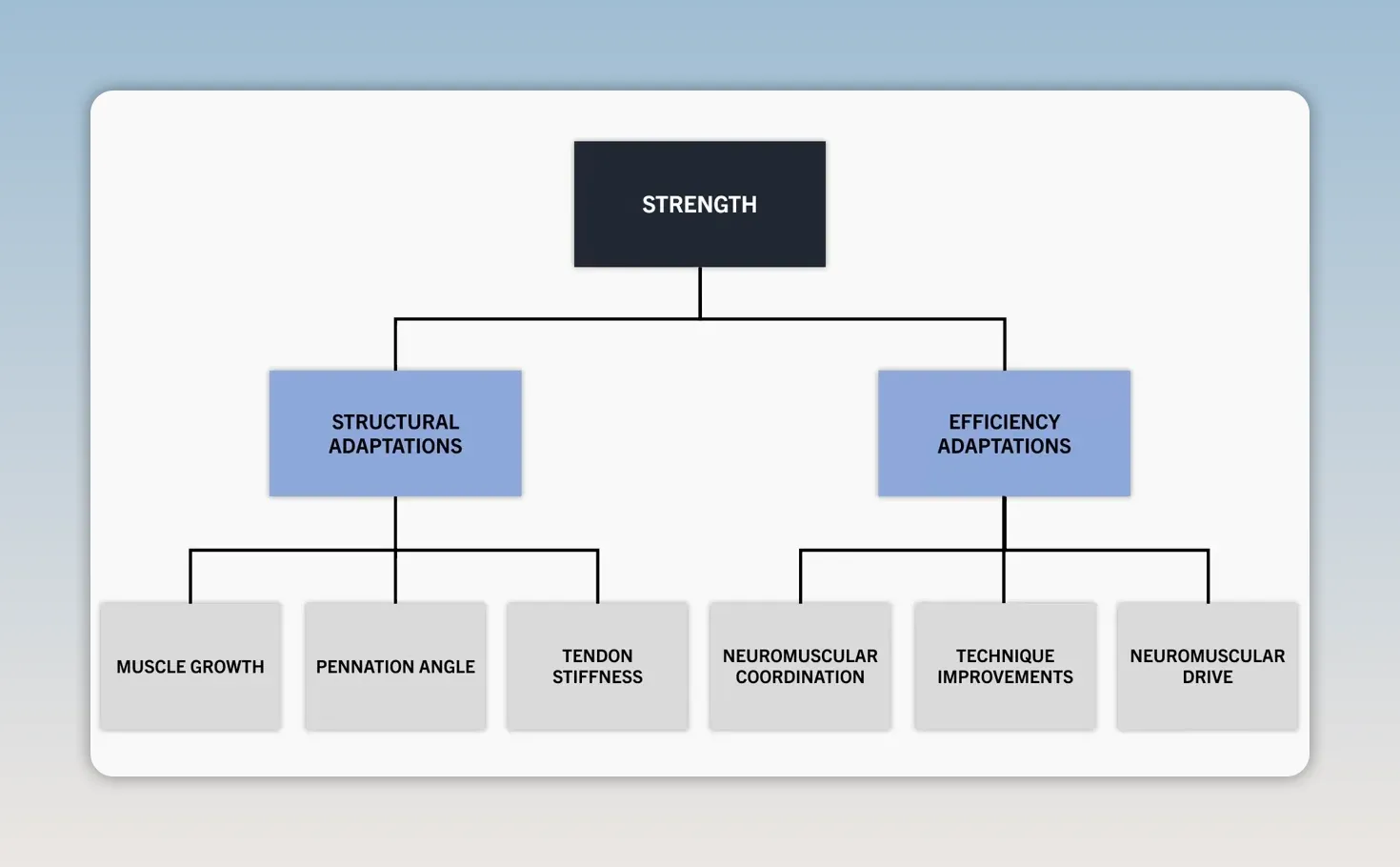
This explains why strength and muscle size do not always increase in direct proportion. Hypertrophy is one contributor to strength, not the complete outcome.
Can You Train for Strength and Hypertrophy Together?
Yes. Strength and hypertrophy are highly compatible, and they do not appear to be competing adaptations. Almost all forms of resistance training produce some combination of strength gains and muscle growth.
Growing the muscles involved in a lift can support strength development. Becoming stronger does not necessarily cause muscle growth directly, but strength development does not seem to inhibit it either.
The main limitation is practical rather than physiological. We all have a finite amount of:
- Time available for training.
- Mental energy to dedicate to training.
- Joint tolerance for repeated loading.
Maximizing one goal can use resources that would otherwise be available for the other. A program designed to maximize a competition lift at all costs may leave less room for additional muscle-building work. Similarly, very high hypertrophy volumes can make it harder to devote enough fresh, focused practice to heavy strength lifts.
You can make progress toward both goals simultaneously, but maximizing both is a different challenge.
Specificity: The Main Principle Behind Strength Training
Specificity means that training transfers best to a task when it closely resembles that task. In simple terms, we get better at what we practice.
For strength training, this applies to exercise selection, load, rep range, technique, and even the rules used to judge a successful repetition.
If the goal is a stronger barbell squat 1RM, performing barbell squats with heavy loads and low repetitions provides the most direct practice. Smith machine squats are somewhat different, so their transfer is likely to be lower. Leg presses are less similar again, and leg extensions offer relatively little direct practice of the squat movement itself.
That does not mean less specific exercises are useless. They can build the muscles involved in squatting. They simply do not replace practicing the skill being tested.
A study comparing bench press variations demonstrates this principle. Thirty-six men with at least two years of resistance training experience trained either the Smith machine bench press or dumbbell bench press twice per week for 10 weeks. Each group improved its six-repetition maximum more in the exercise it had practiced.
Competition standards matter too. For example, a competition bench press may require a chest touch, a pause until the press command, full elbow extension, flat feet, and continued contact between the buttocks and bench. Practicing a different style is not equally specific to that test.
Hypertrophy has no equivalent performance task to reproduce. We are using an exercise to stress a muscle and stimulate growth, not to improve a judged repetition. This creates much greater flexibility in exercises, rep ranges, and techniques.
Proximity to Failure: More Important for Muscle Growth
Proximity to failure describes how close a set comes to the point where another repetition is no longer possible. We commonly express this using reps in reserve, or RIR:
- 0 RIR: you finish the set with no additional repetitions available.
- 1 RIR: you could have completed one more repetition.
- 2 RIR: you could have completed two more repetitions.
Reaching 0 RIR does not require attempting and failing a repetition. It means the last completed repetition was the final one you could perform.
A meta-regression on proximity to failure found an overall relationship between training closer to failure and greater muscle growth. For 1RM strength, however, there was no clear directional relationship when load was equated.
In other words, using the same weight but taking a set closer to failure does not appear to improve strength in the same way it improves the hypertrophy stimulus.
Why strength programs still include hard sets
There are two reasons training close to failure still has a place in strength development.
First, very heavy loading eventually makes it unavoidable. A true 1RM is, by definition, a repetition performed with no repetitions in reserve. Training for maximal strength requires exposure to heavy weights, even though every training set does not need to reach that limit.
Second, accessory exercises often exist to grow the prime movers of the main lifts. Since muscle growth supports long-term strength potential, these accessories benefit from a hypertrophy-oriented approach.
Practical recommendation: for hypertrophy, aim to finish sets with no more than around two repetitions in reserve. For primary strength lifts, prioritize the intended load rather than trying to make every set equally close to failure. Use closer-to-failure training for accessories intended to build muscle.
Training Volume: Count Sets for the Goal You Are Pursuing
Here, volume means the number of sets performed per week. The way we count those sets differs by goal:
- Hypertrophy: weekly sets for a particular muscle group.
- Strength: weekly sets of a particular lift.
A meta-regression examining training volume and frequency found positive relationships between volume and both outcomes. However, the relationship was stronger for muscle growth.
The hypertrophy analysis suggested further benefits even at volumes exceeding 30 weekly sets per muscle. Strength showed much earlier diminishing returns, with the relationship flattening considerably after roughly five weekly sets of an individual lift.
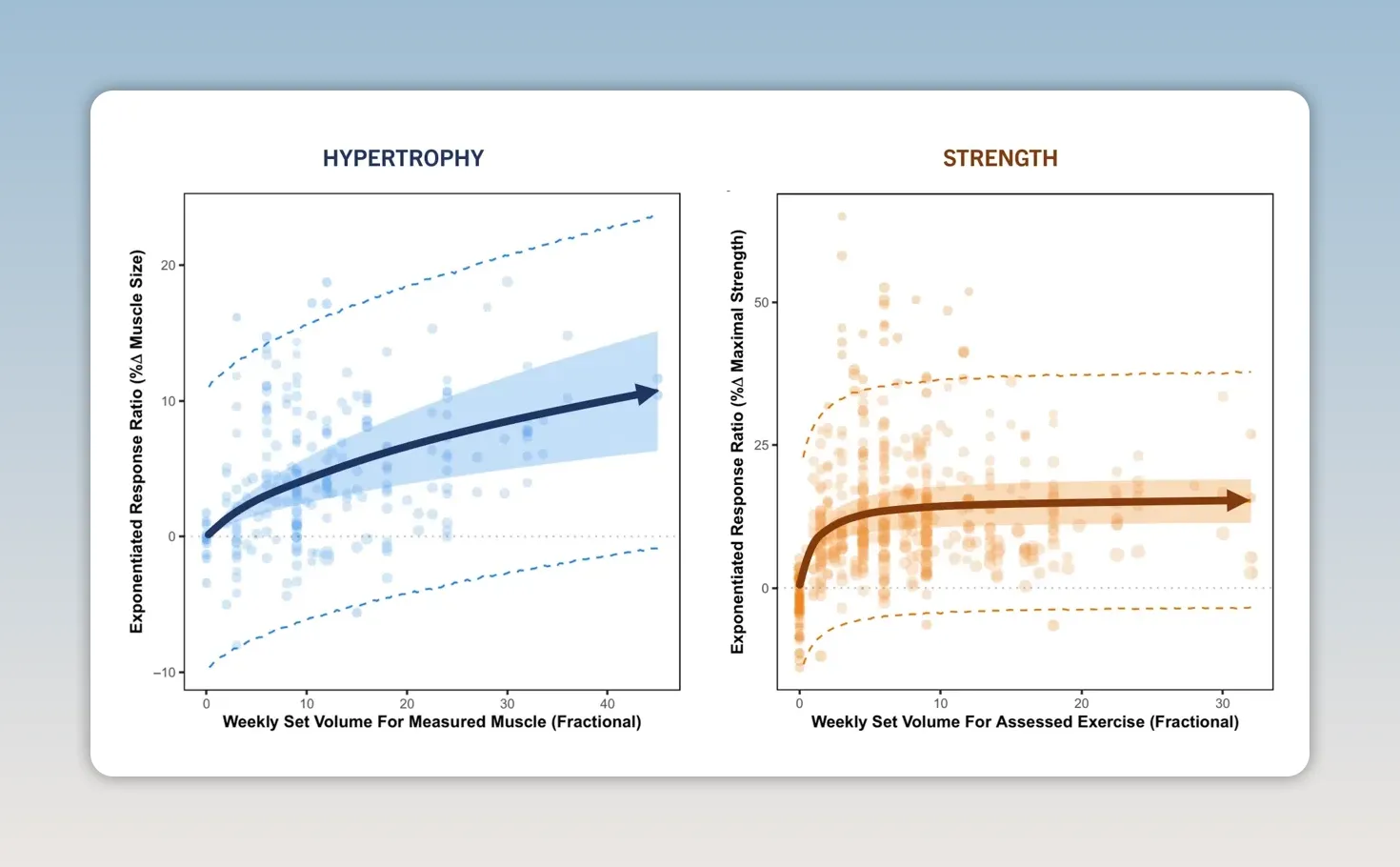
These findings do not mean everyone needs extremely high volume, or that five sets is a universal ceiling for strength. They describe overall relationships, and short-term improvements in a lift are not the same as maximizing long-term strength potential.
Practical weekly volume ranges
For hypertrophy, useful general guidelines are:
- Around 5 sets per muscle per week: a minimum-dose approach that can produce some growth in many cases.
- Around 10 to 20 sets per muscle per week: a general range for substantial growth.
- More than 20 sets per muscle per week: potentially useful when trying to maximize growth of a priority muscle.
For strength, around 5 to 10 sets per lift per week appears sufficient to capture much of the short-term benefit. More technical tasks, such as Olympic lifts or certain gymnastics skills, may benefit from additional practice volume.
It can also be useful to include approximately 5 to 15 further weekly accessory sets targeting the prime movers. Those sets serve a different purpose: building the muscle that supports future strength development.
Progressive Overload: An Outcome for Strength, a Tool for Hypertrophy
Progressive overload means making training more challenging over time. Repeating exactly the same training indefinitely may produce initial progress, but eventually the stimulus becomes insufficient for further adaptation.
For strength, prioritize increasing load
In strength training, progressive overload closely resembles the goal itself. If you lift more weight in the target exercise while meeting the same rules and standards, your strength performance has improved.
Technique can become more efficient as part of this process. What matters is that the repetition still meets the required standard. This applies to the main strength lifts, not necessarily to accessories intended to grow a particular muscle.
A practical approach is to prioritize increasing load in the main lifts within approximately the 1 to 5 rep range, while progressing accessories with a muscle-building focus.
For hypertrophy, let progression follow adaptation
For muscle growth, progressive overload is a way to keep providing an effective stimulus. It is not something we need to force at the expense of the exercise's purpose.
The process is cyclical: effective training stimulates muscle growth, growth increases our capacity, and that increased capacity allows us to perform more demanding training.
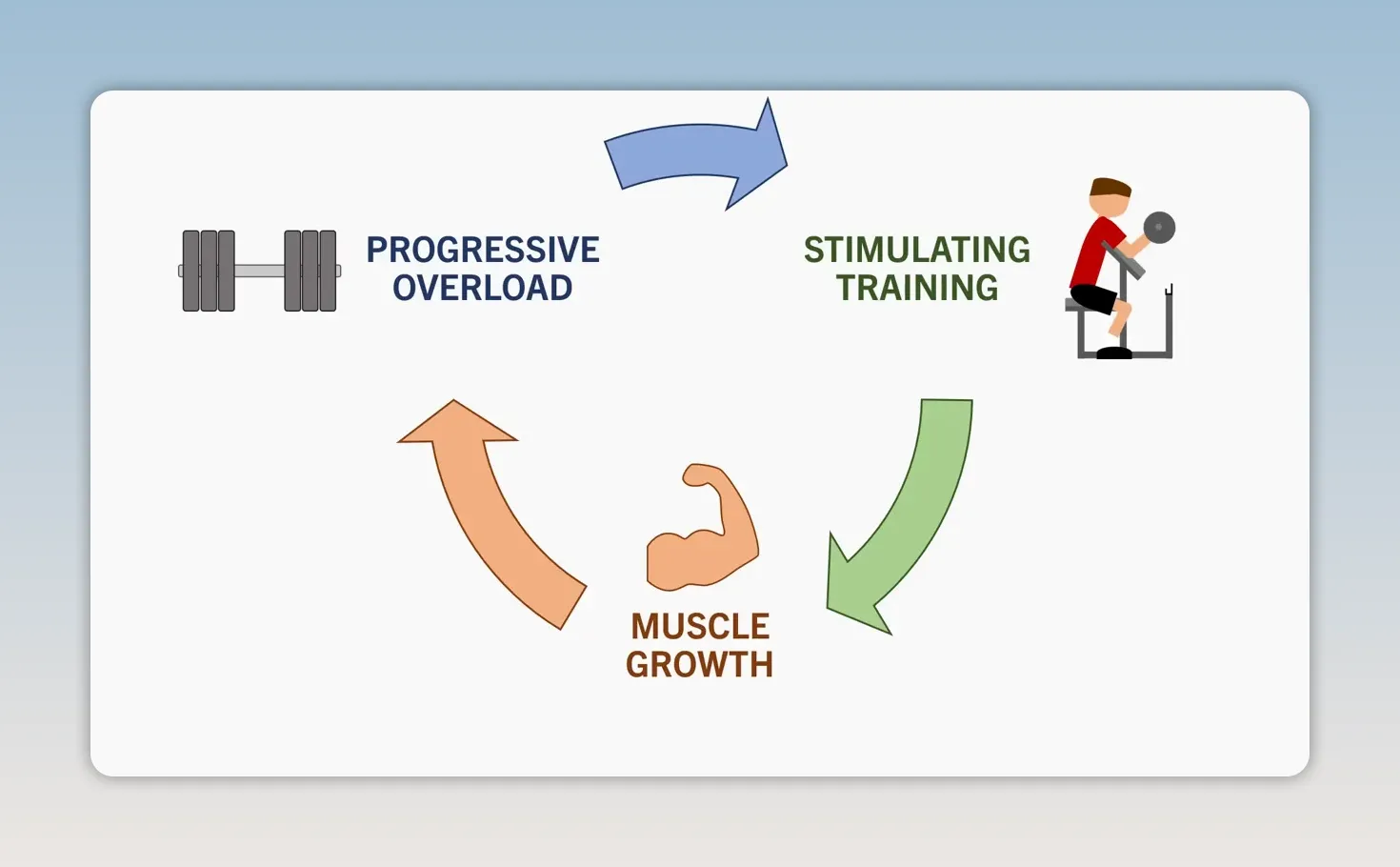
If sets remain close to failure, improved capacity will generally allow more repetitions with the same weight over time. Once repetitions become higher than intended, you can increase the load.
A study comparing rep progression with load progression tested this in 43 trained men and women. Participants performed lower-body training twice per week for eight weeks, taking all sets to failure. One group increased load after exceeding its rep targets, while the other kept the same load and added repetitions.
Both approaches produced similar increases in quadriceps and calf muscle thickness.
For hypertrophy, add repetitions, load, or both as your capacity improves. Do not sacrifice effective technique simply to record a higher number. Doing so can change the intended muscular stimulus and increase joint stress or irritation.
Reps and Load: Heavy for Strength, Flexible for Hypertrophy
Load and repetitions are separate variables, but they are directly related. Heavier weights limit how many repetitions we can complete, while lighter weights allow more.
For maximal strength, heavier loading is generally superior because it more closely resembles the task of lifting a maximal weight.
A meta-analysis of different loading ranges categorized training as:
- Light: loads permitting more than 15 repetitions.
- Moderate: loads corresponding to a 9 to 15 repetition maximum.
- Heavy: loads corresponding to an 8 repetition maximum or heavier.
For strength, heavy loads outperformed moderate and light loads, while moderate loads outperformed light loads. For hypertrophy, there were no clear advantages between the loading categories when sets were sufficiently demanding.
The practical distinction is straightforward:
- Strength priority: perform the specific strength lift with challenging loads, commonly for 1 to 5 repetitions.
- Hypertrophy priority: focus on getting close to failure rather than finding one supposedly optimal rep range.
For most hypertrophy work, approximately 5 to 15 repetitions per set is a useful general recommendation. It is a practical range, not a strict boundary beyond which muscle growth stops.
Exercise Selection: Practice the Lift or Target the Muscle
Choosing exercises for hypertrophy
The most important question is whether fatigue of the target muscle limits the set. If you continued to failure, the muscle you intend to grow should be the main reason you cannot complete another repetition.
Beyond that, several features may make an exercise somewhat more effective:
- Loading the muscle at longer lengths: exercises that place the target muscle under load in a stretched position appear favorable.
- Providing stability: reducing unrelated balance or stabilization demands can help the target muscle approach true muscular failure.
- Using complementary exercises: some muscles may benefit from more than one exercise rather than relying entirely on a single movement.
There is still considerable flexibility. Many exercises and combinations can work well if they allow the intended muscle to be trained hard.
Choosing exercises for strength
For strength, specificity remains the first priority. Perform the exercises you want to improve regularly enough to develop the relevant skill.
A meta-analysis comparing machines and free weights found no significant difference in muscle growth between them. Strength gains, however, favored the equipment used during training: machine training improved machine tests more, while free-weight training improved free-weight tests more.
Variation can still help manage joint stress and monotony. The appropriate amount depends partly on how close you are to a strength peak.
- Further from a peak: there is more room for exercise variations, different equipment, and techniques that emphasize muscle growth.
- Closer to a peak: training should increasingly resemble the competition lifts, technique standards, and equipment.
For example, a powerlifter several months from competition might use hack squats, dumbbell bench presses, and stiff-leg deadlifts to shift the emphasis toward hypertrophy and alleviate joint stress. As competition approaches, competition-style squats, bench presses, and deadlifts become more important.
Lifting Technique: Move More Weight or Stress the Target Muscle?
For strength, the aim is to use the most mechanically efficient technique permitted by the rules or personal standards being used. The purpose is to lift the most weight successfully.
For hypertrophy, technique serves a different purpose. Small technique differences may not dramatically change growth when sets are close to failure, but several strategies can help keep the work focused on the intended muscle:
- Include the lengthened portion of the movement. This can involve a full range of motion or partial repetitions through the lengthened half.
- Control the eccentric phase. The exact lowering duration is not especially important, but the muscles should actively lower the load rather than allowing it to drop.
- Limit external momentum. Aim for the target muscle to perform most of the work and become highly fatigued before unrelated muscles limit the set.
The squat illustrates the difference. A powerlifter may use a low-bar position and more forward torso lean to maximize the load while reaching the required competition depth. A hypertrophy-focused squat may use a more upright torso and greater depth to train the quadriceps and glutes through a larger range.
Neither approach is automatically better. The relevant question is which outcome the technique is intended to improve.
Training Frequency: More Practice Matters More for Strength
Frequency is the number of times a muscle group or specific lift is trained each week. To understand its independent effect, we need to compare schedules with the same total weekly volume.
For hypertrophy, frequency appears to have relatively little influence when volume is equated. Distributing a muscle's weekly sets across two or more sessions may offer a small advantage over completing everything in one session, but the difference is generally modest.
Strength has a stronger relationship with frequency. More frequent exposures provide additional opportunities to practice the movement in a relatively fresh state, rather than performing all the week's sets in one increasingly fatiguing session.
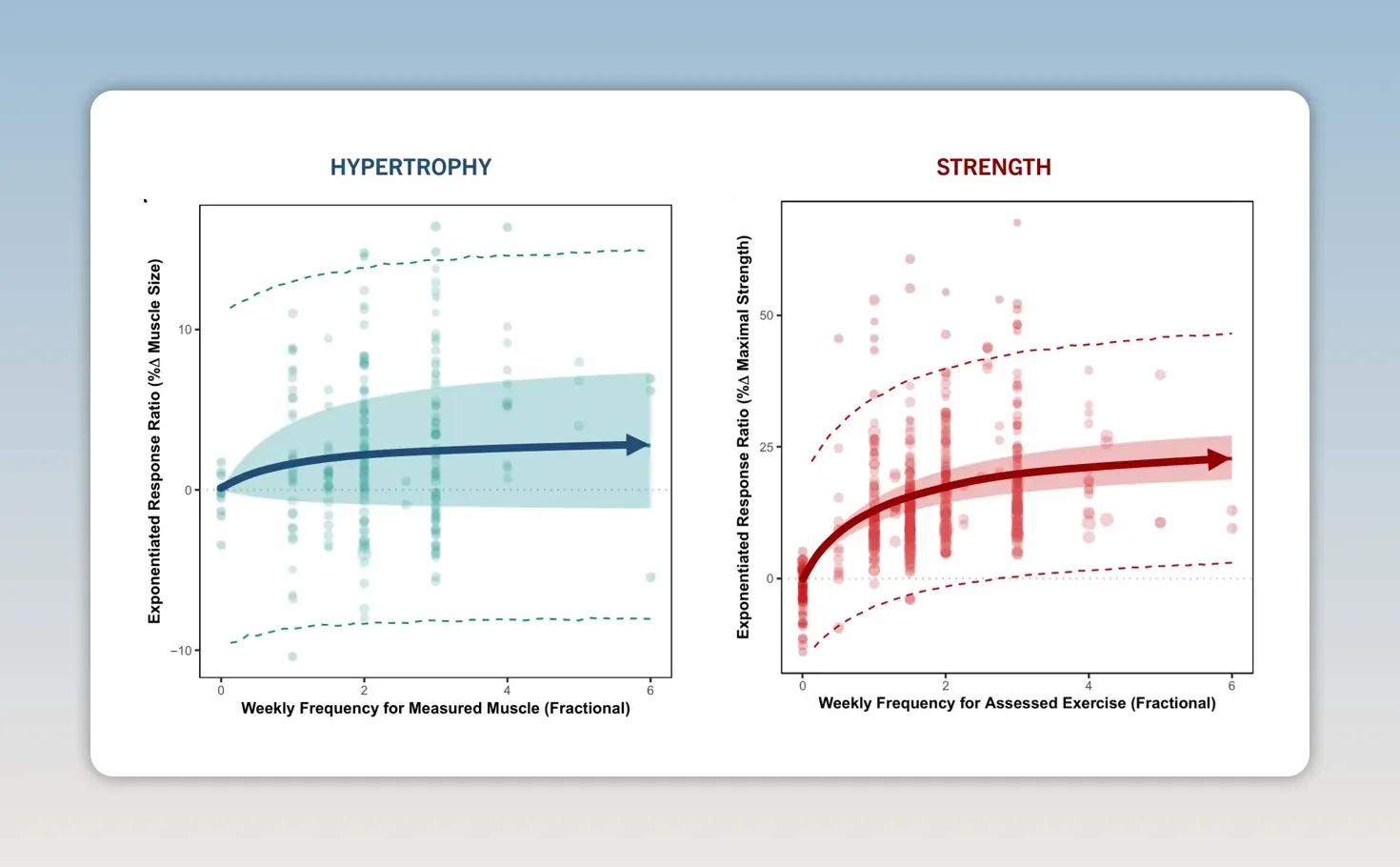
For muscle growth, organize frequency mainly around distributing the required volume. For strength, consider spreading the key lift's sets across more frequent sessions rather than concentrating them all into one workout.
Rest Periods: Balance Set Quality With Training Time
Both short and long rest periods can produce strength gains and muscle growth. However, longer rests generally support better outcomes on a per-set basis.
In a study comparing one-minute and three-minute rest periods, 21 resistance-trained men performed the same training routine. Both groups improved muscle thickness and squat and bench press 1RM, but the longer-rest group achieved superior strength gains and somewhat better muscle growth.
The trade-off is workout duration. Longer rests make each set more productive, but they also take time. Shorter rests may reduce the stimulus from each individual set while allowing more sets to fit into the same session.
Useful general recommendations are:
- Main strength lifts: rest approximately 3 to 6 minutes, depending on the exercise and the lifter, allowing enough recovery for the next set.
- Hypertrophy exercises: rest approximately 1 to 3 minutes as a compromise between set quality and time efficiency.
The goal is not to minimize rest for its own sake. It is to recover enough to perform useful work while keeping the session practical.
How to Prioritize Strength, Hypertrophy, or Both
Most resistance training contributes to both outcomes. The difference lies in how we organize the work and what we treat as the priority.
To prioritize strength: practice the specific lifts, use heavy loads, develop efficient technique within consistent standards, and prioritize increasing the weight lifted. Distribute practice across the week and allow enough rest to maintain performance.
To prioritize hypertrophy: select exercises that challenge the intended muscle, perform sufficient weekly volume, and take sets close to failure. Include the lengthened portion of the movement, control the lowering phase, and add reps or load without compromising effective technique.
To pursue both: use specific heavy work to develop performance in the main lifts, then apply hypertrophy principles to accessories that grow the relevant muscles. This combines practice of the strength task with development of the tissue that helps support it.
These are different emphases, not mutually exclusive training systems. A clear priority simply helps us decide where to spend limited training time, effort, and joint tolerance.
|