Time is one of the biggest barriers to consistent training. Work, school, family commitments, relationships, and social events all compete for space in the week. Even when we can make time to exercise, we may not want to spend most of our leisure time in the gym.
The solution is not necessarily to rush through everything or simply do less. Time-efficient hypertrophy training means getting a meaningful muscle-building stimulus within the time we are willing to invest.
There are several ways to improve that balance, from choosing a more convenient gym to adjusting training volume, rest periods, set structures, and exercise selection. Some can save time with little apparent downside. Others involve accepting a small reduction in stimulus in exchange for a substantially shorter workout.
Key Takeaways
- Time-efficient training balances workout duration with the muscle-building stimulus achieved.
- Convenient gym access and essential-only warm-ups can reduce time without cutting working sets.
- Noncompeting supersets can shorten sessions while preserving recovery between sets for each muscle.
- Adjust volume, rest periods, frequency, and exercise selection around your realistic weekly time budget.
Table of Contents
- What Makes a Workout Time Efficient?
- 1. Choose a Convenient Training Location
- 2. Keep Your Warm-Up Specific to Your Needs
- 3. Allocate Training Volume According to Your Priorities
- 4. Consider Fewer Weekly Sessions Without Cutting Weekly Work
- 5. Adjust Rest Periods to Match Your Time Budget
- 6. Use Alternative Set Structures
- 7. Select Exercises With Their Full Time Cost in Mind
- Build Your Program Around Realistic Time Constraints
What Makes a Workout Time Efficient?
Time efficiency has two components: workout duration and the hypertrophic stimulus achieved during that workout.
We could dramatically shorten a session by removing most of the training, but that would probably reduce its effectiveness. The more useful question is which changes reduce time without having a major negative effect on muscle growth.
The right balance depends on your priorities:
- To maximize muscle growth: You may accept longer workouts to obtain every worthwhile additional benefit.
- To build muscle within a limited schedule: You may accept a slightly smaller stimulus if it substantially reduces the time commitment.
Neither approach is inherently better. The aim is to make deliberate trade-offs rather than assuming that the longest workout is always the most appropriate one.
1. Choose a Convenient Training Location
The time cost of training begins before the first set. Traveling to and from the gym can add 30 minutes or more to a session.
Distance alone does not tell the whole story. A nearby facility might still involve getting into the car, sitting in traffic, and searching for parking. A gym farther from home could be more convenient if it is next to work or school and fits naturally into your day.
When comparing facilities, consider how easily you can access them before, after, or during your existing commitments. If several suitable gyms are available, the most convenient option can reduce the total time investment without changing the training itself.
Of course, convenience is not the only consideration. Cost, equipment, atmosphere, the people who train there, and how busy it gets may justify choosing a less convenient location. The point is to include travel time in the decision rather than treating it as separate from the workout.
2. Keep Your Warm-Up Specific to Your Needs
An extensive warm-up can take 20 to 30 minutes before the working sets even begin. Light cardio, stretching, foam rolling, mobility drills, activation exercises, rehabilitation work, and multiple preparation sets all add up.
For hypertrophy-style training, there is little reason to include every component automatically.
In a study comparing warm-up strategies, 15 men with an average of about eight months of lifting experience completed four sets of bench presses, squats, and biceps curls at 80% of one-repetition maximum. They performed as many repetitions as possible under four conditions:
- No warm-up.
- A specific lifting warm-up.
- An aerobic warm-up.
- A combination of aerobic and specific warm-ups.
Total repetition performance was similar, with no consistent pattern favoring one condition. This does not establish that warm-ups never matter, or answer every question about injury risk. It does suggest that an elaborate routine is not automatically necessary to support repetition performance in this context.
Some elements can still be useful:
- Preparation sets before heavy compound lifts can help you feel physically and mentally ready.
- Light cardio can provide additional physical activity if you are otherwise inactive for much of the day.
- Specific rehabilitation or preparation exercises may help you manage an existing pain or injury issue.
A practical starting point is one or two warm-up sets before your primary compound lifts. Adjust from there according to the exercise and your needs. Keep additional components when they provide a clear benefit, rather than including them simply because they are commonly presented as mandatory.
3. Allocate Training Volume According to Your Priorities
Training volume here refers to the number of sets performed for a muscle group each week. It has one of the largest influences on total training time.
With other variables held constant, adding sets increases time approximately linearly. The relationship between volume and muscle growth is different.
A meta-regression examining training volume and frequency supports a dose-response relationship in which more weekly sets generally produce more growth, but with diminishing returns. Each additional set appears to contribute less additional benefit as volume rises.
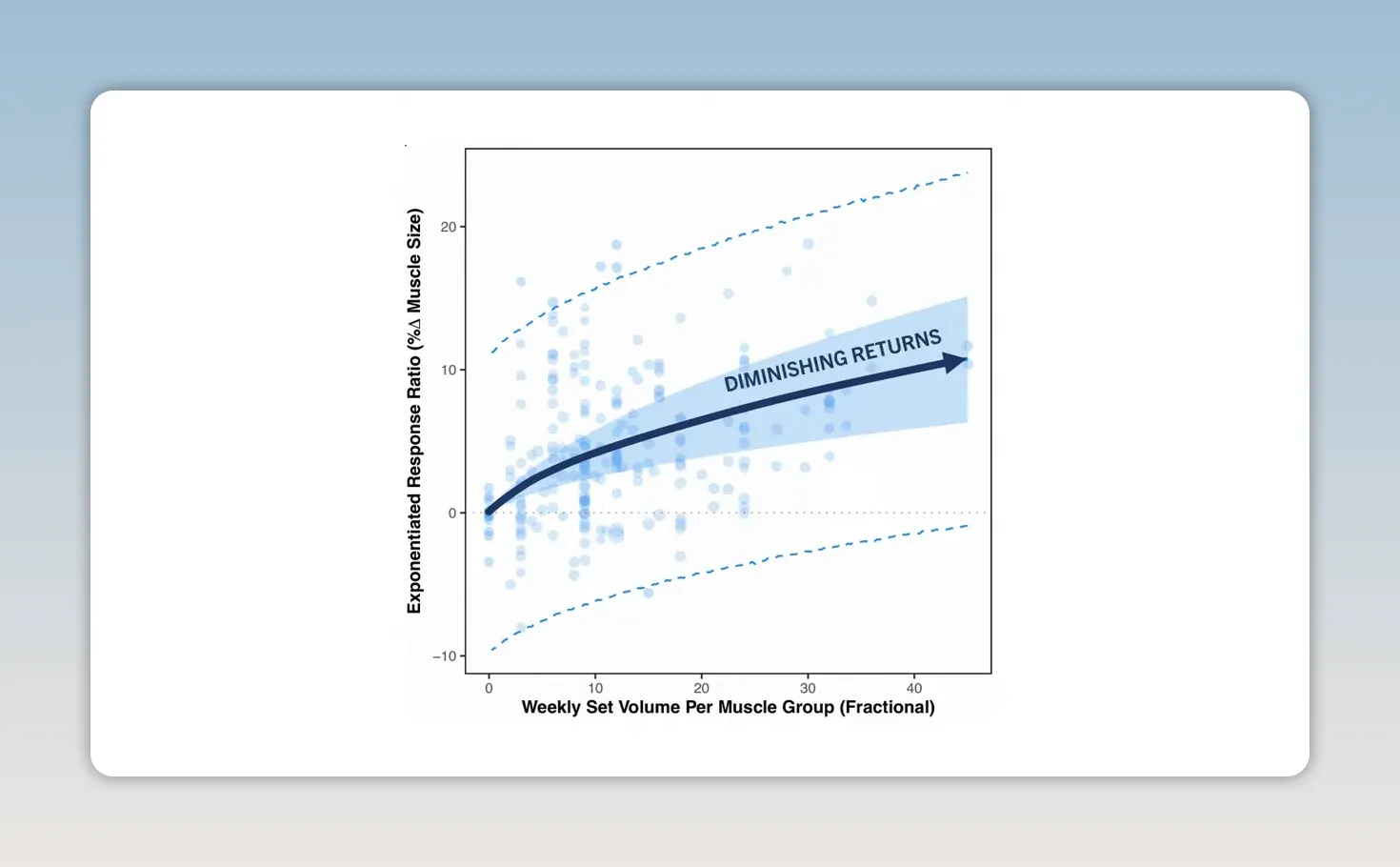
This creates two reasonable approaches.
Higher Volume for Maximum Growth
If maximizing growth is the overriding goal, training important muscles toward the higher end of your volume range may be appropriate. It requires more time, and the extra return becomes progressively smaller, but that may still be worthwhile to you.
Lower Volume for a Better Return on Time
If the goal is substantial progress within a shorter schedule, a lower-volume approach can be more appropriate. You can still achieve notable muscle growth, with considerably less time spent training. The trade-off is that growth may be slower than with a more extensive program.
You also do not have to give every muscle the same allocation. Higher-priority muscles can receive more sets, while muscles you are less concerned about developing receive fewer.
Spend your limited training time where the additional growth matters most to you.
4. Consider Fewer Weekly Sessions Without Cutting Weekly Work
Training frequency refers to how often we train. To understand its effect on time efficiency, we need to distinguish between adding workouts and redistributing the same amount of work.
Four one-hour workouts clearly take more time than three one-hour workouts. But what if the total exercises and sets remain unchanged?
Condensing a four-day program into three days makes each session longer, but it can reduce the weekly time commitment by removing one round trip to the gym and one session’s preparation and general warm-up.
When weekly volume is equated, frequency does not appear to have a major independent effect on hypertrophy. Distributing the work across more days may offer a small advantage, but it is not generally a dominant factor in muscle growth.
Avoid Cramming Too Much Work Into One Session
There is a limit to how useful consolidation can be. A preprint meta-regression on per-session volume suggests diminishing returns as the number of sets for a muscle within a workout increases, particularly beyond roughly 10 sets.
That is not a hard cutoff beyond which sets suddenly become useless. It is a practical reason not to compress a high-volume program into excessively demanding sessions.
Reducing frequency is most attractive when:
- The resulting sessions remain a manageable length.
- Traveling to and from the gym takes a meaningful amount of time.
- You can generally avoid exceeding about 10 sets for an individual muscle in one workout.
For someone with a long commute, one fewer weekly gym visit may save more time than several small changes within the workout.
5. Adjust Rest Periods to Match Your Time Budget
Rest periods often account for most of a hypertrophy workout. The actual lifting can occupy a surprisingly small proportion of the session.
Consider a simplified budget for 20 working sets, each lasting about 30 seconds:
- Lifting time: Approximately 10 minutes.
- Rest allocation at two minutes per set: Approximately 40 minutes.
- Combined time: Approximately 50 minutes, before other preparation and transitions.
In that example, about 80% of the allocated time is rest. The exact total depends on where rests and exercise changes occur, but the main point is clear: changing rest duration can have a large effect on session length.
Do Longer Rest Periods Build More Muscle?
A meta-analysis of nine studies on rest intervals and hypertrophy found that a range of rest durations supported muscle growth. Overall estimates favored moderate rests of around one to two minutes over very short rests of less than one minute, although the findings varied with the measurement method.
Direct measurements, such as muscle thickness and cross-sectional area, tended to favor longer rests for the arms and thighs. Whole-body measurements, such as DEXA and bioelectrical impedance, favored shorter rests in the three studies using those outcomes.
My interpretation is that the evidence leans slightly toward moderate to longer rest periods, particularly when considering direct muscle measurements. Very short rests can still build muscle, but may provide a somewhat smaller stimulus per set.
The likely trade-off is straightforward: longer rests may improve the stimulus from each set, but they also make the workout longer. I would expect diminishing returns in the growth benefit, rather than every additional minute producing an equivalent improvement.
Shorter Rests Can Substantially Reduce Session Duration
Returning to the 20-set example, reducing the rest allocation from two minutes to one minute cuts it from roughly 40 minutes to 20 minutes. Combined with 10 minutes of lifting, the estimated workout falls from about 50 minutes to 30 minutes.
That may involve a small compromise in stimulus, but the time saving is substantial.
Shorter Rests Also Increase Training Density
Training density is the amount of work completed within a given period. Instead of finishing earlier, you could use shorter rests to complete more work in the same time.
Assuming 30-second sets and ignoring other time costs, a 45-minute window could accommodate approximately:
- 18 sets with two-minute rests.
- 30 sets with one-minute rests.
These are time-budget illustrations, not a recommendation that everyone should perform 30 sets. There is no direct comparison here establishing that the shorter-rest, higher-volume option produces better growth.
I would hypothesize that it could be similar or superior in some circumstances because volume appears to have a stronger relationship with hypertrophy than rest duration. However, that remains an inference rather than a demonstrated outcome.
Longer rests may improve stimulus per set. Shorter rests can improve stimulus per minute. Which matters more depends on your constraints.
6. Use Alternative Set Structures
We can also organize sets differently to reduce inactive rest time. Three useful options are supersets, drop sets, and myo-reps.
Antagonist and Noncompeting Supersets
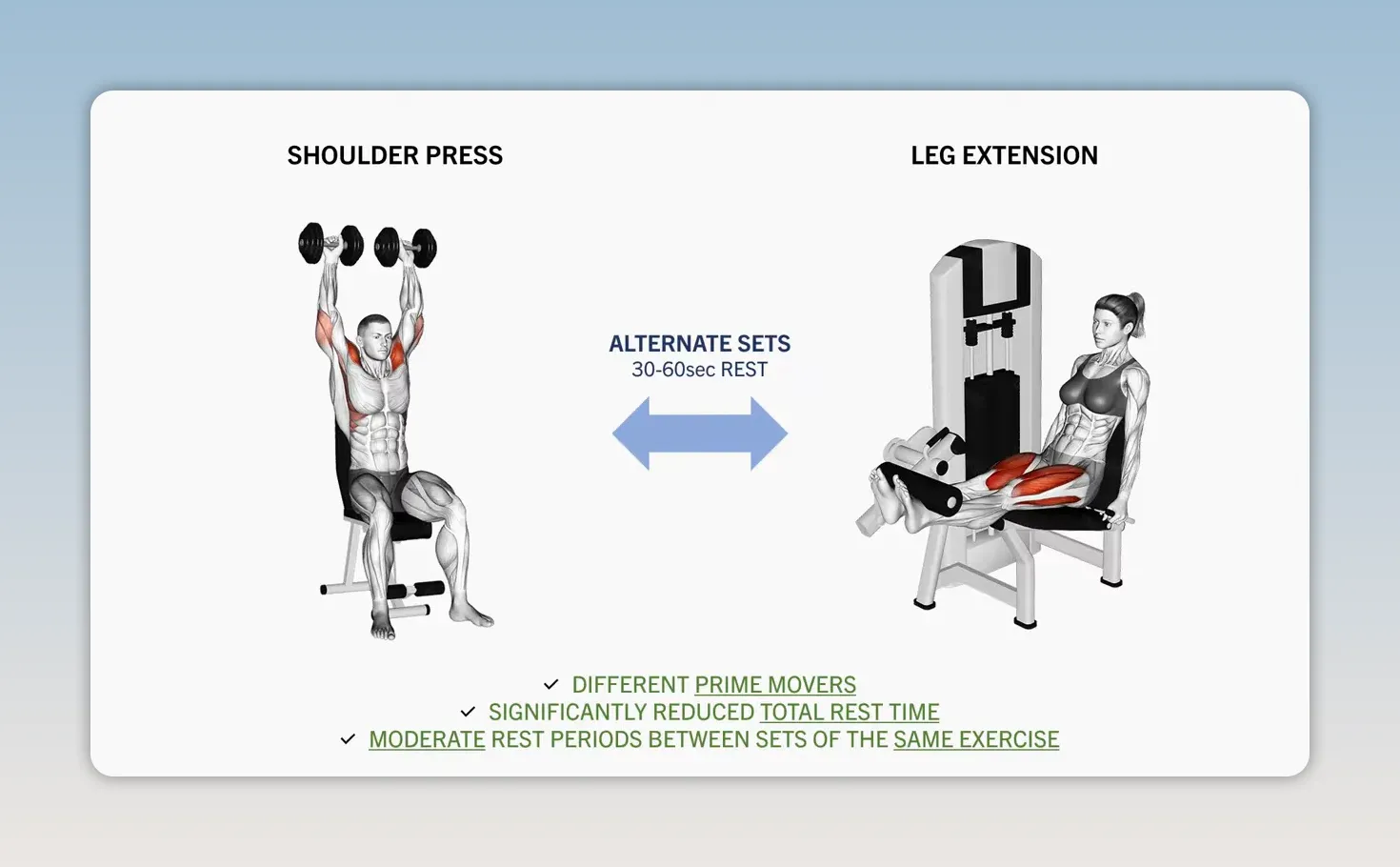
Supersets alternate between two exercises. For time efficiency, the important feature is choosing exercises that do not use the same muscles as their prime movers.
True antagonist pairings train opposing muscle groups, such as leg extensions and leg curls. Noncompeting pairings can also work, such as a shoulder press paired with a leg extension.
In the shoulder press and leg extension example, the shoulders recover while the quadriceps work, and vice versa. There is less inactive time between exercises, while each muscle still receives a reasonable interval before it works again.
Two studies help illustrate the potential:
- In a six-week study of 16 untrained men, participants performed three sets each of leg curls and leg extensions using either traditional sets or paired sets. Both approaches maintained two minutes between sets of the same exercise. Quadriceps and hamstring growth was similar, but paired-set sessions were significantly shorter.
- In a preprint study of 43 trained men and women, traditional training was compared with performing two antagonistic exercises before a two-minute rest. Muscle thickness increased similarly across the measured muscles, while superset sessions were about 25 minutes shorter on average.
This makes noncompeting supersets particularly attractive: they can reduce workout duration without requiring the same reduction in local muscle recovery that occurs when simply shortening rests between repeated sets of one exercise.
The main limitation is practical. Occupying two stations may not be feasible in a busy public gym. At home, two exercises may require the same piece of equipment with incompatible setups. Choose pairings that work in the facility you actually use.
Drop Sets
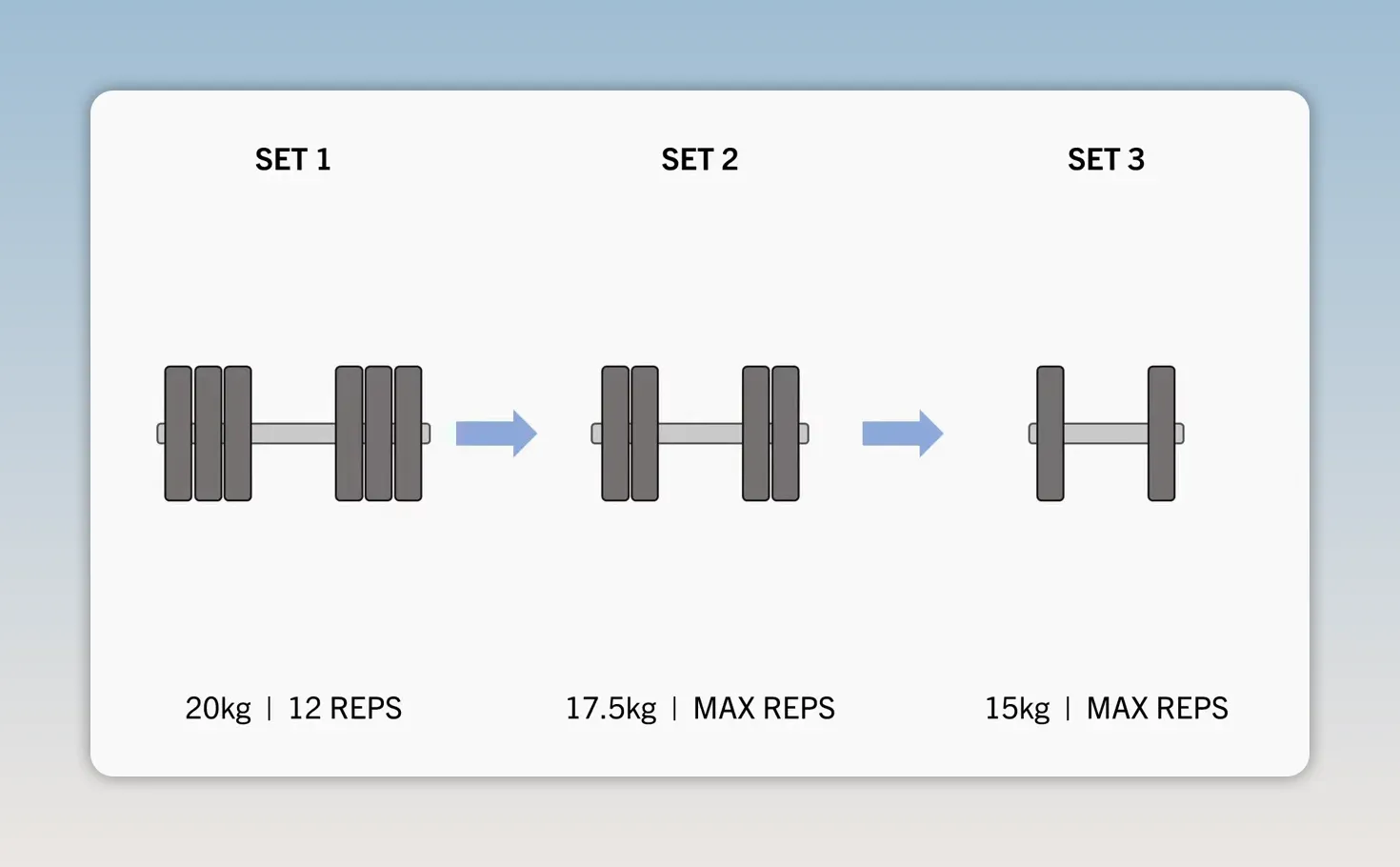
A drop set begins with a set taken to or close to failure, followed almost immediately by another set with a lighter load. You can repeat the load reduction more than once.
For example:
- Perform 12 repetitions with 20 kg, reaching failure.
- Reduce the load to 17.5 kg and immediately perform as many repetitions as possible.
- If planned, reduce the load again to 15 kg and repeat.
This allows repeated efforts near failure without extended rest periods.
A small study involving nine untrained men compared dumbbell curl protocols using three traditional sets to failure at either 80% or 30% of one-repetition maximum, or one set at 80% followed by four load reductions.
Biceps cross-sectional area increased similarly across the conditions, but the drop-set protocol took significantly less time.
Individual drop efforts may provide less stimulus than fully rested traditional sets, but their greater density can make the overall approach effective within a shorter period.
Exercise choice matters. Highly fatiguing compound free-weight lower-body lifts are less suitable, particularly when reaching true muscular failure would be difficult to manage safely.
Myo-Reps
Myo-reps use short rests rather than repeated load reductions:
- Perform an activation set of approximately 10 to 15 repetitions to or very close to failure.
- Rest for about 10 to 30 seconds.
- Perform a mini-set with the same load, typically achieving far fewer repetitions.
- Repeat the short-rest and mini-set sequence until you complete the planned number of mini-sets or reach a repetition target.
For example, you might perform 12 lat pulldowns with 50 kg, rest for 30 seconds, and then complete three to six more repetitions with the same load. Further mini-sets follow the same pattern.
Like drop sets, this structure allows several efforts near failure within a short period.
I am not aware of direct hypertrophy evidence specifically testing this exact myo-rep structure. Based on related methods and the rest-period research, I would expect a similar trade-off to drop sets: a mini-set may be less stimulative than a fully rested traditional set, but more efforts can fit into the available time.
That makes myo-reps a plausible time-saving option, not a technique we can confidently claim is superior or definitively equivalent.
7. Select Exercises With Their Full Time Cost in Mind
Exercise selection affects session duration largely through preparation and recovery requirements.
Some lifts require more technical preparation, psychological readiness, and progressive warm-up sets. Some also create enough fatigue that longer rests are needed before another productive set.
Compound free-weight lower-body movements often have higher requirements in both areas. Machines and isolation exercises can often be completed with less preparation and shorter rest periods.
Back Squats Versus Leg Extensions: A Time Example
Consider an illustrative comparison of four working sets:
- Barbell back squat: Seven minutes of preparation, followed by four 30-second sets and three rests averaging two and a half minutes, totals approximately 16.5 minutes.
- Leg extension: About one minute of preparation, followed by four 30-second sets and three 90-second rests, totals approximately 7.5 minutes.
These are examples, not fixed requirements. A strong lifter may need several preparation sets before squatting. A leg extension may require only a brief warm-up, depending on the person.
The broader point is that two exercises with the same number of working sets can have very different total time costs.
Local Muscle Growth Versus Whole-Body Effects
Compound exercises, isolation exercises, machines, and free weights can all effectively develop their target muscles. That does not mean they produce identical growth across every muscle involved.
In a study of 63 untrained women, Smith machine squats and leg extensions were performed twice weekly for eight weeks. Overall quadriceps muscle-thickness increases were similar. However, leg extensions produced greater rectus femoris growth, while squats produced greater vastus lateralis growth.
For whole-body outcomes, compound exercises may offer additional benefits because they involve more musculature, including accessory and stabilizing muscles.
A study of 36 amateur soccer players compared programs consisting mostly of compound or mostly of isolation exercises, performed three times weekly for eight weeks. Both improved body composition, but the compound-focused program produced somewhat greater gains in fat-free mass.
This supports a useful distinction: an exercise can be time efficient for a particular target muscle without necessarily providing the same broader stimulus as a compound movement.
For a time-limited hypertrophy routine, I would generally favor lower-fatigue machines and isolation exercises, while retaining some compound free-weight lifts where their broader benefits are valuable.
Build Your Program Around Realistic Time Constraints
The most practical approach starts with the schedule you can realistically maintain, rather than an ideal program with no time limit.
- Define your weekly availability. Decide how many days you are willing to train and how much time you can spend on each visit.
- Account for the whole commitment. Include travel, preparation, and warm-ups, not just working sets.
- Allocate volume by priority. Give more work to the muscles you most want to develop and accept a lower allocation elsewhere.
- Choose a manageable frequency. Consolidate sessions when it saves meaningful overhead without creating excessively long or crowded workouts.
- Adjust rest periods and set structures. Use noncompeting supersets where practical, and consider shorter rests, drop sets, or myo-reps when their trade-offs suit the exercise.
- Select exercises that fit the budget. Consider preparation time and recovery demands alongside the muscles trained.
The goal is not to make every session as short as possible. It is to obtain the best training stimulus within a time investment that makes sense for your life. Removing unnecessary preparation, organizing rest more intelligently, and making deliberate choices about volume can make effective muscle-building training considerably more manageable.


