Training should reflect the outcome you want to achieve. Building muscle, lifting a heavier weight, improving sport performance, and maintaining long-term health all involve exercise, but they do not require exactly the same approach.
Most training goals fall into three broad categories:
- Body composition: increasing muscle mass, reducing body fat, or both.
- Performance: improving a measurable athletic output, such as strength, running speed, or sport-specific performance.
- Health and longevity: developing and maintaining physical capacities that support health, function, and quality of life.
There is considerable overlap between these categories. However, understanding what drives each outcome allows us to allocate training time and effort more effectively.
Key Takeaways
- Muscle growth requires appropriate exercises, challenging sets, and sufficient weekly training volume.
- Fat loss combines a calorie deficit with sufficient protein, physical activity, and muscle-preserving resistance training.
- Performance training should develop the specific skills and physical qualities required by the event.
- Health-focused training combines resistance exercise, cardiorespiratory fitness, and a sustainable body composition.
Table of Contents
- Training for Body Composition
- Training for Strength
- Training for Sport Performance
- Training for Health and Longevity
- Combining Goals and Understanding the Trade-Offs
Training for Body Composition
Body composition refers to what the body is made of. From a training and nutrition perspective, the main tissues we are trying to manipulate are muscle and fat. Most people pursuing a body composition goal want to gain muscle, lose fat, or achieve some combination of the two.
How muscle growth occurs
Muscle growth, or hypertrophy, is an increase in muscle size. To understand it, we can think of muscle as a series of structures nested within one another: myofibrils make up the contractile machinery inside muscle fibers, and many muscle fibers make up a whole muscle.
Three adaptations are relevant to discussions of muscle growth, although the evidence supporting them differs.
- Myofibrillar hypertrophy: an increase in the contractile material within muscle fibers. As individual fibers grow, the whole muscle increases in size.
- Sarcoplasmic hypertrophy: an increase in the non-myofibrillar components of the muscle fiber, including fluid and other structures involved in muscle function. In theory, this could increase muscle size without a proportional increase in force-producing tissue. Its extent and contribution to human muscle growth remain less clearly established.
- Hyperplasia: an increase in the number of muscle fibers. This has been observed in animal research, but its relevance to human training adaptations is not well established. We cannot confidently prescribe a specific training method to target it.
The practical point is that we do not need to resolve every detail of muscle physiology to train effectively. The main programming variables are much more straightforward.
How to train for muscle growth
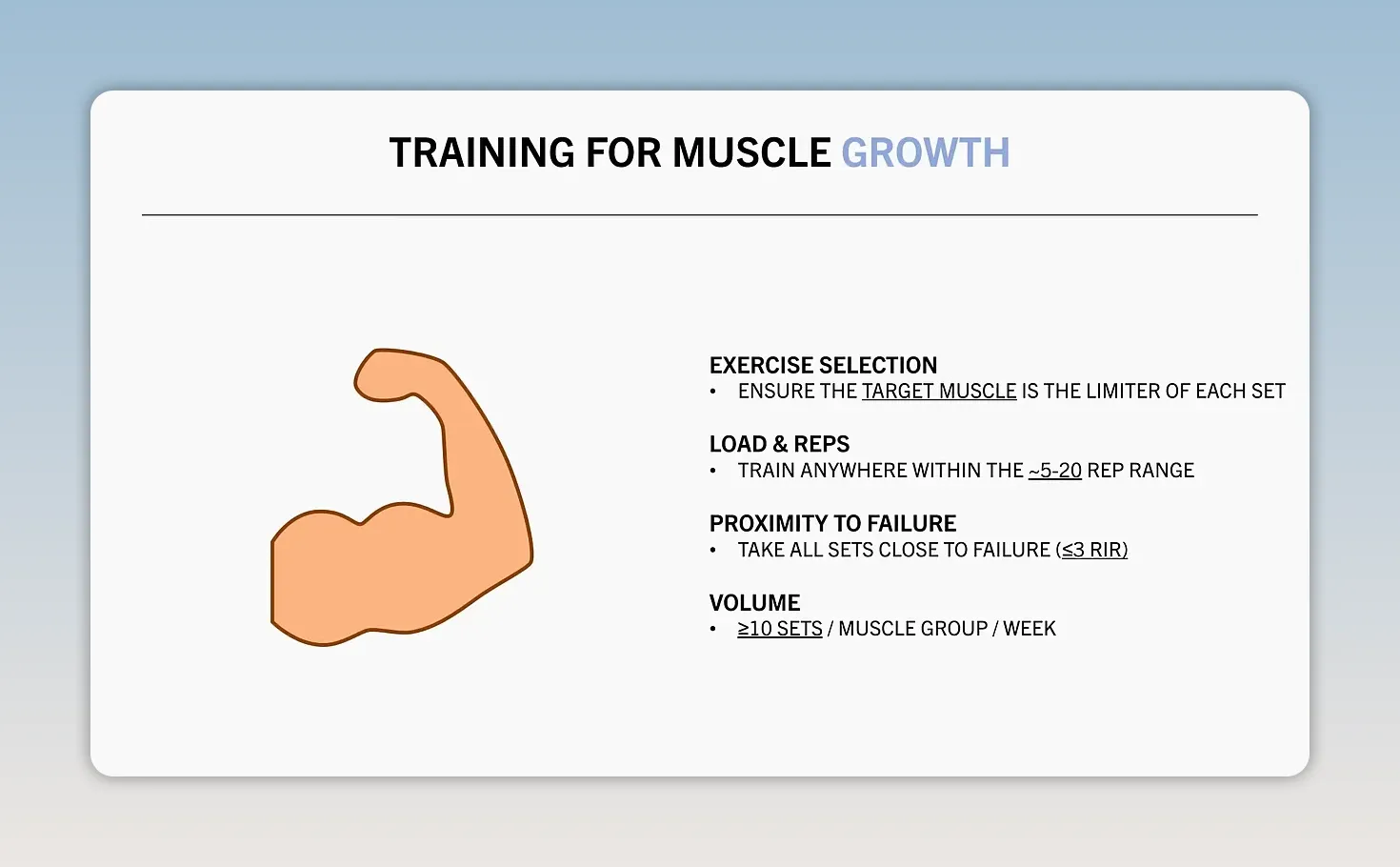
A useful general framework for hypertrophy training is to select appropriate exercises, use a practical repetition range, train sufficiently close to failure, and accumulate enough weekly volume.
- Exercise selection: choose exercises in which the target muscle is what limits the set. If another factor consistently makes you stop first, the exercise may not be doing the intended job particularly well.
- Loading: loads that allow approximately 5 to 20 repetitions per set provide a useful general range.
- Effort: take working sets close to failure, generally within about three repetitions in reserve. This means finishing when you estimate that you could perform no more than roughly three additional repetitions.
- Volume: moderate to high training volumes are generally useful for maximizing hypertrophy. Around 10 or more sets per muscle group per week is a broad reference point, with higher volumes potentially useful when the additional time and effort are justified.
These are general recommendations rather than a complete prescription. Individual exercises, muscle groups, and training circumstances introduce further nuance, but these variables provide a solid foundation.
How to lose fat while preserving muscle
Fat loss is a reduction in adipose tissue. Aesthetically, this reveals more of the shape of the muscle underneath, creating greater muscle definition.
However, losing body weight and improving body composition are not necessarily the same thing. Ideally, most of the weight lost comes from fat rather than muscle. Three components help achieve this: nutrition, general physical activity, and resistance training.
1. Establish an appropriate calorie deficit
Nutrition is the most important component to get right for weight loss. A calorie deficit means consuming fewer calories than you expend, on average, over time.
As a general guideline, aim to lose no more than approximately 1% of body weight per week. A more modest rate of loss can help make the diet easier to maintain and improve the likelihood of preserving muscle.
Protein intake also matters. A useful minimum reference point is approximately 1.5 grams per kilogram of body weight per day, or about 0.7 grams per pound. Higher intakes may provide additional benefits, but meeting a sufficient baseline is the first priority.
The combination we are looking for is a manageable calorie deficit and enough protein to support muscle retention. For a more detailed explanation of the nutrition setup, see this guide to setting calories and macros for muscle growth and fat loss.
2. Use physical activity to support energy expenditure
General physical activity includes any movement that expends energy. This covers intentional exercise, such as running or playing sport, as well as everyday movement, such as walking around a supermarket.
Daily step counts provide a useful, although incomplete, overview of activity. They capture a mixture of exercise and non-exercise movement without requiring us to track every individual action.
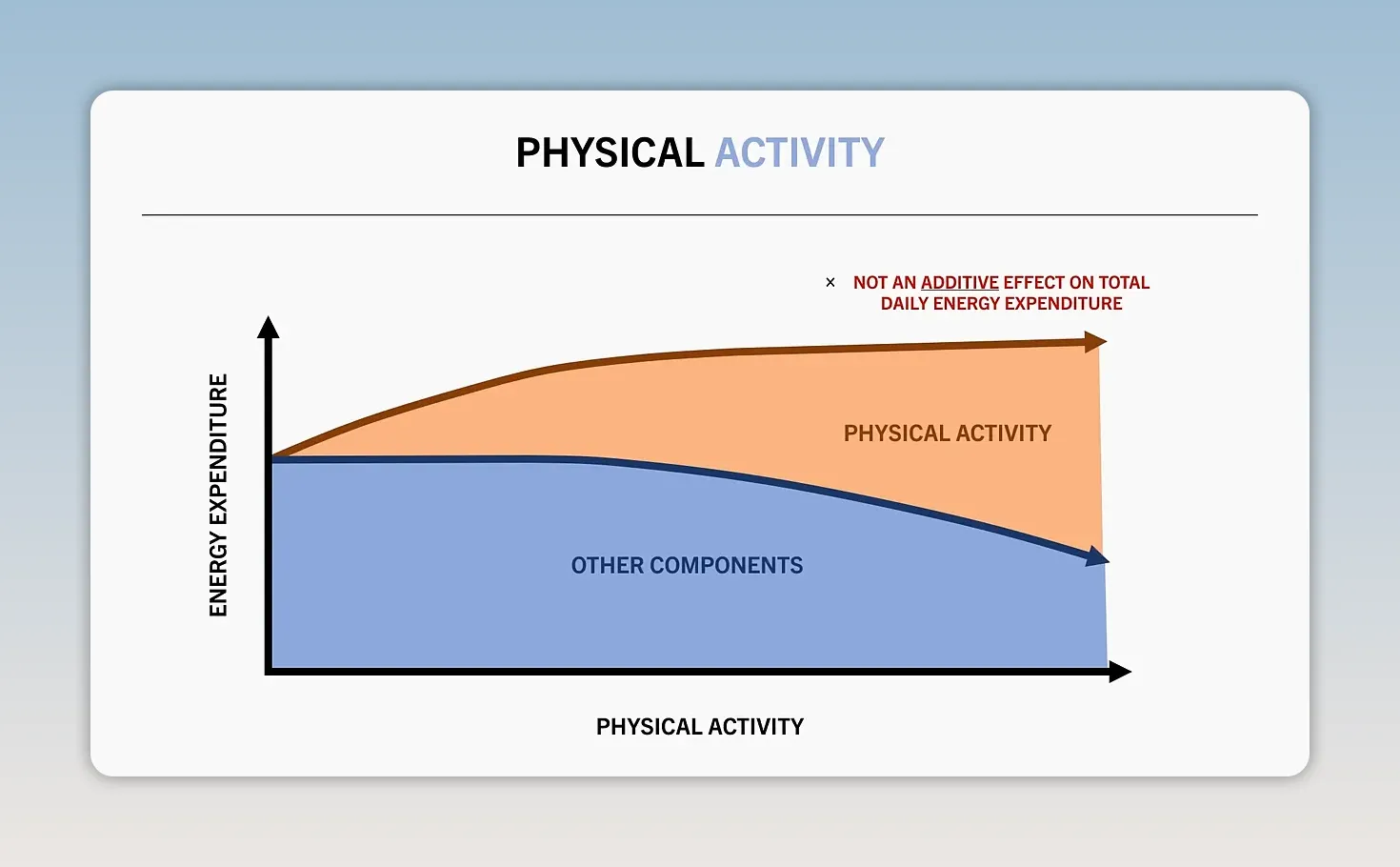
More activity can help create a calorie deficit, but the relationship between exercise and total daily energy expenditure is not necessarily linear. Under the constrained energy expenditure model, additional exercise expenditure may be partly offset by changes in other components of daily expenditure.
In practical terms, adding more exercise can produce diminishing returns for weight loss. This does not mean activity stops being useful. It means that continually adding exercise may eventually become an inefficient way to make the deficit larger.
Around 10,000 steps per day is a reasonable general target for someone aiming to reduce body weight, rather than a requirement or a special threshold. Going beyond it is an option, but the extra time and effort should be considered alongside the potential compensatory response.
3. Keep resistance training focused on muscle retention
A modest deficit and sufficient protein help preserve muscle, but resistance training supplies the stimulus to maintain it.
The body still needs a reason to retain muscle tissue during weight loss. Nutrition alone does not replace that training stimulus.
Train to retain muscle in much the same way you would train to build it. The same broad principles apply: appropriate exercises, sufficiently challenging sets, and an adequate training volume.
Depending on the individual context, it may even be possible to gain some muscle during a weight-loss phase. In most cases, however, the main expectation should be to retain as much existing muscle as possible while reducing body fat.
Training for Strength
Performance training aims to improve a specific athletic output. Strength is one example: the goal is to lift more weight in a particular exercise under particular conditions.
In powerlifting, this means maximizing the squat, bench press, and deadlift for one repetition. In weightlifting, it means maximizing the snatch and the clean and jerk.
The rules matter, too. Most powerlifting federations, for example, require the hip crease to descend below the top of the knee for a squat to count. Strength performance is therefore not simply about moving a load somehow. It is about moving that load within the requirements of the event.
Two broad adaptations improve strength: greater lifting efficiency and more relevant muscle mass.
Improve lifting efficiency
Lifting efficiency describes how much weight you can lift with your current body weight and body composition. You can become stronger without gaining muscle by getting better at expressing the strength you already possess.
This happens through neural and technical adaptations.
Neural adaptations help the involved muscles produce and coordinate force more effectively. These include recruiting more of the available muscle fibers, improving coordination between muscles, and reducing unnecessary opposing activity.
Technical improvements allow you to move the load more efficiently. They may involve finding a better movement path, controlling tempo to improve stability, or making effective use of the stretch-shortening cycle where the lift allows it.
The most direct way to improve efficiency is specific practice. Three variables determine much of that specificity:
- Exercise: practice the lift you want to improve.
- Loading: heavier loads more closely resemble the demands of a one-repetition maximum.
- Technique: practice the technique you intend to use in competition, within the rules of the event.
Highly specific training can produce rapid initial strength improvements. However, efficiency has limits. Once you are close to maximizing what you can lift with your current muscle mass, further progress becomes more difficult.
Build muscle that contributes to the lift
Increasing the size of the prime movers creates more contractile tissue that can contribute to force production. With other factors held equal, a larger muscle has greater strength potential than a smaller one.
Training specifically for strength will usually build some muscle, particularly early in a lifting career. For a more experienced lifter, however, that stimulus may no longer be sufficient to maximize further growth. More direct hypertrophy work can become useful.
The basic muscle-building recommendations still apply, but two considerations become especially important for strength transfer:
- Choose relevant movement patterns. Some hypertrophy exercises should resemble the competition lift closely enough to train its prime movers and the muscle regions most involved.
- Allocate volume according to contribution. Spend more effort developing the muscles that actually limit the lift rather than distributing training equally across every muscle group.
For example, if improving squat performance is the priority, additional work for the quadriceps and glutes is generally more relevant than putting the same time and effort into calves and biceps.
Use periodization to shift the emphasis
Periodization is strategic long-term programming. It allows us to emphasize different qualities at different stages rather than trying to maximize everything at once.
For strength development, a useful general progression is:
- Earlier in the training cycle: emphasize muscle growth to increase future strength potential. Continue practicing the competition lifts, but they may be performed less heavily or less frequently.
- As the target event approaches: gradually place more emphasis on specific lifting efficiency.
- Near the performance peak: prioritize expressing strength with the muscle mass you currently have, while reducing some accessory volume rather than removing hypertrophy work altogether.
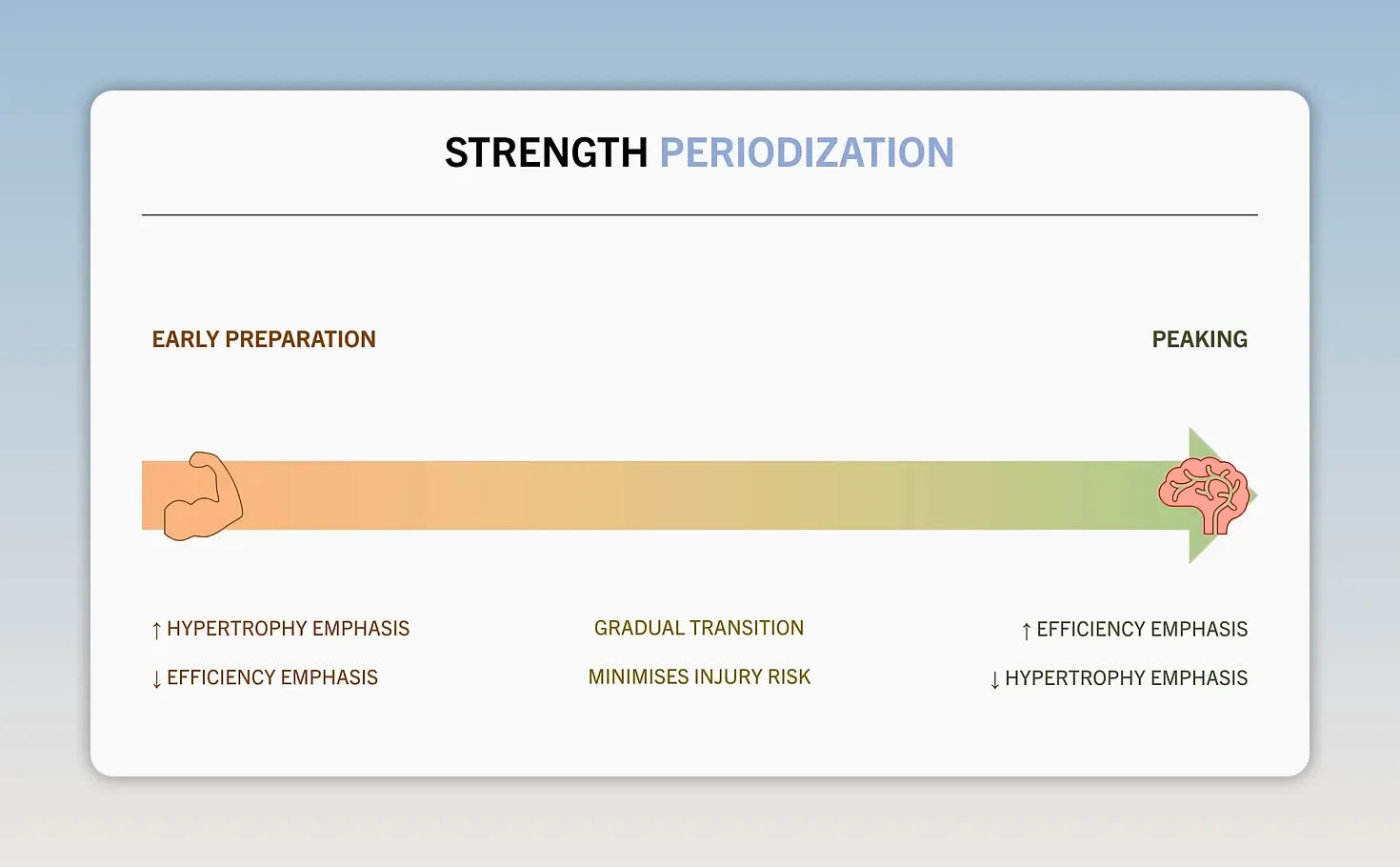
The transition should be gradual. An abrupt change in training style can expose tissues to demands they have not yet adapted to, potentially increasing injury risk.
Training for Sport Performance
There is no universal program for sport performance. Different sports place different demands on skill, speed, power, strength, body composition, and endurance.
The task is to identify which qualities matter for the sport and athlete, then develop them without allowing supplementary training to displace the work that matters most.
Prioritize sport-specific skill
In most sports, skill practice is the most important training component. Physical capacity can enhance performance, but it cannot replace the ability to execute the sport itself.
The balance differs between events. Table tennis and badminton are highly influenced by skill, whereas sprinting and endurance running depend more heavily on physical output. Even so, each sport requires an appropriate approach to practice.
Skill training can be organized along a spectrum between repeated exposure and competitive specificity.
- High exposure, lower specificity: repeatedly practice one component in a controlled setting. An example is hitting 100 tennis forehands from the same position toward the same target.
- Lower exposure to any single skill, higher specificity: practice in a more realistic competitive environment, combining movement patterns with timing, positioning, and decision-making.
Younger or less skilled athletes generally benefit from substantial repetition to develop fundamental skills. More advanced athletes usually need greater emphasis on applying those established skills under game-like conditions.
Develop speed in a low-fatigue state
Speed training requires maximal intent and enough recovery to preserve performance. It is not simply hard running performed while tired.
Useful methods include all-out straight-line sprints and change-of-direction drills. Distances and movement demands should reflect the requirements of the sport, with full recovery between efforts.
The key distinction is the purpose of the session: developing maximal speed requires high-quality efforts, not accumulating fatigue.
Use ballistic and plyometric exercises for power
Ballistic and plyometric exercises provide different ways to develop explosive performance.
- Ballistic exercises: involve accelerating through the propulsive action rather than deliberately slowing the movement at the end. Examples include squat jumps and medicine ball throws. These can be useful for acceleration, lateral movement, and jumping from a relatively static position.
- Plyometric exercises: make substantial use of the stretch-shortening cycle, in which a rapid lengthening action precedes shortening. Examples include repeated hurdle jumps, drop jumps, and bounds. These are often used to develop maximal speed and dynamic jumping ability.
Not every athlete needs the same exercises or the same amount of each method. The selection should follow the demands of the sport.
Build general strength and address relevant injury risks
For athletes outside strength sports, lifting weights is usually a means to improve physical capacity rather than the competitive task itself.
Consequently, maximizing a specific gym lift is less important. The broader goal is to develop a useful strength base across primary movement patterns such as squatting, hinging, pressing, and pulling.
Some athletes may also benefit from more targeted strength work intended to reduce injury risk. Field-sport athletes, for example, often include eccentric and isometric work for the hamstrings and adductors to help reduce the risk of muscle strains.
This is another reason to individualize training. Athletes require different amounts of speed, power, general strength, and targeted work.
Match body composition to the sport
The most useful physique is the one that supports the athlete’s event or position, not necessarily the one that looks leanest or carries the most muscle.
A lighter, leaner physique is generally advantageous in gymnastics. Some rugby positions benefit from substantially more muscle mass and may also tolerate or benefit from carrying more body fat.
Training and nutrition can manipulate these characteristics, but the desired direction depends on performance requirements. Body composition is a tool for the sport rather than an independent aesthetic target.
Develop the endurance the sport actually requires
Endurance is the ability to sustain or repeat the required performance. That definition looks very different across sports.
A distance runner needs to run continuously for a prolonged period. A boxer needs to punch, evade, and move in multiple directions across repeated two- to three-minute rounds with short rests. Their endurance programs should not be identical.
There are three broad ways to develop endurance for sport:
- Sport practice: practicing the sport itself often provides a substantial, highly specific conditioning stimulus.
- Specific conditioning: additional work that resembles the event’s movement patterns, effort durations, and work-to-rest structure. This may help prepare an athlete after time away or during an appropriately managed return from injury before full practice resumes.
- General conditioning: less specific aerobic work, such as continuous cycling, running, or rowing at a relatively low intensity, intended to develop broad cardiovascular and respiratory capacity.
General conditioning will not transfer perfectly to every sport. However, it can build an aerobic foundation that supports more specific endurance development once sport practice is included.
Training for Health and Longevity
Training for health aims to improve or maintain the physical qualities that support long-term function and quality of life. Precise prescriptions for maximizing longevity are difficult to establish, but resistance training, cardiorespiratory exercise, and maintaining an appropriate body composition are useful foundations.
Resistance training for strength, muscle, bone, and mobility
Resistance training helps develop and maintain muscle mass and strength. It also supports bone density, while training through a full range of motion can help maintain joint mobility.
Importantly, achieving meaningful health benefits does not require the same training volume or intensity as maximizing hypertrophy or competitive strength.
Two to three resistance-training sessions per week, lasting approximately 45 to 60 minutes, are a practical general framework. More training may be appropriate for additional goals, but even a smaller amount can be highly beneficial compared with doing none.
Cardiorespiratory training for heart and metabolic health
Cardiorespiratory training develops the ability of the heart, blood vessels, and respiratory system to support exercise. Greater cardiorespiratory fitness is associated with favorable health outcomes, including improvements in blood pressure, resting heart rate, blood lipids, and insulin sensitivity.
The exercise should challenge the cardiorespiratory system rather than ending primarily because one small muscle group becomes fatigued. Running, cycling, and appropriately designed circuit sessions are possible options.
A practical starting framework is low- to moderate-intensity cardiorespiratory exercise two to three times per week. Depending on the individual, making one or two sessions higher intensity, such as interval training, may provide further benefits.
Frequency is only part of the prescription, since total duration and intensity also matter. The World Health Organization’s physical activity guidance provides a useful broader reference for exercise and health.
Maintain a body composition that supports health
Maintaining muscle, strength, and bone mass is one side of the equation. Managing body fat is the other.
The aim is not to become as lean as possible. It is to maintain a body composition that supports health and function, avoiding both excessive body fat and a level of leanness that compromises health.
As broad reference ranges, approximately 10% to 20% body fat for males and 18% to 28% for females can provide a general orientation. These should not be treated as precise diagnostic cutoffs or a guarantee of ideal health.
The practical emphasis is maintaining an appropriate body weight and composition through sustainable nutrition alongside regular exercise, rather than pursuing an extreme physique.
Combining Goals and Understanding the Trade-Offs
You can train for several goals simultaneously and make good progress. Muscle growth can support strength, resistance training can improve health, and aerobic training can contribute to both sport preparation and long-term function.
However, the further you push toward maximizing one specific outcome, the more likely it is that other outcomes will receive less attention or be compromised.
This is not necessarily a problem. It simply means that specialization involves trade-offs.
Your priorities can also change over time. An athlete might place performance first during one stage of life and later emphasize health and longevity. A lifter may spend one phase building muscle and another preparing to express maximal strength.
The most appropriate program is therefore not a single method that everyone should follow indefinitely. It is an approach that reflects your current goal, develops the qualities that goal requires, and makes deliberate choices about what to prioritize.
|