We are often told to wait at least 48 to 72 hours before training the same muscle again. Train it sooner, the reasoning goes, and you will interfere with recovery and blunt muscle growth.
But is that a physiological requirement, or just a useful general guideline?
Around 48 hours is a reasonable starting point, not a universal minimum. Some training sessions may allow you to train a muscle again the next day. Others may require three or four days before you are ready to repeat a demanding workout. The difference depends largely on how much work you performed, how hard you trained, and how accustomed you are to the exercises.
To make sense of this, we need to separate actual muscle growth from the different markers we use to estimate recovery.
Key Takeaways
- Allow roughly 48 hours between sessions initially, then adjust using performance, fatigue, and soreness.
- Consecutive-day training can support muscle growth when weekly volume is distributed across smaller sessions.
- High volume, proximity to failure, and unfamiliar exercises generally increase recovery requirements.
- Different exercises can emphasize different regions within the same muscle group.
Table of Contents
- Where the 48 to 72 Hour Rule Comes From
- What Training Frequency Research Tells Us
- Muscle Recovery Is Not a Single Process
- Why Familiar Workouts Usually Require Less Recovery
- Different Exercises Can Stress Different Muscle Regions
- Practical Recommendations: When Should You Train a Muscle Again?
Where the 48 to 72 Hour Rule Comes From
The traditional advice is based on a simplified application of the general adaptation syndrome model. This describes training as a cycle of stress, recovery, and adaptation:
- Training creates disruption. A sufficiently challenging resistance training session disturbs the muscle’s normal state, or homeostasis.
- Performance temporarily declines. Fatigue, muscle damage, and inflammation can reduce the muscle’s ability to produce force.
- The body recovers and adapts. In the simplified model, the muscle repairs and supercompensates, becoming bigger and stronger.
- Another session repeats the cycle. Repeated exposure to training stress supports progress over time.
This gives us a useful conceptual model. However, it does not establish exactly how many hours must pass between sessions. It also leaves an important question unanswered: do we really need every aspect of recovery and adaptation to finish before providing another training stimulus?
The best place to start is research measuring muscle growth itself.
What Training Frequency Research Tells Us
Training frequency refers to how many times per week a muscle is trained. To isolate the effect of frequency, researchers can match total weekly training volume while distributing that work across different numbers of sessions.
The evidence discussed here suggests that training more than once per week may offer a slight advantage over training a muscle only once. More importantly for recovery, very high frequencies do not necessarily compromise hypertrophy when weekly volume is held constant.
Training a Muscle Three Versus Six Times Per Week
One study comparing three and six weekly sessions used the same exercises and total weekly volume in both groups:
- Three sessions per week: Four sets of each exercise per session.
- Six sessions per week: Two sets of each exercise per session.
The higher-frequency group trained each muscle on six consecutive days. For example, the chest received a fly variation each day from Monday through Saturday.
After six weeks, muscle growth was similar between groups for most of the muscles measured. The exception was the biceps, which showed no growth in the higher-frequency group. That result differed from the overall pattern and may have reflected random variation, but it remains a limitation rather than something we can confidently dismiss.
The main implication is still important: training the same muscle on consecutive days was compatible with growth across most measured muscles.
Training the Same Muscle Twice Per Day
A study comparing once-daily and twice-daily training took this further. Both groups performed the same exercises on the same training days, using the same total volume and repetition ranges.
One group completed all its sets in a single session. The other split the work evenly between morning and afternoon sessions. This meant the same muscles were trained again after only a few hours of recovery.
After eight weeks, there were no noticeable differences in muscle growth between groups.
The Important Qualification: Less Work Per Session
These findings do not mean recovery is irrelevant. In both examples, increasing frequency meant reducing the amount of work performed in each session.
Two sets may create less disruption than four sets. Splitting a workout between morning and afternoon may also reduce the fatigue generated within either individual session.
Training a muscle more frequently is not the same as repeating a full, high-volume workout more frequently. When weekly volume is matched, shorter intervals between sessions may work partly because each session requires less recovery.
Muscle Recovery Is Not a Single Process
The word “recovery” is vague. Lifting performance, muscle protein synthesis, and muscle soreness can all change after training, but they do not necessarily return to baseline at the same time.
Each provides information. None gives us a perfect countdown to the next productive workout.
1. Recovery of Lifting Performance
Resistance training temporarily reduces lifting performance through fatigue and muscle damage. One way to assess recovery is to measure how quickly someone can move a familiar submaximal load.
In a study of performance recovery after resistance training, participants performed three sets of 10 repetitions to failure in the squat and bench press. Before and after the workout, researchers measured bar velocity using repetitions at 75% of one-repetition maximum.
This provided an indicator of strength without the fatigue of repeatedly testing maximal lifts.
Bar velocity decreased immediately after training in both exercises. By around 48 hours, performance had largely returned to baseline.
However, that result applies to the particular workout tested. The training session itself can substantially change the recovery timeline:
- Potentially longer recovery: More volume, closer proximity to failure, and compound exercises that load muscles at longer lengths.
- Potentially shorter recovery: Less volume, stopping further from failure, and isolation exercises that emphasize shorter muscle lengths.
These are general tendencies, not guarantees. We should not assume every squat workout or every isolation workout creates the same recovery demand.
2. Muscle Protein Synthesis
Muscle protein synthesis, or MPS, is another marker used to understand the response to resistance training. It reflects the production of muscle proteins involved in repair and adaptation, but an acute increase in MPS is not a direct measurement of long-term muscle growth.
A review of training-related changes in muscle protein synthesis illustrated different response patterns in trained and untrained lifters.
- Trained lifters: MPS peaked within a few hours, fell close to baseline relatively quickly, and showed a smaller elevation extending toward roughly 36 hours.
- Untrained lifters: MPS remained elevated for more than 48 hours.
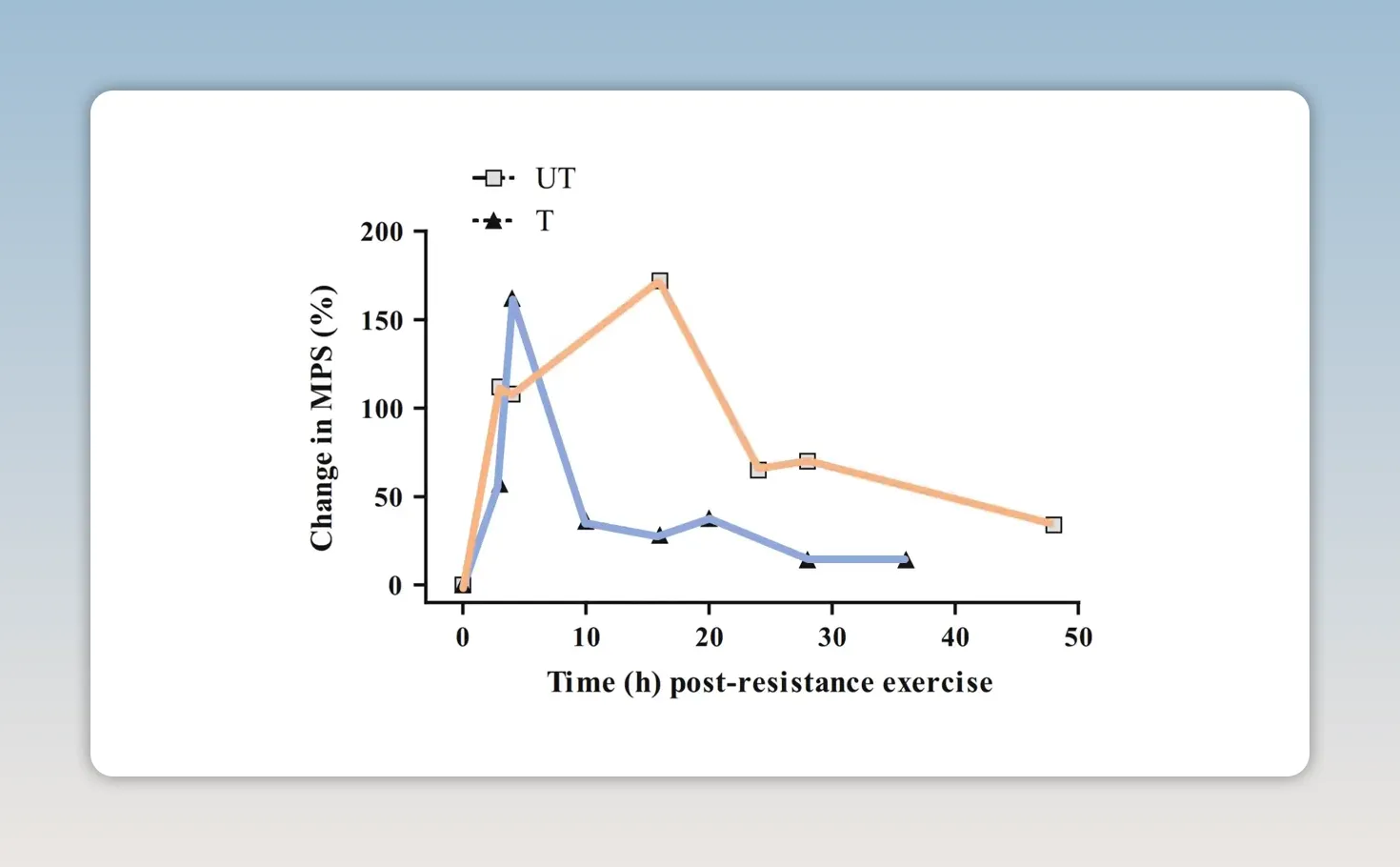
There are two useful observations here. First, the response in experienced lifters may be shorter than traditional recovery advice implies, with much of the elevation subsiding within the first day. Second, beginners may need longer to recover because resistance training is a new and more disruptive stimulus.
What we cannot do is turn this graph into an exact training schedule. A return toward baseline does not prove that every aspect of recovery is complete, and an elevated rate does not prove that another session would interfere with growth.
3. Muscle Soreness
Muscle soreness is commonly treated as a sign of muscle damage and a general indicator of recovery. However, soreness is not directly correlated with muscle growth.
A study examining the repeated-bout effect provides a useful example. Participants who had not trained in the previous six months performed five sets of six repetitions to failure using incline dumbbell curls. They repeated the same workout seven days later.
After the first session, biceps soreness peaked around 48 hours and was still above baseline four days later. After the second session, participants experienced very little soreness.
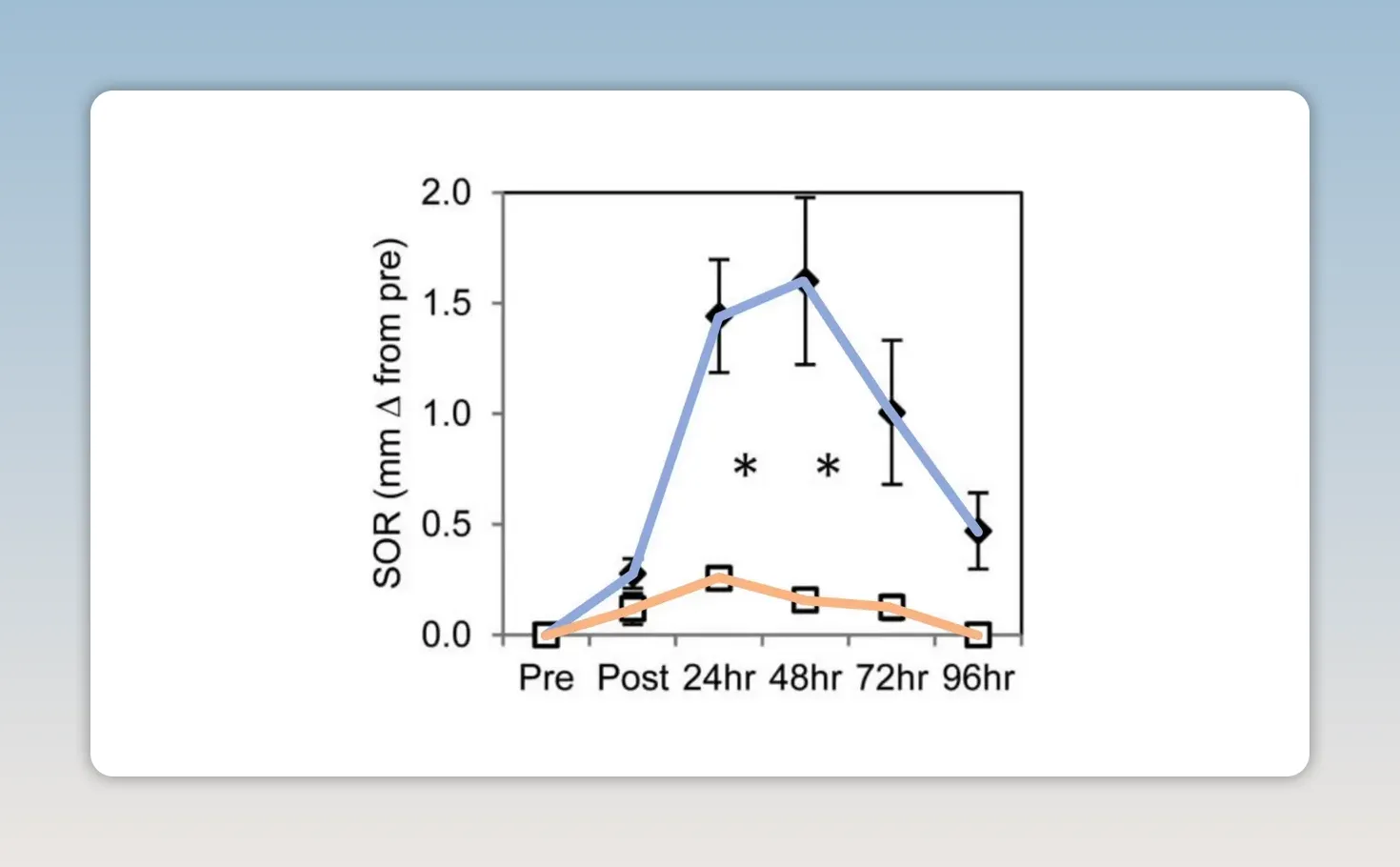
The exercise protocol was the same, but the soreness response was very different. Familiarity with the workout clearly matters.
This also shows why soreness cannot tell us precisely how long a muscle needs before another growth-producing session. Depending on the workout and the person’s familiarity with it, soreness may resolve quickly or persist for several days.
Can You Train a Muscle While It Is Still Sore?
There is no exact cutoff, but my general recommendations are:
- If the muscle is very sore, give it more time. Significant soreness will probably reduce lifting quality, and the muscle may still need substantial recovery.
- If soreness is slight and does not interfere with the workout, training is probably fine. Complete absence of soreness is not always necessary.
- After a particularly sore response, wait until the peak has passed before considering another session. Then use workout quality, fatigue, and performance to help guide the decision.
Passing the soreness peak is a practical guideline, not proof that the muscle is fully recovered.
Why Familiar Workouts Usually Require Less Recovery
Recovery studies often deliberately use demanding protocols. Researchers need to create enough disruption to measure what happens afterward.
They may also recruit untrained participants. Even when participants are experienced lifters, the study workout may differ from what they normally do.
Both factors can exaggerate the disruption compared with an ordinary week of familiar training.
Most regular lifters repeat broadly similar workouts each week. When they change their program, they may adjust only one or two variables. As the body becomes accustomed to the stress, the recovery demand is likely to be lower than it was during the first exposure.
Across the recovery indicators discussed, the timeline can span roughly one to five days. That is a broad range because it combines different workouts, training backgrounds, and definitions of recovery.
The most useful pattern is straightforward:
- More volume, training closer to failure, and unfamiliar exercises generally push recovery requirements upward.
- Less volume, training further from failure, and familiar exercises generally allow shorter recovery periods.
Different Exercises Can Stress Different Muscle Regions
Another consideration is regional muscle stress. Training a muscle group does not mean every part of that group receives the same amount of stress.
Horizontal rows and vertical pulls both train the back, but they tend to emphasize different regions:
- Horizontal rows: Tend to bias the upper and middle trapezius and rhomboids.
- Vertical pulls: Tend to bias the latissimus dorsi and lower trapezius.
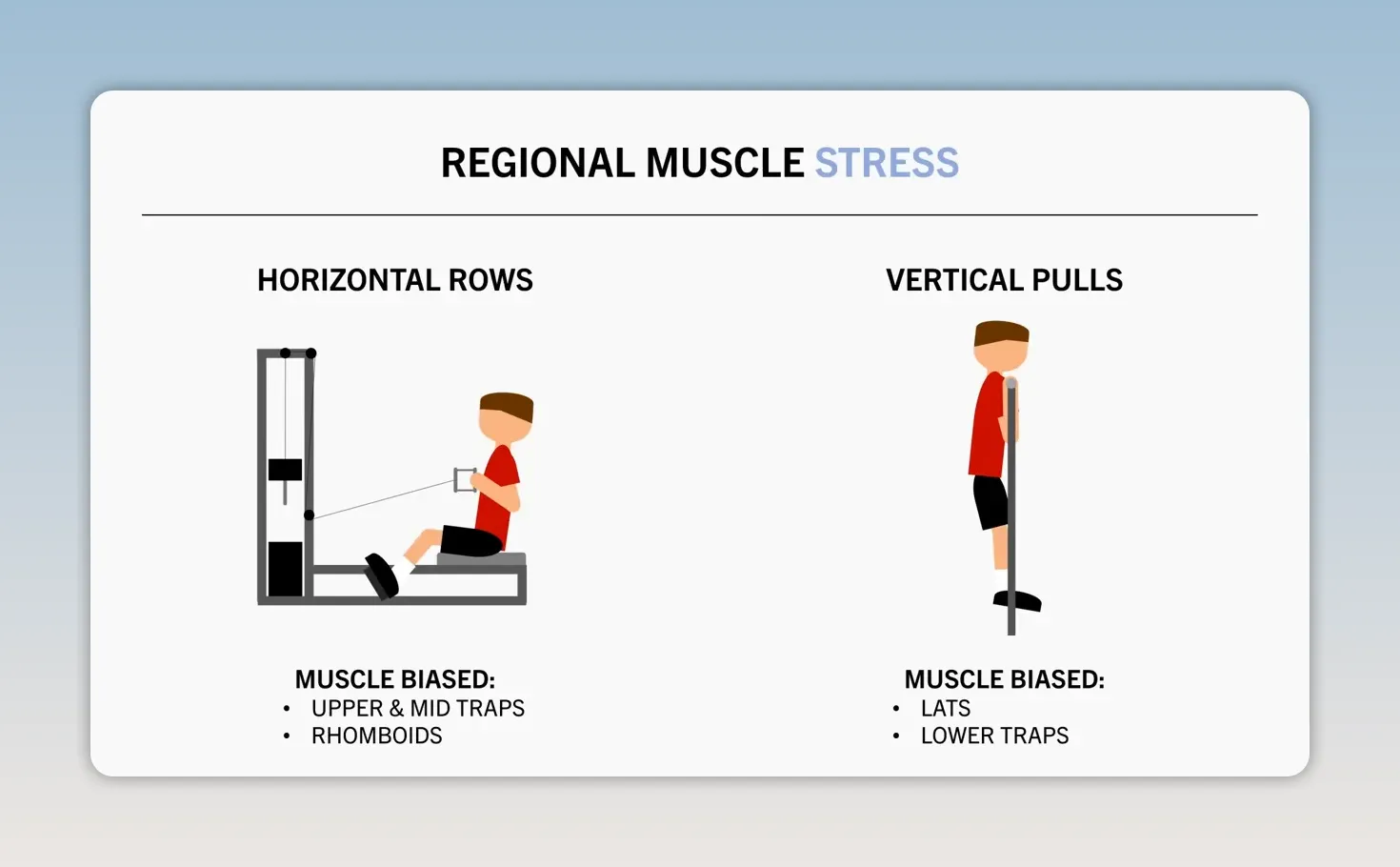
For example, a demanding pull-up session might leave the lats needing two or three days before another hard session. But the upper-back muscles may have received less stress and could potentially tolerate a seated cable row the following day.
Those time frames are illustrative, not fixed recovery rules for individual muscles. The principle is that the exercise and its regional emphasis matter more than the broad muscle-group label alone.
This may allow you to train the same general muscle group within a short period without placing the same demand on every region. It does not mean the exercises have no overlap.
Practical Recommendations: When Should You Train a Muscle Again?
The strongest evidence for a hypertrophy question is research measuring actual muscle growth. In the studies discussed, short recovery intervals did not consistently reduce growth when total weekly volume was matched.
At the same time, performance, soreness, and MPS responses indicate that training creates a recovery demand. The sensible approach is to use a starting guideline and then adjust it to the workout and your response.
- Start with roughly 48 hours between sessions for the same muscle. This is a reasonable default, rather than a mandatory waiting period.
- Check performance, perceived fatigue, and soreness. If there is little soreness or fatigue and lifting performance is not reduced, consecutive-day training may be reasonable.
- Allow more time after unusually demanding sessions. A high-volume workout performed very close to failure, especially with a new exercise, may justify three or four days before another hard session for that muscle.
- Reduce per-session volume if you increase frequency. The high-frequency findings came from spreading the same workload across more sessions, not repeatedly adding full workouts.
- Consider regional exercise emphasis. Different movements may let you train less-stressed portions of a muscle group while other regions continue recovering.
The goal is not to wait a prescribed number of days. It is to allow enough recovery to perform productive training. Use 48 hours as your starting point, then let the difficulty of the session, your familiarity with it, and your actual response determine whether you need less time or more.
|