Over time, the weights we use in the gym should generally increase as our muscles grow. But that does not mean we need to add weight every session, or that a heavier lift always provides a better muscle-building stimulus.
For hypertrophy, the purpose of increasing load is to keep training effective as we adapt. The goal is not simply to move the most weight possible.
A good time to increase load is when you can exceed your target rep range with effective technique and appropriate rest periods. If going heavier means losing control, shifting work away from the target muscle, or aggravating joint pain, maintaining or reducing the load may be the better option.
Key Takeaways
- Increase load when you exceed your target rep range with effective technique and consistent rest periods.
- Adding repetitions can support hypertrophy progression without increasing weight every session.
- Maintain or reduce load when heavier lifting compromises technique or aggravates joint pain.
- Use small load increases, introducing them to only one or two sets if needed.
Table of Contents
- How Much Does Load Matter for Muscle Growth?
- Progressive Overload Does Not Have to Mean Adding Weight
- Two Variables That Can Make Progress Look Better Than It Is
- When Should You Increase Load?
- When Should You Maintain or Reduce the Weight?
- How to Increase Load Without Compromising the Stimulus
- How This Differs From Training for Maximum Strength
- A Practical Checklist for Your Next Load Increase
How Much Does Load Matter for Muscle Growth?
Muscle growth can be achieved across a broad range of loads. A systematic review and network meta-analysis on resistance training loads compared three categories:
- Light loads: weights that allow more than 15 repetitions before reaching failure.
- Moderate loads: approximately a 9 to 15 repetition maximum.
- Heavy loads: an 8 repetition maximum or heavier.
The researchers found no significant differences in hypertrophy when comparing light with heavy loads, light with moderate loads, or moderate with heavy loads. In other words, all three categories tended to produce similar muscle growth.
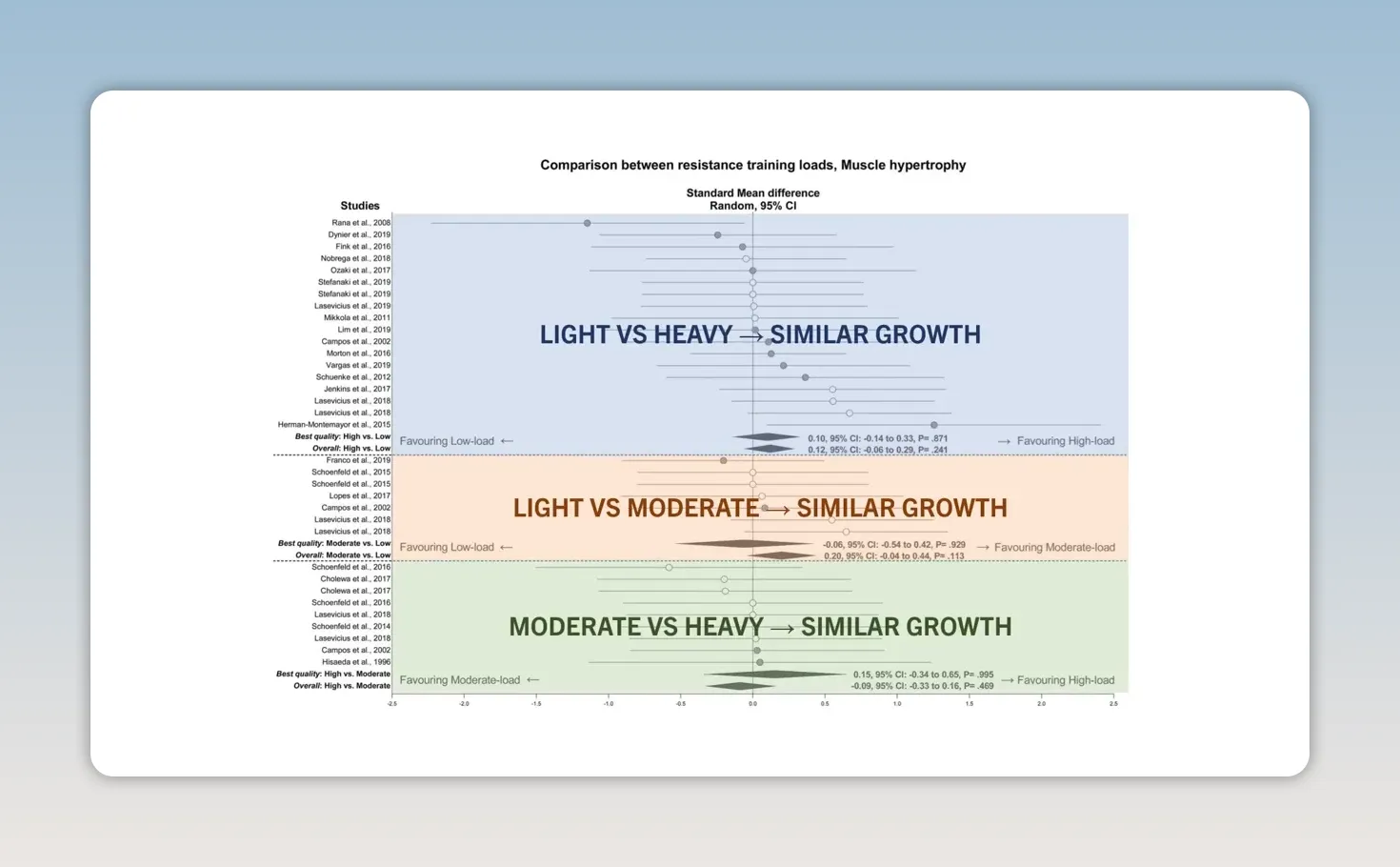
That does not mean load selection is irrelevant. There are still practical limits, and going extremely heavy or extremely light can make training less effective for hypertrophy.
As a practical guide, approximately 5 to 20 repetitions per set, performed close to failure, tends to produce similar muscle growth on a per-set basis. This is a useful working range rather than a rigid boundary beyond which muscle growth suddenly stops.
The important distinction is between the load itself and how challenging that load is for the muscle. A lighter weight can still provide an effective stimulus when the set is sufficiently demanding.
Progressive Overload Does Not Have to Mean Adding Weight
If the same weight eventually becomes much easier, continuing to perform the same number of repetitions will no longer provide the same challenge. Training needs to progress as we adapt.
Increasing load is one way to accommodate this. Increasing repetitions is another.
Increasing Load Versus Increasing Repetitions
A study comparing load progression with repetition progression examined 43 lifters with an average of roughly four years of training experience. They trained twice per week for eight weeks, performing four sets each of:
- Back squats.
- Leg extensions.
- Standing calf raises.
- Seated calf raises.
One group trained in the 8 to 12 rep range and increased the load when they could exceed that range. The other group began in the same rep range but kept the load constant, adding repetitions as their performance improved.
Both groups achieved similar increases in calf and quadriceps muscle thickness, with no significant differences between them.
This suggests that the number of challenging sets performed within an effective hypertrophy rep range is more important than whether progression comes from adding weight or adding repetitions.
Allow Progression Rather Than Forcing It
Once we are familiar with an exercise, improvements in performance can reflect the muscular adaptations we have achieved. It is therefore useful to think of rep and load increases as something our adaptations allow, rather than numbers we must force upward regardless of how we lift.
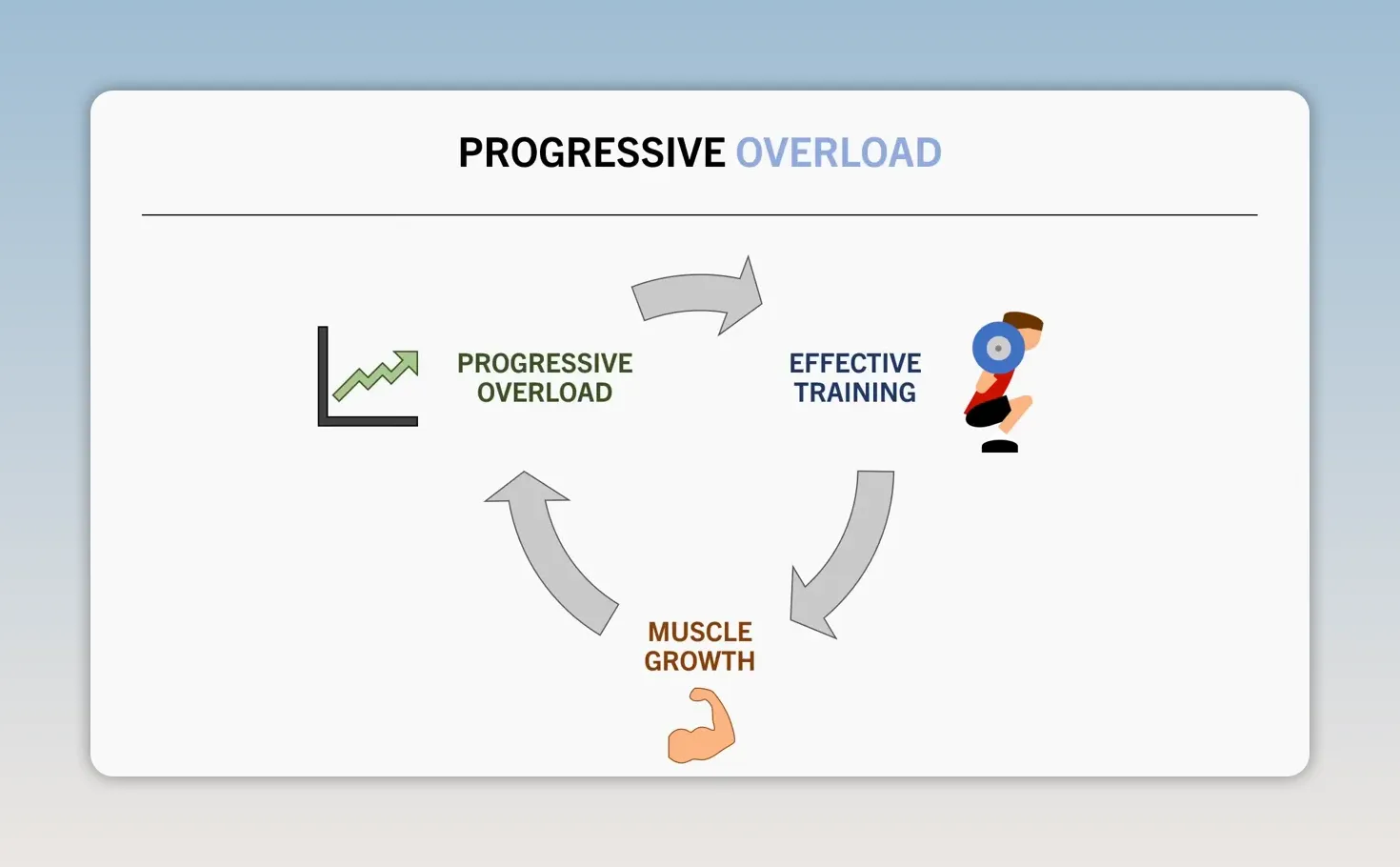
If you continue taking sets close to failure, the repetitions you can perform should reflect your current capacity. As that capacity improves, you can perform more repetitions or use more weight while maintaining a similar level of effort.
There is no need to predetermine exactly how quickly this must happen. Your rate of progression is influenced by:
- How long you have been lifting.
- How close you are to your muscular potential.
- Your genetic response to training.
- The design of your training program.
- Whether you are eating in a calorie surplus, deficit, or at maintenance.
- Your sleep, stress, and motivation to train.
Rather than deciding that every exercise must increase by a certain amount each week, track your rep performance and let it guide your load selection.
Two Variables That Can Make Progress Look Better Than It Is
A heavier lift is not necessarily evidence of muscle growth. Two major variables can change how much weight you lift without reflecting a muscular adaptation: technique and rest periods.
1. Lifting Technique
The purpose of hypertrophy training is to apply mechanical tension to a particular muscle group. Muscles respond to the local stress they experience, not simply to the number printed on a dumbbell or loaded onto a bar.
Changing technique often allows us to lift more weight. But that extra weight may come from involving other muscles and joints more, rather than increasing the demand on the intended muscle.
For muscle growth, useful technique priorities include:
- Use fairly strict execution. Aim for fatigue of the target muscle to limit the set, rather than compensations elsewhere.
- Include the lengthened portion of the movement. This can involve a full range of motion or partial repetitions performed in the lengthened range.
- Control the eccentric phase. Keep the muscle actively involved as you lower the weight instead of allowing the load to drop.
- Limit excessive bouncing where relevant. Minimize reliance on the stretch-shortening cycle when transitioning from lowering to lifting.
These choices will often reduce the amount of weight you can lift. That is not a problem if they improve how effectively the target muscle is trained.
For hypertrophy, technique comes first and load comes second. Adding weight while making the exercise less effective is not a useful trade.
2. Rest Periods
Both shorter and longer rest periods can support muscle growth, although longer rests tend to produce somewhat greater hypertrophy on average.
A systematic review of rest intervals and muscle hypertrophy compared short rests of one minute or less with longer rests of more than one minute. Average growth across the reviewed interventions was approximately 6% with shorter rests and 9% with longer rests. These are averages from the included research, not guaranteed outcomes for an individual program.
There is also a time trade-off. Longer rests allow more recovery, but they make sessions longer. Shorter rests may allow more sets within the same available training time, which can also support muscle growth.
Depending on the exercise, roughly 1 to 3 minutes between sets is a useful practical compromise between hypertrophy and time efficiency.
Rest duration also changes performance. If you rest longer, you can usually perform more repetitions or lift more weight on subsequent sets. If your rest periods gradually increase over time, some of your apparent progress may simply come from recovering longer.
Longer rest is not inherently wrong. The issue is extending it purely to make the numbers improve, then treating those numbers as evidence of muscle growth. Keep rest periods reasonably consistent when comparing performance.
When Should You Increase Load?
Assuming technique is effective and rest periods are appropriate, there are two main reasons to try a heavier weight.
You Have Exceeded Your Target Rep Range
Suppose your target for an exercise is 8 to 12 repetitions. If you can perform more than 12 repetitions with good technique, it may be time to increase the load.
The heavier weight should bring your repetitions back toward the intended range while allowing you to maintain effective execution.
Exceeding a target range does not suddenly make a set ineffective. Performing more than 12 repetitions can still produce excellent hypertrophy. Increasing the load is often simply more practical than allowing repetitions to keep rising indefinitely.
The target rep range helps organize training. It is not a strict biological cutoff.
You Want to Test Whether a Heavier Load Suits the Exercise Better
You can also experiment with a heavier weight before exceeding your target range. Sometimes a slightly heavier load and lower rep range may feel more effective for a particular exercise.
When comparing loads, consider your perceived:
- Mind-muscle connection.
- Stretch in the target muscle under load.
- Muscle pump.
- Muscle soreness after training.
These are subjective indicators to help assess the exercise, not a direct measurement of muscle growth. They should be considered alongside technique and joint comfort.
If a heavier load feels productive in the target muscle and remains well controlled, it may be worth keeping. If it reduces control, feels less effective, or shifts the sensation toward the joints, the lighter load is probably the better choice.
When Should You Maintain or Reduce the Weight?
There are times when increasing load works against the purpose of hypertrophy training. Two common reasons to hold back are ineffective technique and joint pain.
Your Technique Needs Improvement
If your current technique is not effectively challenging the target muscle, improve that first.
Adding weight to an already poorly controlled movement can increase demands on other muscles, joints, and connective tissues without providing a better stimulus where you want it.
If the load is too heavy to execute the exercise effectively, reducing it slightly may actually improve the quality of the set. A smaller number on the bar does not necessarily mean a smaller stimulus to the muscle.
You Have Joint Pain or Irritation
Heavier loads generally place greater demands on the joints and connective tissues involved in an exercise. If those structures are already irritated, going heavier may aggravate the problem, whether or not load was the original cause.
Lingering joint pain is therefore a reason not to increase weight. Reducing the load may be appropriate while the irritation settles.
This does not mean abandoning effective hypertrophy training. Lighter loads can still provide a strong muscle-building stimulus when performed with effective technique and sufficiently close to failure. The aim is to challenge the muscle without using joint pain as something to push through.
How to Increase Load Without Compromising the Stimulus
Use Small, Gradual Increases
When you are ready to increase weight, generally use the smallest practical increment available:
- Barbell exercises: add the smallest suitable plates.
- Dumbbell exercises: move to the next available pair.
- Cable and machine exercises: move the selector pin up one increment.
There are two main reasons to progress gradually.
First, unless you are a complete beginner, muscle growth is unlikely to happen quickly enough to justify repeated large jumps in load. Trying to force those jumps may simply encourage changes in technique.
Second, abrupt increases in training demands may raise the risk of pain or injury. A case report on workload management in student-athletes emphasized sudden workload spikes as an important injury-risk consideration.
That evidence comes from athletes rather than a direct test of small versus large weight increases in hypertrophy training. It nevertheless supports a sensible practical approach: introduce greater training demands gradually rather than making unnecessary jumps.
You Do Not Have to Increase Every Set
A common approach is to increase the weight and use it for every working set. That is an option, but it is not a requirement.
You can use the heavier load for the first one or two sets, then return to a lighter load for the remaining sets.
This is particularly useful in two situations:
- The next available increment is a little too demanding for all sets. A heavier initial set or two can help you become accustomed to the new load while the lighter sets preserve effective execution and your intended rep range.
- You are experimenting with load selection. One or two heavier sets may be enough to compare technique, joint comfort, and the perceived stimulus with your usual weight.
There is no need to turn a load increase into an all-or-nothing decision. You can introduce it to part of the exercise and assess how well it works.
How This Differs From Training for Maximum Strength
These recommendations are primarily for hypertrophy. Maximum strength training has a different immediate objective: lifting the greatest amount of weight possible within the relevant rules.
That changes how we manipulate training variables. Strength-focused training typically emphasizes:
- The most mechanically efficient legal technique.
- Use of the stretch-shortening cycle where relevant and permitted.
- Lower rep ranges to develop neural efficiency and heavy-lifting performance.
- Longer rest periods to maximize recovery between sets.
- Higher psychological arousal when needed for performance.
For a strength goal, increasing the load while maintaining valid technique is directly relevant to the outcome being trained. However, pursuing heavier performance can come with greater joint-loading demands and potential irritation, which still need to be managed.
For hypertrophy, the heaviest possible lift is not the outcome. The load is a tool for stressing the target muscle.
A Practical Checklist for Your Next Load Increase
Before moving up in weight, work through the following:
- Check your execution. Is the target muscle doing the intended work with a controlled lowering phase and appropriate range of motion?
- Check your rest periods. Has performance improved under reasonably comparable conditions?
- Check your repetitions. Can you exceed your target range with effective technique, or are you deliberately testing a different load?
- Check your joints. Is there pain or irritation that makes increasing weight a poor choice?
- Make a small increase. Use the smallest practical jump, potentially for only the first one or two sets.
- Reassess the result. Keep the increase only if the exercise remains effective for the muscle you are trying to grow.
The objective is not to force the logbook upward at any cost. Train effectively, track your performance, and allow load and repetitions to increase as your capacity improves. Progress the weight to support the stimulus, not at the expense of it.
|