A diet can help you lose weight without helping you keep it off. That is the main problem with treating weight management as a short-term project: the plan changes what you do for a few weeks or months, but not necessarily what you return to afterward.
The real test is not simply whether a diet produces weight loss. It is whether the behaviors behind that weight loss are realistic enough to maintain.
Instead of searching for another set of food rules, we need to focus on building everyday eating and activity habits that support a healthy body weight with less ongoing reliance on willpower.
Key Takeaways
- Short-term weight loss is easier to achieve than lasting results from an unsustainable diet.
- Long-term weight management depends on making supportive eating and activity behaviors your default.
- Home-prepared, balanced meals and regular movement provide a practical foundation for sustainable weight management.
- Weight tracking provides feedback, while temporary calorie tracking can build lasting knowledge about food choices.
Table of Contents
- Why Short-Term Diets Often Fail Long-Term
- The Alternative: Change Your Default Behaviors
- 1. Pay Attention to Hunger and Satiety
- 2. Cook and Prepare Food at Home More Often
- 3. Use a Flexible Healthy Eating Framework
- 4. Track Body Weight to Understand the Trend
- 5. Use Calorie Tracking as a Learning Tool
- 6. Set a Reasonable Daily Step Target
- Build a Routine You Do Not Need to Abandon
Why Short-Term Diets Often Fail Long-Term
Many named diets promise rapid weight loss or substantial health benefits. They often achieve this by eliminating certain foods or food groups, or by placing a strong emphasis on others.
These approaches vary considerably. Restrictive diets such as carnivore and paleo remove substantial categories of food, while a Mediterranean-style eating pattern offers a much more balanced framework. Having a name does not make every eating pattern nutritionally equivalent. However, even a reasonable framework will struggle to deliver lasting results if we cannot continue following it.
Most calorie-restricted diets can produce weight loss when followed for a sufficient period. The more important question is: what happens when the diet ends?
Weight regain is common
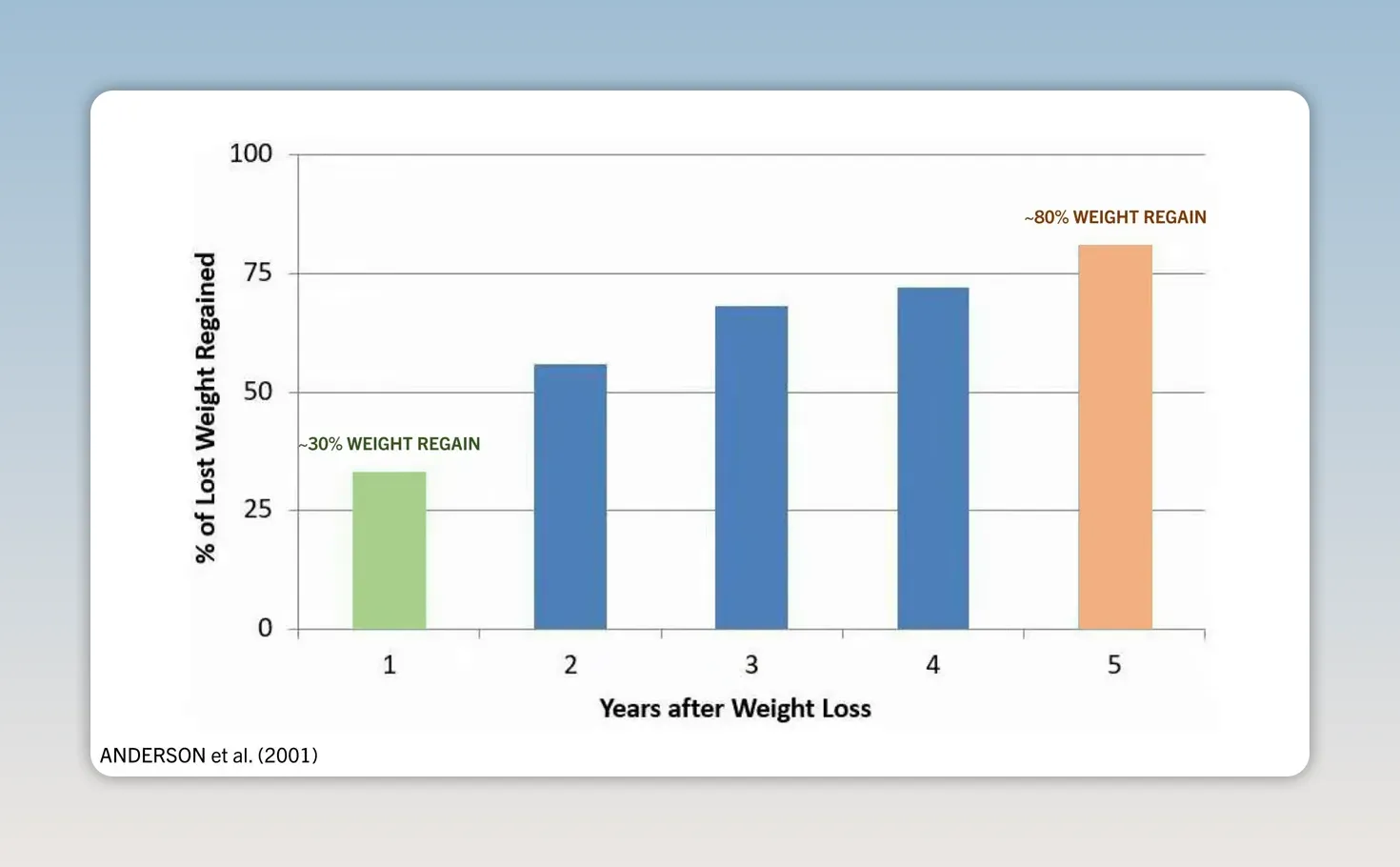
A 2001 meta-analysis of long-term weight loss maintenance illustrates the problem. On average, around 30% of the weight initially lost had been regained after one year, increasing to around 80% after five years.
Those percentages refer to the proportion of lost weight regained, not the proportion of people who regained weight. They are also group averages, rather than a prediction of what must happen to any individual.
A similar maintenance challenge appears after weight loss medication is stopped. A meta-analysis of weight regain after medication cessation found that body weight tended to rise again, with a projected return to baseline after around 1.7 years.
The comparison with behavioral weight management programs showed less pronounced regain following those programs. This reinforces the importance of planning for maintenance, rather than treating an intervention as a permanent solution once it has produced an initial result.
The cost is not only physical
Returning to your starting weight might seem like a neutral outcome. In practice, the process can carry a psychological cost.
A demanding weight loss plan may require substantial mental effort and interfere with social life, work, study, and mood. If the weight subsequently returns, it can leave us feeling that all that effort was wasted.
That feeling of failure can reduce confidence and make another attempt less appealing. So, even when body weight ends up where it started, we may feel more burnt out than before.
The Alternative: Change Your Default Behaviors
Long-term weight management generally requires longer-lasting changes to eating and exercise habits. Essentially, we need to change what we do by default.
If a temporary diet is followed by a return to frequent energy-dense convenience foods and minimal movement, our body composition is likely to reflect that pattern again. If our usual routine includes home-prepared meals, balanced food choices, and regular activity, maintaining a healthy body composition may become more manageable.
This is simple in principle, but not necessarily easy. Our lifestyles develop through years of influences, including:
- Where we live and which foods we can access.
- Culture, childhood experiences, and family habits.
- The modern food environment.
- Occupation, time demands, and personal priorities.
- Socioeconomic circumstances.
Many of these factors sit partly or entirely outside our control. Behavior change therefore needs to work within our circumstances, rather than assume that everyone has the same resources or opportunities.
For weight loss, the practical aim is to develop habits that help us consume fewer calories on average and expend a little more energy through movement. For maintenance, those habits need to support an intake and expenditure that keep body weight relatively stable.
The goal is not to maintain a calorie deficit forever. It is to create a sustainable routine that supports the weight we are trying to maintain. This may take longer than a quick-fix diet, but it offers a better foundation for lasting change.
1. Pay Attention to Hunger and Satiety
Hunger and satiety are biological signals that help regulate food intake. After a meal, we generally feel satisfied. Over the following hours, hunger gradually returns.
However, the availability and appeal of food can make it easy to eat for reasons other than physical hunger. We may want something to eat even when we do not particularly need more food at that moment.
A useful starting point is to notice the difference between wanting food and feeling physically hungry. Similarly, during a meal, pay attention to when you feel comfortably satisfied rather than continuing until you cannot fit in any more.
One rough tool I use is a hunger scale, where 10 represents the greatest hunger:
- Before eating: around 7 or 8 out of 10 represents noticeable physical hunger.
- After eating: around 2 or 3 out of 10 represents being mostly full and well satisfied.
These are subjective reference points, not rigid thresholds or a reason to ignore your needs. The underlying behavior is more important than the number: become more aware of hunger, and finish meals satisfied rather than excessively full.
2. Cook and Prepare Food at Home More Often
Home cooking can be difficult to prioritize when life is busy and convenient food is readily available. However, preparing our own meals often makes it easier to eat a diet with a lower calorie density and a better micronutrient profile.
Two large studies help illustrate the association:
- A US study involving more than 9,000 adults found that more frequent home cooking was associated with lower self-reported calorie intake and a lower prevalence of obesity.
- A UK study involving more than 11,000 adults found that eating home-cooked meals more frequently was associated with higher fruit and vegetable intake and a lower prevalence of excess body fat.
In the UK study, excess body fat was defined as above 25% for males and 38% for females. These were the study's classification thresholds.
These findings are associations, so they do not establish that home cooking alone caused the differences. Nevertheless, they support a useful practical recommendation: if it is feasible, prepare your own meals the majority of the time.
The aim is to make higher-quality meals a normal part of your routine, rather than something you only prepare during a temporary diet.
3. Use a Flexible Healthy Eating Framework
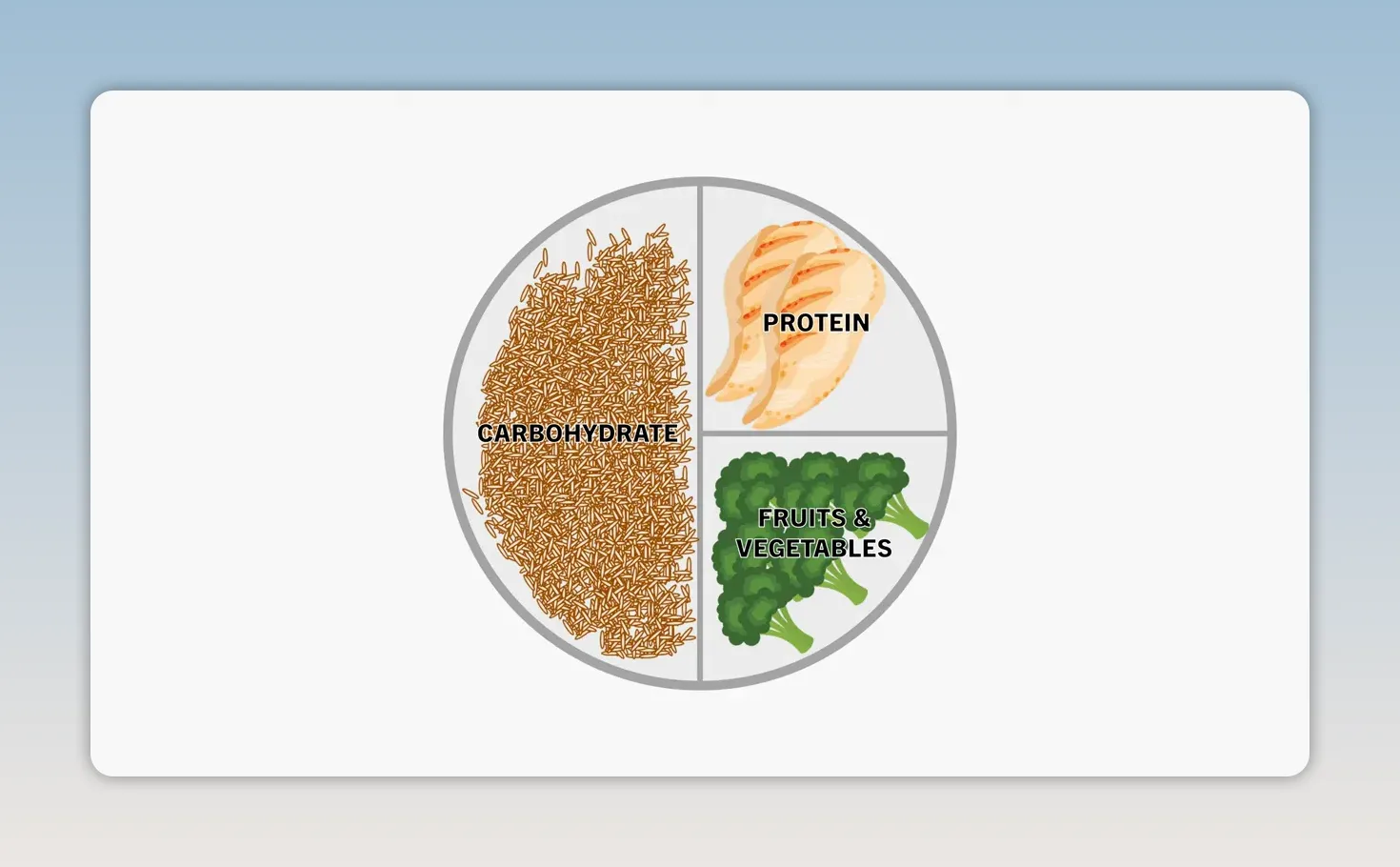
A healthy eating framework gives meals some structure without requiring a long list of banned foods. Different authorities recommend different proportions, but my general framework uses three main components:
- A carbohydrate source.
- A protein source.
- Fruit and/or vegetables.
Carbohydrates: adjust the portion to activity
A carbohydrate source is usually the largest component in this framework. Foods such as bread, rice, pasta, and potatoes provide a relatively inexpensive, filling staple around which to build a meal.
As a rough guide, the carbohydrate component can account for:
- Less active individuals: around one-third of meal volume.
- Fairly active individuals: around one-half of meal volume.
- Highly active individuals: closer to two-thirds of meal volume.
These are flexible proportions by food volume, not percentages of calories. They are not intended to be exact fractions that remain fixed while every other component stays unchanged.
Protein: include a clear source
A protein source should generally account for around one-quarter of the meal's volume. Examples include red meat, poultry, fish, eggs, and tofu.
These foods increase the meal's protein content. Depending on the source, they can also contribute micronutrients such as iron or calcium that may be less abundant elsewhere in the diet.
Fruit and vegetables: add volume and nutrients
Include fruit and/or vegetables with each meal, using around one-quarter of meal volume as a general starting point.
Fruit and vegetables tend to have a low calorie density, meaning they add a relatively large amount of food volume without adding a large amount of energy. This can help make meals satisfying while keeping total calorie intake more manageable.
They also provide fiber and many important micronutrients. The benefit is broader than weight management: they improve the nutritional quality of the meal.
4. Track Body Weight to Understand the Trend
Regular self-weighing provides feedback about whether your current eating and activity habits are producing the outcome you want. That applies whether the goal is weight loss or weight maintenance.
In a six-month trial of a daily self-weighing intervention, adults with overweight lost around 7% of their body weight in the intervention group. Dietary and activity reports suggested that participants reduced calorie intake and increased physical activity.
The important point is not that standing on a scale directly causes fat loss. It is that feedback can influence behavior. Knowing the direction of the trend may help us make adjustments that better match our goal.
A practical approach is to:
- Weigh yourself two to four times per week if daily weighing does not suit you.
- Record the measurements in an app or spreadsheet.
- Use weekly averages to help interpret the pattern.
- Graph the data so you can see the longer-term direction.
Focus on the trend, rather than an isolated measurement. Body weight can fluctuate substantially in the short term, so individual readings do not necessarily tell you whether your routine is working.
5. Use Calorie Tracking as a Learning Tool
Calorie tracking means recording and quantifying food intake, often with an app such as MyFitnessPal or MacroFactor.
For most people, recording everything they eat every day is not an appealing lifelong commitment. However, trying it at some stage can provide useful education about the foods that make up your regular diet.
Tracking can help you identify:
- How many calories your usual foods and meals contain.
- Where extra calories may be adding up.
- How different choices affect protein, carbohydrate, fat, and recorded micronutrient intake.
- Alternative foods that better suit your goals.
The long-term value is the knowledge you gain. You can use that understanding to make more informed food choices even after you stop logging meals.
In other words, calorie tracking does not have to become your lifestyle to teach you something useful about it.
6. Set a Reasonable Daily Step Target
Step counts are a useful general indicator of how much movement you accumulate, particularly through walking, jogging, running, and activities that involve those movements.
They capture more than formal exercise. Walking the dog, moving around at work, gardening, commuting on foot, and playing sport can all contribute.
For rough activity classifications:
- Low: fewer than 5,000 steps per day.
- Moderate: around 5,000 to 10,000 steps per day.
- High: around 10,000 to 15,000 steps per day.
- Very high: more than 15,000 steps per day.
These are broad guides, not a complete measurement of every form of exercise. The purpose of a daily target is to give regular movement a place in your routine.
How you achieve that movement will differ. Some people have active occupations or commutes. Others play sport, train at a gym, run, or take regular leisurely walks. The best fit is an approach you can continue doing.
Movement supports energy expenditure and may help appetite regulation
For body composition, a major benefit of physical activity is increased energy expenditure. Alongside appropriate food intake, this can help create the conditions for weight loss and support subsequent maintenance.
Being at least moderately active also has wider benefits for health and longevity.
There is also a hypothesis that physical activity helps appetite better align with energy requirements. When we are very inactive, food intake may not fall enough to match lower expenditure. Becoming more active may improve that relationship, although it should not be treated as a guarantee of perfect appetite regulation.
Build a Routine You Do Not Need to Abandon
Short-term diets often succeed at producing short-term weight loss. The difficulty is maintaining the result when the rules become impractical and familiar habits return.
A more sustainable approach is to make useful behaviors part of everyday life: paying attention to hunger and fullness, preparing meals at home, using a balanced meal framework, monitoring weight trends, learning about calorie intake, and staying regularly active.
The goal is not to find a diet you can tolerate until you reach a target. It is to develop a way of eating and moving that still makes sense afterward.
|